
Module 1 · Chapter 3
Sustainable farming strategies and climate resilient cropping systems
The intensification of agricultural production, which took place in the last century in the countries of the current European Union, seriously worsened today's efforts for sustainability in the agricultural sector. One example of agricultural intensification can be the excessive input of nutrients into the environment. Despite some restrictions related to the volume of fertilizer application that took place a few years ago, the consequences of the intensive use of fertilizers persist to this day [1]. From the point of view of fertilizers and nutrients contained in them and from the point of view of their entry into the environment, reducing their excess in terms of improving the state of the environment is one of the most fundamental problems of the common agricultural policy [2]. It turns out that protective measures related to the transition to organic farming, such as more diverse sowing practices, the use of biological pesticides, conservation tillage, etc., increase the uptake of fertilizers by plants [3] and reduce the runoff of surface water, which is essential to maintain nutrients in the soil and reduce the need for imported fertilizers [4]. Due to the fact that organic farming is an alternative farm management system that combines various conservation measures and manure fertilization, while prohibiting the application of mineral fertilizers, farmers can see an increase in the resistance of their business to external economic shocks that mineral fertilizer prices can cause or completely avoid their risk.
The strategy of sustainable agriculture is significantly influenced by legislation at the regional and European level. Most of these regulations take the form of binding directives that can have a strong influence on the adoption and development of sustainable agriculture strategies. Knowledge of current legislation is important to understand the differences in approaches to sustainable agriculture in Europe compared to other areas. It is very important to try to create sustainable development strategies because temperature and water availability are key factors in determining plant growth and yield. These are factors that will also change with the changing climate, and their predicted changes are not optimistic. The climate changes that humanity fears today may cause changes in the invasiveness dynamics of pests, pathogens and weeds, and only for the worse.
Instability caused by climate and weather will undoubtedly affect the level of food supply and access to it, alter social and economic stability and regional competitiveness. In this regard, adaptation is seen as a key factor that will shape the future severity of climate change impacts on food production. Climate change will affect food production worldwide due to increased pressure from weeds [5], pests and pathogens [6]. The most debatable, due to climate change, are the frequency of extreme events such as floods, droughts, changes in precipitation, temperature differences and associated changes in food systems on a global scale of pathogens [7]. The manifestation of the above-mentioned is expected only in the second half of the 21st century, which does not change the importance of taking protective measures today and moving, for example, towards sustainable agriculture strategies and crop cultivation systems resistant to climate change.
Monocultures - Unmodern Cultivation in Modern Agriculture
A big problem in today's agriculture is monocultures, where their share continues to increase worldwide. About 80% of the 1.5 billion hectares are used for the purpose of monocultures of several cereals and several species of animals. Wheat, corn, rice and potatoes alone account for roughly 60% of the world's plant food sources, and just 14 animal species provide 90% of all animal protein [8]. The variety of crops per unit of arable land is still decreasing today.
A good example that monocultures are not a suitable solution for today's modern agriculture is, for example, the epidemic of corn blight (Helminthosporium maydis) in the USA in 1970. The epidemic of corn leaf blight in the USA resulted in a crop loss estimated at a 15% reduction in corn yield or a loss of one billion dollars [9]. The epidemic in the USA is not the only example that demonstrates the reduction in the diversity of cultivated plants and how this reduction threatens world food production [10]. The Irish potato famine, between 1845 and 1852, was the result of extensive planting of a genetically uniform clone (a single variety called Lumpers) and an outbreak of potato blight (Phytophthora infestans) which caused an 80% reduction in yield. As a result, millions of Irish people starved to death and another two million emigrated. The Great Bengal Famine in India in 1943 was caused by a devastating disease (Cochliobolus miyabeanus) that nearly destroyed rice production. More than a century ago in France, grapevines were completely eradicated by Phylloxera vertifoliae until a resistant cultivar was introduced from the USA [11].
Traditional Agriculture as a Path to Diversification and Sustainability Standards
In many developing countries, traditional agriculture still persists, i.e. agriculture that uses practices, methods and techniques that are passed down from generation to generation and often involves a large amount of manual labor and the use of simpler tools that help improve biodiversity and support the resilience of agro-ecosystems [12] . For example, in constantly coping with extreme weather events and climate variability, farmers living in Africa, Asia, and Latin America have developed and/or inherited complex agricultural systems managed in a sophisticated manner. These systems have enabled small farming families to meet their subsistence needs in the midst of environmental variability without depending on modern agricultural technologies [13].
Nowadays, despite the general modernization of agriculture, the trend of organic farming, diversification of agricultural production, emphasizing biodiversity and minimizing inputs into the system is increasingly occurring, which gives these ecosystems resistance to environmental and economic changes [14]. Among the strategies that will make it possible to preserve agricultural production in the coming years, to increase its resistance to climate changes, pathogens and pests, are the protection and restoration of ecosystems, the sustainable use of soil and water resources, agroforestry, diversification of farming, adjustments to cultivation practices and the inclusion of stress-resistant crops [15].
Biodiversity in the Agroecosystem
The level of existing biodiversity can mean the difference between a system being stressed or somewhat resilient to stress. In order for an agroecosystem to function and provide environmental services, it is necessary that the number of organisms in a given agroecosystem be diverse [16]. If the agroecosystem does not have high biodiversity, its ability to respond to external changes decreases [17]. Two types of biodiversity can be distinguished in an agroecosystem, namely functional diversity, which refers to the diversity of organisms and the ecosystem services they provide, which ensure its functioning [18]. The second is diversity, which creates diversity in responses to environmental change among species, and these species have the same function in the agroecosystem and thereby ensure its function. If an agroecosystem contains both types of these diversities, it can be assumed that it will be resistant to external influences [19]. Biodiversity provides a large number of ecosystem services beyond food production, including nutrient recycling, regulation of microclimate and hydrological processes, suppression of undesirable organisms or phytoremediation. Because biodiversity-mediated restoration processes and ecosystem services are largely biological, their persistence depends on maintaining biological integrity and diversity in agroecosystems.
Challenges and Strategies for Sustainable Agriculture
Agricultural expansion and intensification have a profound effect on our atmosphere as well. These atmospheric changes, or climate change will affect global food security [20]. Prior to the early 19th century, the CO2 concentration was around 250 ppm or lower. In 2013, the concentration continuously increased to a level of approx. 400 ppm (Figure 2d). With CO2 emissions being the main contributor to the greenhouse effect, the average global temperature has increased by more than 1°C since 1850 (Figure 2e). If the deterioration of the climate is not controlled, it may become irreversible and this situation will continue to worsen, especially due to the higher frequency of forest fires, which will also result from the ever-increasing temperature. As a result of the ever-increasing temperature, the glaciers in the Arctic will melt faster, which will subsequently lead to an increase in CO2 emissions and a further increase in temperature. Although the melting of glaciers does not directly contribute to the increase in CO2 emissions, it can indirectly contribute to the increase in emissions. When glaciers melt, they release large amounts of fresh water into the surrounding oceans. This influx of fresh water can disrupt ocean circulation patterns, which in turn can change the distribution of nutrients and carbon in the ocean. Disruption of ocean circulation can lead to a reduction in the amount of carbon dioxide that the ocean is able to absorb from the atmosphere. This in turn can lead to an increase in the concentration of CO2 in the atmosphere, which contributes to climate change.
This warming will cause a poor distribution of rainfall, worsening floods and droughts, and in some areas will have detrimental effects on crop growth, such as reduced germination and seed multiplication, increased incidence of diseases and pests [20], [21], [22].
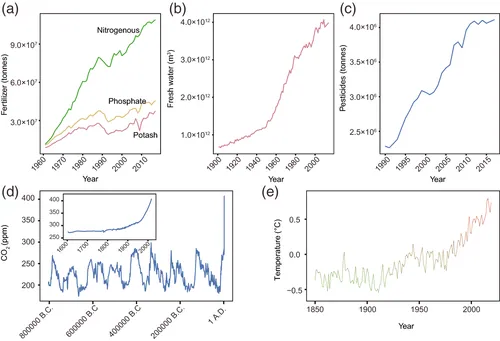
(a) Consumption of nitrogen, phosphate and potassium fertilizers
(b) Water consumption
(c) Consumption of pesticides
(d) Changes in CO2 concentration
(e) Global average temperatures
Requirements for sustainable agriculture
Agroecology as a concept currently has the greatest potential to secure access to the realization of the right to adequate food, such as availability, accessibility, adequacy and sustainability of food. Agriculture must also not compromise the ability to meet future needs at the expense of biodiversity and natural resources. Agriculture must be developed in a way that increases the incomes of small farmers and consumers from poorer backgrounds, because hunger is mainly caused by poverty and not by lack of food. In the future, the only system that will be able to face all of today's incipient problems, especially connected with the climate, will be a system that will be focused on a high level of diversity, productivity and efficiency [24]. Due to the increasingly expensive inputs (e.g. in the form of fuel or agrochemicals), the constant limitation of nitrogen supplies and the rapidly changing climate, such a system will be increasingly difficult to create. This big challenge, which is becoming more and more real, will probably have to be solved with the help of new technologies that will be friendly to the environment and will also take into account the ever-shrinking areas of arable land. One of the options to proceed in the future is to increase the efficiency of production according to Figure 2.

The transformation of agricultural production so that it not only produces an abundant amount of food, but also becomes a major contributor to global protection and biodiversity is one of the greatest challenges of the 21st century [25].
Sustainable development standards
For example, the concepts adopted by Unilever, Global Bioenergy Partnership and Rainforest Alliance are pioneering in terms of sustainability, where Unilever has adopted a series of measures related to the principles of agricultural sustainability and requires its suppliers to comply with these principles [26].
Other initiatives that aim to create a common whole, including economic, environmental and social metrics, because thanks to data from these sectors it will be possible to find out whether a given agricultural system is really managed in a sustainable way, are the Global Bioenergy Partnership [27]. The main requirement of this initiative is to find ways in the company to implement the sustainability plan and at the same time how to evaluate the goals and methods used in the company that work across the environmental and economic spheres.
The use of standards and their subsequent checks, when the checks do not have to be carried out by the state, but directly by the customer in the form of audits, can support the sustainability of agriculture and the resilience of the given agro-ecosystem [25].
For example, the Rainforest Alliance [28] has developed a series of standards that cover environmental, social, labor and agronomic farm management. Rainforest Alliance certification is built on three pillars of sustainability: environmental protection, social justice and economic viability. Trends expected on farms in tropical areas that adhere to the standards include less soil erosion, reduced pollution and waste generation, better habitat for wildlife, reduced risks to human health and improved conditions for workers.
Green agriculture as the key to sustainability
There are many ways to achieve new models of biodiverse, resilient, productive and resource-efficient agriculture, such as:
1. Use of conservation practices involving minimal or no tillage
2. Sustainable intensification (increase profitability and efficiency of production
3. Transition to organic farming
4. Use of agroecological systems
These are only some of the possible ways to fight climate change in agriculture, and every farmer who applies any of the above methods in his business contributes to a better future for all people in all countries.
These farming practices are similar in principle but very different methodologically, such as high versus low land inputs, market-driven versus non-market-driven agriculture, large monoculture areas versus biodiverse small farms.
Here are a number of attributes that an agricultural system should contain in order to be considered sustainable in the long term. However, there are many ways to assess agricultural systems in terms of sustainability. The basis must be to agree on the attributes for sustainability assessment and apply them in all systems that stand for sustainability.
Basic attributes of sustainable agriculture [25]:
Use of local crop varieties and livestock breeds to increase genetic diversity and improve adaptation to changing biotic and environmental conditions
Avoid the unnecessary use of agrochemicals and other technologies that have an adverse impact on the environment and human health (e.g. heavy machinery)
Efficient use of resources (nutrients, water, energy, etc.), reduced use of non-renewable energy and reduced dependence of farmers on external inputs
Use of agroecological principles and processes such as nutrient cycling, biological nitrogen fixation, allelopathy, biological control, etc.
Productive use of human capital in the form of traditional and modern scientific knowledge and skills to innovate and the use of social capital through the recognition of cultural identity, participatory methods and farmer networks to strengthen solidarity and the exchange of innovation and technology to solve problems
Reduce the ecological footprint of production, distribution and consumption processes, thereby minimizing greenhouse gas emissions and soil and water pollution
Promoting practices that increase the availability of clean water, carbon sequestration, biodiversity conservation, soil and water conservation, etc.
Strengthening the adaptive capacity and resilience of the agricultural system by maintaining the diversity of the agroecosystem
Recognition and dynamic preservation of agricultural heritage systems that enable social cohesion and a sense of pride and promote a sense of belonging and reduce migration
Sustainability Strategy
A sustainability strategy could theoretically be easily achievable, or come fairly close to it. At the same time, preserving the possibility for every inhabitant of the world to buy food would not be difficult at all. If buyers, especially the largest ones, required their suppliers, in this case farmers, to adhere to specific principles, rules and principles while maintaining prices, it would be possible to achieve sustainability in agriculture faster than is the case today. However, it would be ideal if part of the standards would be set by the government of the given state, or a state grouping, which would ensure the unification of all involved farmers, exactly as is the case with organic farming. Of course, it is very important to educate the population on the issues of today's agriculture, because the moment the population is very well acquainted with this issue, it will arouse interest in regulated production and products from sustainable farming systems. Just as vegan products are, these products from sustainable production could be equally or more in demand.
References
European Environment Agency. (2018). Agricultural Land: Nitrogen Balance. Available online: https://www.eea.europa.eu/airs/2018/natural-capital/agricultural-land-nitrogen-balance#tab-based-on-indicators (accessed on 26 March 2020).
European Commission. (2020). The Common Agricultural Policy at a Glance. Available online: https://ec.europa.eu/info/food-farming-fisheries/key-policies/common-agricultural-policy/cap-glance_en (accessed on 26 March 2020).
Alam, M. K., Bell, R. W., Salahin, N., Pathan, S., Mondol, A. T. M. A. I., Alam, M. J., ... & Shil, N. C. (2018). Banding of fertilizer improves phosphorus acquisition and yield of zero tillage maize by concentrating phosphorus in surface soil. Sustainability, 10(9), 3234.
Edmeades, D. C. (2003). The long-term effects of manures and fertilisers on soil productivity and quality: a review. Nutrient cycling in Agroecosystems, 66(2), 165-180.
IPCC. (2014). Climate Change 2014: Impacts, Adaptation and Vulnerability. IPCC Special Report, WGII.
Lobell, D. B., Schlenker, W., & Costa-Roberts, J. (2011). Climate trends and global crop production since 1980. Science, 333(6042), 616-620. https://doi.org/10.1126/science.1204531
Adams, R. M., Hurd, B. H., Lenhart, S., & Leary, N. (1998). Effects of global climate change on agriculture: An interpretative review. Climatic Research, 11(1), 19-30.
Vigouroux, Y., Barnaud, A., Scarcelli, N., & Thuillet, A. C. (2011). Biodiversity, evolution and adaptation of cultivated crops. Comptes Rendus Biologies, 334(5-6), 450-457.
Heinemann, J. A., Massaro, M., Coray, D. S., Agapito-Tenfen, S. Z., & Wen, J. D. (2014). Sustainability and innovation in staple crop production in the US Midwest. International Journal of Agricultural Sustainability, 12(1), 71-88. https://doi.org/10.1080/14735903.2013.806408
Altieri, M. A. (1999). The ecological role of biodiversity in agroecosystems. In Invertebrate Biodiversity as Bioindicators of Sustainable Landscapes
Thrupp, L. A. (1998). Cultivating diversity: agrobiodiversity and food security. World Resources Institute.
Koohafkan, P., & Altieri, M. A. (2010). Globally Important Agricultural Heritage Systems: a legacy for the future UN-FAO.
Denevan, W. M. (1995). Prehistoric agricultural methods as models for sustainability. In R. M. C. Netting (Ed.), Smallholders, householders: Farm families and the ecology of intensive, sustainable agriculture (pp. 21-43). Stanford University Press.
Netting, R. M. C. (1993). Smallholders, householders: Farm families and the ecology of intensive, sustainable agriculture. Stanford University Press.
Mijatović, D., Van Oudenhoven, F., Eyzaguirre, P., & Hodgkin, T. (2013). The role of agricultural biodiversity in strengthening resilience to climate change: towards an analytical framework. International Journal of Agricultural Sustainability, 11(2), 95-107.
Altieri, M., & Nicholls, C. (2004). Biodiversity and pest management in agroecosystems. CRC Press.
Folke, C. (2006). Resilience: The emergence of a perspective for social-ecological systems analyses. Global Environmental Change, 16(3), 253-267.
Loreau, M., Naeem, S., Inchausti, P., Bengtsson, J., Grime, J. P., Hector, A., ... & Wardle, D. A. (2001). Biodiversity and ecosystem functioning: current knowledge and future challenges. Science, 294(5543), 804-808.
Cabell, J. F., & Oelofse, M. (2012). An indicator framework for assessing agroecosystem resilience. Ecology and Society, 17(1), 18.
Wheeler, T., & Von Braun, J. (2013). Climate change impacts on global food security. Science, 341(6145), 508-513.
Lobell, D. B., & Gourdji, S. M. (2012). The influence of climate change on global crop productivity. Plant Physiology, 160(4), 1686-1697.
Taiz, L. (2013). Agriculture, plant physiology, and human population growth: past, present, and future. Theoretical and Experimental Plant Physiology, 25, 167-181.
Tian, Z., Wang, J. W., Li, J., & Han, B. (2021). Designing future crops: challenges and strategies for sustainable agriculture. The Plant Journal, 105(5), 1165-1178.
Funes-Monzote, F. R. (2009). Agricultura con futuro. La alternativa agroecológica para Cuba. Est. Exp. Pastos y Forrajes Indio Hatuey. Matanzas. 156p.
Koohafkan, P., Altieri, M. A., & Gimenez, E. H. (2012). Green agriculture: foundations for biodiverse, resilient and productive agricultural systems. International Journal of Agricultural Sustainability, 10(1), 61-75.
Pretty, J., Smith, G., Goulding, K. W. T., Groves, S. J., Henderson, I., Hine, R. E., ... & Walter, C. (2008). Multi-year assessment
Global Bioenergy Partnership. (2010). Bioenergy and food security. Retrieved from www.globalbioenergy.org/bioenergyinfo/bioenergy-and-food-security/en/
Rainforest Alliance. (2007). Our work in sustainable agriculture. Retrieved from www.rainforest-alliance.org/work/agriculture