
Module 1 · Chapter 4
Tillage systems under climate resilient cropping systems and crop rotation, cover crops and precrops effects
Agriculture leaves a significant footprint on the earth's surface. According to the United Nations (FAO), arable land is approximately 1.53 billion hectares, which is about 12% of the earth's land. Grasslands cover approximately 3.38 billion hectares, which is about 26% of the earth's land. This combined area of agricultural land represents about 38% of the earth's surface, making agriculture the industry that uses the largest amount of land on the planet. The remaining land is occupied by deserts, mountains, tundra, cities, ecological reserves, and other areas unsuitable for agriculture [1]. In recent decades, global crop production has increased substantially along with agricultural land. FAO reports a 47% increase in production between 1985 and 2005 (ref.18), while the increase in agricultural land is only 2.4%. However, despite the impressive increase in crop yields between 1985 and 2005, between 1965 and 1985, the increase in production was even 56%, which may indicate that crop yields are increasing more slowly today than before, and it is a matter of time before yield growth completely stops [1]. However, one of the ways to constantly improve plant yields is to focus on the biodiversity of the agroecosystem. Biodiversity is the basis of agriculture, as it includes all species of plants, animals, and microorganisms within the agroecosystem [2]. Biodiversity provides valuable genetic resources for further crop breeding. Crops that are used today have ancestors in wild species or varieties that have been selectively crossed or hybridized [2]. Perry [3] stated that biodiversity has an essential role in the provision of ecological services, such as preventing soil erosion and/or microclimate regulation. Altieri [4] added that biodiversity contributes to ecosystem services by recycling nutrients or regulating pest populations. However, these ecosystem services can only be preserved or maintained if biodiversity is preserved in the agroecosystem [4]. If there is a loss of biodiversity in an agroecosystem, very high maintenance inputs can be expected, simply because the loss of biodiversity in an agroecosystem will cause the system to lose its self-sustaining capacity.
One of the ways to maintain biodiversity, or to further improve it, is reduced tillage. Currently, it appears that changes in soil cultivation and crop rotation practices have a great influence on the composition of soil fauna, including pests but also useful organisms. Tillage has a significant impact because it changes the chemical and physical properties of the soil. Research by Stinner and House [5] shows that the response of pest populations to reduced tillage varies quite a bit. Reduced tillage indirectly shapes the species composition of the soil microbiome by contributing to soil moisture retention and modulating soil temperature [6]. The species composition of the microbiome associated with reduced tillage will create an environment that can be antagonistic to pathogens through competition [7].
Environmental Implications of Plough Tillage
Intensive tillage and the use of heavy machinery have produced mixed opinions at best in today's knowledge [8]. Soil erosion has become a global problem with increasing demand for primary soil resources and is a major risk to agricultural productivity and sustainability. As such, plowing exacerbates wind and water erosion, which is becoming an increasing problem today as more and more emphasis is placed on agricultural intensification. Plowing disrupts the soil structure and exposes it to intense rainfall and high wind speeds, which directly leads to erosion [8].
Erosion is a very significant cause of soil degradation, along with others, such as soil carbon loss, nutrient depletion, soil compaction, soil acidification, or salinization [9]. The problem of erosion, especially the water one, is not only about the washing away of topsoil, which in itself represents a big problem, but water erosion has other negatives, such as the floating of pesticides into the groundwater, which can infect water courses and threaten these ecosystems as well.
In recent years, reduced tillage practices have become increasingly widespread, which have the potential to increase soil mass, improve carbon sequestration, and thus potentially contribute to mitigating climate change [10], [11], [12]. Reduced tillage results in an increase in the amount of organic matter and less compaction of the soil, which results in improved physical properties and thereby, for example, improving the ability of the soil to absorb precipitation and retain water, which can later be used for crops [13], [14], [15].
Table 1. Summary of the four production systems C-IT conventional intensive agriculture, C-NT conventional no-tillage agriculture, O-IT organic intensive agriculture, O-RT organic low-tillage agriculture
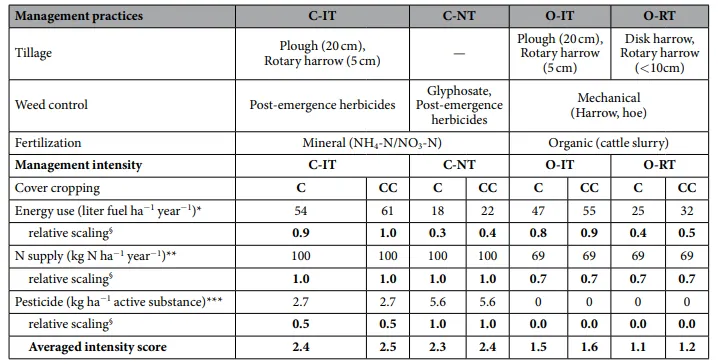
Management intensity is estimated for each production system using three anthropogenic inputs (energy use, weed control, and fertilization). These factors have also been used in various studies evaluating the intensity of agricultural land use [16], [17]. Energy consumption is measured as L of fuel per ha per year. Includes primary processing soil, preparation network beds, sowing, fertilizing, spraying, and mechanical weight loss weeds. Seeding (all systems ) and mulching ( except C-NT) were included next controlling surgery for treatment covering crops [18].
The most important factor in determining the quality of soil is soil organic matter. Schlesinger [19] states that the loss of soil carbon in maize fields is a result of intensive processing land, which leads to increased emissions of greenhouse gases. Reicosky and Lindstrom [20] evaluated help portable dynamic chamber short-term impact plow and miscellaneous processing of land for emissions oxide of carbon, when carbon is in high measure released from the soil over time two to three weeks after processing soil. In systems with low processing, soil loosens carbon lower, and the smallest losses of carbon from the soil are after no-till processing soil. Reicosky and Lindstrom [20] and Reicosky [21], [22] concluded that intensive processing methods of land, in particular plowing to a depth of 0.25 m, affect this initial soil flow differently and suggested more gentle techniques of land management such as preservative processing soil.
The context between global warming and the amount of CO2 in the atmosphere increased interest in saving soil carbon in systems of agricultural production, which led to the need to understand how processing soil affects the emission of greenhouse gases (carbon dioxide, methane, oxide stuffy). Kimble et al. [23] stated that appropriate processing of soil can contribute to the reduction of emissions of greenhouse gases because agricultural soil plays an important role in the sequestration of carbon. Reasonably, land management organic matter plays a key role in the maintenance of fertility soil, physical Properties of soil, and biological activities when these factors are necessary for the production of food and quality of life environment. That's why it would be appropriate to implement no tillage procedures, which will reduce the emission of sulfurous oxide [24], [25]. Oxide stuffy has about 310 times larger potential for global warming up than oxide carbon [26] and must be included in the calculations of greenhouse gases because oxide nitrogen is associated with the use of nitrogenous fertilizer, and the level of nitrogen in the soil is affected by the processing soil as well as carbon [27], [28], [29].
Crop Rotation, Cover Crops, and Precrops Effect
Soil health depends on a complex community of interacting organisms, including bacteria, fungi, protozoa, arthropods, and earthworms. Plant residues are the source of nutrition for these organisms. Microbially mediated decomposition of plant residues releases energy and nutrients, enabling these soil organisms to provide essential ecosystem services [30], [31].
Studies comparing organic and conventional farming practices have been conducted to understand the dynamics of the soil food chain and to determine whether organic matter inputs have advantages over inorganic sources, which currently represent the largest inputs to agricultural land [32], [33], [34], [35]. Supporting the development of resilient systems is increasingly important today, if only because the livelihood of communities depends on these systems [1].
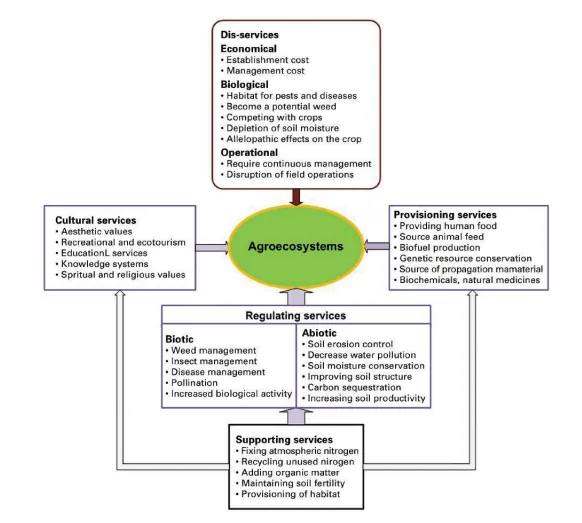
Resilient systems, improved soil health, and other extremely important factors in tillage can be improved through crop rotation. The definition of crop rotation is a systematic or repetitive sequence of crops grown over several harvest seasons. The choice of crops is mainly influenced by the ecology of the agroecosystem and the economics of agricultural production [36] and is not determined by the farmer, or at least he should not determine it. Crop selection depends on edaphic, biotic, and climatic factors. Pearson [36] introduced the term "comparative advantage", where this designation is related to the adaptation of a crop to the environment, differences in the necessary inputs to produce a given crop and market influences. This can directly affect sowing practices and, therefore, crop rotation because if the economic advantage is high enough for several crops, the farmer will prioritize this and, therefore, not grow monocultures. Cover crops are part of climate resilient systems. These are defined as plants grown primarily to cover soil to protect it from soil erosion and nutrient loss [37], [38]. Cover crops can be classified in both temperate and tropical climates [39], [40]. Cover crops are recognized for their ability to contribute to various agroecosystem services [41]. Agroecosystem services are complex concepts involving various interacting elements that are spatially and temporally interconnected, making it challenging to separate the effects of individual elements from the overall system [42]. Agricultural ecosystems, intended primarily for the production of food, feed, fiber, and industrial raw materials, receive and provide agroecosystem services [43].
Crop rotation has been a recommended practice for plant disease control [44]. Different crop species grown in sequence disrupt disease cycles. For example, in Australia, planting narrow leaf or blue lupine reduced common root rot infection rates in wheat compared to continuous wheat monoculture [45]. Crop rotation is particularly effective for nematode control. In Alabama, rotation with corn resulted in consistent increases in soybean yield compared to continuous soybean under conventional tillage, primarily due to the treatment of soybean cyst nematodes [46]. Tillage practices can interact with crop rotation in disease management. In some cases, conservation tillage systems combined with crop rotation have resulted in improved disease control and increased yields compared to continuous cropping and conventional tillage [46], [47]. However, the interactive effects of rotations and tillage systems on disease organisms may differ [48], [49].
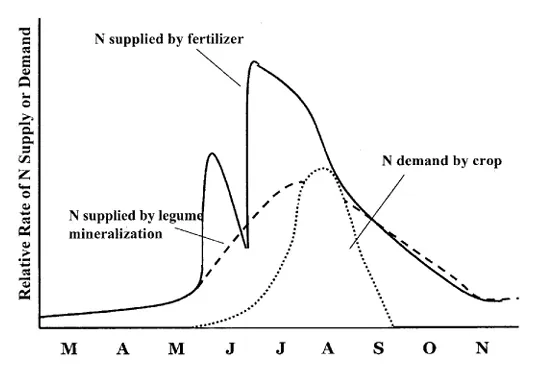
Cover crops are primarily grown to absorb nitrogen from the soil, effectively reducing nitrogen loss through leaching, a form of water erosion [51], [52]. Intercropping efficiency is closely related to the depth of root systems rather than root density [51], [52]. When green manure crops are integrated into the soil through tillage, they often accelerate the mineralization of organic nitrogen. This acceleration can lead to a temporary mismatch between the release of mineral nitrogen, which becomes prone to losses, and the actual nitrogen demand of crops. Such asynchrony can come from a variety of sources, including the addition of inorganic nitrogen fertilizers, animal manure, green manuring, or natural mineralization of soil nitrogen.
In some cases, cover crops exhibit preemptive competition, taking up nitrates from soils that would otherwise be at risk of leaching and making them available to succeeding crops [53]. Preemptive competition is observed, especially during the late spring growth of non-legume cover crops and in regions characterized by a low risk of leaching, such as dry areas. In such situations, optimizing intercropping strategies over several years can be beneficial in terms of maximizing N availability for cash crops.
Conclusion
In conclusion, agriculture has a significant impact on the earth's surface; cultivated land covers approximately 12% of the planet's surface, and pastures occupy about 26%. This combined agricultural area represents about 38% of the earth's surface, making agriculture the largest land-using sector. However, despite substantial increases in crop production over the past few decades, there are signs that crop yields are growing more slowly than before. Limited tillage practices have gained importance as a means of improving soil health and mitigating environmental problems associated with intensive tillage, such as soil erosion and carbon loss. Crop rotation, cover crops, and pre-crop selection are essential components of climate-resilient agricultural systems. Crop rotation breaks disease cycles and can improve overall soil health. Cover crops, on the other hand, help reduce nitrogen loss through leaching and can provide several ecosystem services. Considering growing concerns about climate change and sustainable agriculture, it is increasingly important to adopt agricultural practices that promote soil health, reduce environmental impacts, and increase the resilience of agricultural systems. The integration of limited tillage, strategic crop rotation, and the use of cover crops is a promising approach to achieving these goals, ultimately contributing to more sustainable and climate-resilient agriculture. However, it is essential to realize that the effectiveness of these practices may vary depending on local conditions and must be adapted to specific agroecosystems to achieve the best results.
References
Altieri , M. A. (1999). The ecological role of biodiversity in agroecosystems . In Invertebrate biodiversity as bioindicators of sustainable landscapes (pp. 19-31). Elsevier .
Harlan , J. R. (1975). Our Vanishing Genetic Resources : Modern varieties replacement ancient populations that have provided genetic variability for plant breeding programs . Science, 188(4188), 618-621.
Perry, DA, Oren, R., & Hart, SC (1994). Forest ecosystems . the johns Hopkins University Press . Baltimore, Maryland.
Altieri , MA, 1994. Biodiversity and Pest Management in Agroecosystems . Haworth Press , New York, 185 pp.
Stinner , BR, & House, GJ (1990). Arthropods and others invertebrates in conservation-tillage agriculture . Annual review of Entomology, 35(1), 299-318.
Krupinsky , JM, Bailey, KL, McMullen , MP, Gossen , BD, & Turkington , TK (2002). Managing plant disease risk in diversified cropping systems . Agronomy journal , 94(2), 198-209.
Cook , R. J. (1990). Twenty-five years of progress towards biological control . Biological control of soil-borne plant pathogens ., 1-14.
Diamond , J. (2004). Collapse : How Societies Choose to Fail steed Succeed , ; Viking Adult .
Sullivan , P. (2004). Sustainable management of soil-borne plant diseases : soil systems guide . Sustainable management of soil-borne plant diseases : soil systems guide ., (IP173).
Lal , R. (2004). Soil carbon sequestration impacts on global climate change and food security . science, 304(5677), 1623-1627.
Smith, P., Martino, D., Cai , Z., Gwary , D., Janzen , H., Kumar , P., ... & Smith, J. (2008). Greenhouse gas mitigation in agriculture . Philosophical transactions of the Royal Society B: Biological Sciences , 363(1492), 789-813.
Corsi , S., Friedrich, T., Kassam , A., Pisante , M., & Sà , J. D. M. (2012). Soil organic carbon accumulation and greenhouse gas emission reductions from conservation agriculture : a literature review . Food and Agriculture Organization of the United Nations (FAO).
Luo , Z., Wang , E., & Sun, OJ (2010). Can no- tillage stimulate carbon sequestration in agriculture soils ? A meta- analysis of paired experiments . Agriculture , ecosystems & environment, 139(1-2), 224-231.
Ngwira , AR, Thierfelder , C., & Lambert, DM (2013). Conservation agriculture systems for Malawian smallholder farmers : long-term effects on crops productivity , profitability and soil quality . Renewable Agriculture and Food Systems, 28(4), 350-363.
Verhulst , N., Govaerts , B., Verachtert , E., Castellanos-Navarrete , A., Mezzalama , M., Wall, P., & Sayre , K. D. (2010). Conservation agriculture , improving soil quality for sustainable production systems . Advances in soil science: food security and soil quality , 1799267585, 137-208.
Herzog , F., Steiner, B., Bailey, D., Baudry , J., Billeter , R., Bukácek , R., ... & Bugter , R. (2006). Assessing the intensity of temperate European agriculture and the landscape scales . European Journal of Agronomy, 24(2), 165-181.
Ruiz-Martinez , I., Marraccini , E., Debolini , M., & Bonari , E. (2015). Indicators of agricultural intensity and intensification : a review of the literature . Italian Journal of Agronomy, 10(2), 74-84.
Wittwer , RA, Dorn , B., Jossi , W., & van der Heijden , MG (2017). Cover crops support ecological intensification of arable cropping systems . Scientific reports , 7(1), 41911.
Schlesinger , W. H. (1986). Changes in soil carbon storage and associated properties with disturbance and recovery . In The changing carbon cycle : A global analysis (pp. 194-220). New York, NY: Springer New York.
Reicosky , DC, & Lindstrom , MJ (1993). Fall tillage method : Effect on short -term carbon dioxide flux from soil _ Agronomy journal , 85(6), 1237-1243.
Reicosky , D. C. (1997). Tillage-induced CO 2 emission from soil _ Nutrient cycling in agroecosystems , 49, 273-285.
Reicosky , D. C. (1998). Strip tillage methods : Impact on soil and air quality . In Australian / New Zealand National Soils Conference .
Kimble , JM, Follett , RF, & Cole, CV (1998). The potential of US cropland to sequester carbon and mitigate the greenhouse effects . CRC Press .
Baggs , E.M., Stevenson , M., Pihlatie , M., Regar , A., Cook , H., & Cadisch , G. (2003). Nitrous oxide emissions following application of residues and fertiliser under zero and conventional tillage . Plant and Soil , 254, 361-370.
MacKenzie , A.F., Fan , M.X., & Cadrin , F. (1997). Nitrous oxide emission as affected by tillage , corn-soybean-alfalfa rotations and nitrogen fertilization . Canadian Journal of Soil Science, 77(2), 145-152.
Robertson , GP, Paul, EA, & Harwood , RR (2000). Greenhouse gases in intensive agriculture : contributions of individual gases to the radiative forcing of the atmosphere . Science, 289(5486), 1922-1925.
Parkin , TB, & Kaspar , TC (2006). Nitrous oxide emissions from corn - soybean systems in the Midwest . Journal of environmental quality , 35(4), 1496-1506.
Steinbach, HS, & Alvarez , R. (2006). Changes in soil organic carbon contents and nitrous oxide emissions after introduction of no‐ till in Pampean agroecosystems . Journal of Environmental Quality , 35(1), 3-13.
Liu , XJ, Mosier , AR, Halvorson , AD, & Zhang , FS (2005). Tillage and nitrogen application effects on nitrous and nitric oxide emissions from irrigated corn fields . Plant and soil , 276, 235-249.
Ball , AS, 2006. Energy inputs in soil systems . In: Uphoff , N., Ball , AS, Fernandes , E., Herren , H., Husson , O., Laing , M., Palm, C., Pretty , J., Sanchez, P., Sanginga , N. , Thies , J. ( Eds .), Biological Approaches to Sustainable Soil Systems. CRC Press , Boca Raton , pp. 79 and 89.
Thies , JE, & Grossman, JM (2006). The soil habitat and soil ecology . Biological approaches to sustainability soil systems , 59, 78.
Henneron , L., Bernard, L., Hedde , M., Pelosi , C., Villenave , C., Chenu , C., ... & Blanchart , E. (2015). Fourteen years of evidence for positive effects of conservation agriculture and organic farming on soil life . Agronomy forum Sustainable Development, 35(1), 169-181.
Williams , A., & Hedlund , K. (2013). Indicators of soil ecosystem services in conventional and organic arable fields along a gradient of landscape heterogeneity in southern Sweden . Applied Soil Ecology , 65, 1-7.
Overstreet , L.F., Hoyt , G.D., & Imbriani , J. (2010). Comparing nematode and earthworm communities under combinations of conventional and conservation vegetables production practices . Soil and Tillage Research , 110(1), 42-50.
Reganold , J.P., Andrews , P.K., Reeve , J.R., Carpenter-Boggs , L., Schadt , C.W., Alldredge , J.R., ... & Zhou , J. (2010). Fruit and soil quality of organic and conventional strawberries agroecosystems . PloS one , 5(9), e12346.
Pearson , L. C. (1967). Principles of agronomy. (No Title ).
Brady, N., & Weil , RR (1999). The nature and properties of soil 12th ed . Mac. Pub. Com . New York, 625-640.
Sarrantonio , M., & Gallandt , E. (2003). The role of cover crops in North American cropping systems . Journal of Crop production , 8(1-2), 53-74.
Liebmann . (2000). Integration of soil , crop and weed management in low - external -input farming systems . Weed research , 40(1), 27-47.
Teasdale , JR, Hatfield , JL, Buhler , DD, & Stewart, BA (1998). Cover crops , smother plants , and weed management. Integrated weed and soil management, 247, 270.
Teasdale , J. R. (2003). Principles and practices of using cover crops in weed management systems . Labrada , R. ( ed .) FAO Plant Production and Protection Paper 120 Add . 1: Weed Management for Developing Countries .
Barberi , P., & Mazzoncini , M. (2001). Changes in weed community composition as influenced by cover crop and management system in continuous corn . Weed Science, 49(4), 491-499.
Heal , GM, & Small , AA (2002). Agriculture and ecosystems services . Handbook of agricultural economics , 2, 1341.
Leighty , CE 1938. Crop rotation . pp. 406-430. In: Soils and Men . USDA Yearbook of Agriculture . US Government Printing Office, Washington, DC
Reeves , TG 1984. Lupins in crop rotations . pp. 207-226. In: Proceedings of the I11 International Lupine Congress . June 4-8, 1984, La Rochelle , France.
Edwards, JH, Thurlow , DL, & Eason , JT (1988). Influence of tillage and crop rotation on yields of corn , soybean , and wheat . Agronomy Journal , 80(1), 76-80.
Von Qualen , RH, Abney , TS, Huber , DM, & Schreiber, MM (1989). Effects of rotation , tillage , and fumigation on premature dying of soybeans . Plant diseases , 73(9), 740-744.
Rothrock , C. S. (1987). Take-all of wheat as affected by tillage and wheat-soybean double cropping . Soil Biology and Biochemistry , 19(3), 307-311.
Herman, M. (1990). Effect of tillage systems and crops sequence on the rhizosphere microflora of winter wheat . Soil and Tillage Research , 15(3), 297-306.
Lemessa , F., & Wakjira , M. (2015). Cover crops as a means of ecological weed management in agroecosystems . Journal of crop Science and Biotechnology, 18, 123-135.
Delgado , J. A. (2001). Use of simulations for evaluation of best management practices on irrigated cropping systems . Modeling carbon and nitrogen dynamics for soil management. Lewis Publishers , Boca Raton , FL, 355-381.
Thorup-Kristensen , K. (2001). Are differences in root growth of nitrogen catch crops important for their ability to reduce soil nitrate -N content , and how can this be measured ? Plant and Soil , 230, 185-195. Thorup-Kristensen, K., Magid , J., & Jensen, LS (2003). Catch crops and green manures as biological tools in nitrogen management in temperate zones . Advances in agronomy, 227-302.
Thorup-Kristensen , K., Magid , J., & Jensen, LS (2003). Catch crops and green manures as biological tools in nitrogen management in temperate zones . Advances in agronomy, 227-302.
Crews , TE, & Peoples , MB (2005). Can the synchrony of nitrogen supply and crop demand be improved in legume and fertilizer-based agroecosystems ? A review . Nutrient cycling in Agroecosystems , 72, 101-120.