
Module 1 · Chapter 8
Ecosystem services within climate resilient cropping system
Ecosystem services and climate resilient cropping systems are closely linked. Ecosystem services play a crucial role in ensuring the resilience of crop systems to climate change. Ecosystem services are benefits that humans derive from ecosystems, including the provision of services such as food and water, regulatory services such as climate control and disease control, and cultural services such as recreation and aesthetic values [10]. Climate resilient cropping systems are those designed to be more resilient to the impacts of climate change, such as drought, floods, and extreme weather events. These systems include practices that, among other benefits, increase soil health, reduce soil erosion, save water, and improve nutrient cycles in general. Ecosystem services provide the basis for climate-resilient crop systems by providing the necessary resources and functions to support overall crop production. For example, healthy soil provides the basis for crop growth, and clean water is essential for irrigation. Biodiversity also plays a key role in pollination and pest control, among others. Therefore, the promotion and maintenance of ecosystem services are essential for the development of climate resilient cropping system. This can be achieved through practices such as conservation agriculture, agroforestry, or integrated pest management, which are designed to improve ecosystem services while increasing crop productivity and reducing agriculture's environmental impacts.
The Categories of Ecosystem Services
Ecosystems around the world provide key services that essentially enable human society to function. The term ecosystem services has come to be used for these services. These can be divided into several categories. They are commonly divided into four basic ones: (1) Provisioning services, (2) Regulating services, and (3) Cultural and social services. These services are directly used by humans. But all sorts of natural processes are necessary for them to exist, which are classified into the so-called (4) Supporting services [3].
Provisioning (production) services cover all the goods and services produced by ecosystems that can be used for the material consumption of a global society. These include the production of plants that provide food, fiber, fuel, and other goods, the production of drinking water, etc. Regulating services regulate key natural processes, such as the water cycle, or provide for the regulation of greenhouse gases and related climate change. Regulating services thus largely creates a framework of environmental conditions in which our society operates, the importance of which is usually only realized when there is a deviation in their smooth functioning. Such a deviation can be a flood, drought, dust storm, or climate change. It also follows that these services are not usually subject to the market but become subject to regulations arising from laws and other regulations. Cultural and social services are the sum of what nature means for our psyche, culture, artistic and spiritual inspiration, etc. Although these services make a large contribution to the economy of many sectors of human activity, such as the tourism and entertainment industries, literature, and the arts, they are not generally subject to the market per se. However, for example, attractive tourist places, or places with generally rich biodiversity, can be subject to the market and generate profits. Supporting services, such as primary production, pollination, nutrient cycling, etc., are, with the exception of some services, not directly subject to the market. This makes their evaluation very difficult. The use of nature and natural resources often leads to a reduction in the capacity of ecosystems to provide ecosystem services. As human populations grow and opportunities increase, so does the production volume or frequency of transport. In general, human influence on the functioning of ecosystems and geochemical processes is increasing. Mediterranean and temperate biomes are most affected, i.e., in areas that were the cradle of advanced civilizations. Since ecosystem production services are most closely linked to the well-being of society - i.e., subject to the market - the ecosystems concerned are often changed to increase their production capacity. This often happens at the expense of other natural processes and ecosystem services [3].
Agriculture and Basic Ecosystem Services
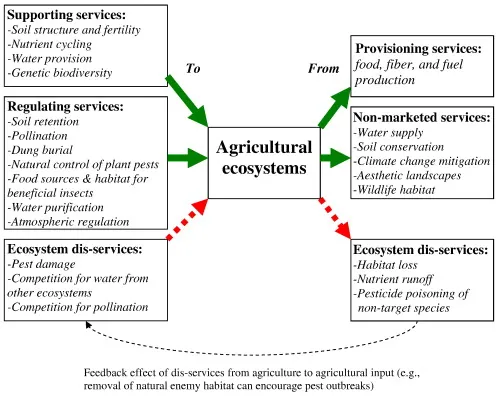
Most of the landscape has been altered by agricultural activity, and most natural ecosystems lie in the matrix of agricultural soils. The conversion of natural ecosystems into agricultural systems, i.e., agroecosystems, can have a strong impact on the system's ability to provide important ecosystem services. However, agroecosystems can also be important sources of ecosystem services. Traditionally, agroecosystems have been considered primarily as sources of provisioning services, and the approach to agriculture has depended on this. However, other types of ecosystem services have been considered in recent decades. Indeed, agroecosystems also provide supporting services such as pollination, pest control, support for genetic diversity for future agricultural use, retention of water in the landscape, protection against soil erosion, and support nutrient cycles. However, whether a particular agricultural system provides and supports such services depends on the management. In addition to supplying and regulating services, agroecosystems can provide various regulating and cultural services to humans, too. Regulating services from agriculture can include flood threat control, water quality control, carbon sequestration, and climate control through mitigation of greenhouse gas emissions, disease control, and the provision of decomposition processes. Cultural services related to agroecosystems can include landscape appearance, education, recreation, tourism, or religious aspects [12]. The preservation of biodiversity can also be considered as a cultural ecosystem service influenced by agriculture, as most cultures recognize the appreciation of nature as an explicit human value. On the other hand, biodiversity can contribute a range of supporting services to agroecosystems and surrounding ecosystems [10].
Biological pest control, which is a supporting service [19], is one of the essential benefits of ecosystems for agriculture. Within agroecosystems, this is an important ecosystem service. Natural ecosystems often support it. Unmanaged habitats provide spaces and diverse food resources for natural enemies of agricultural pests (so-called antagonists), which in turn provide biological regulating services in agroecosystems [2]. Such biological controls can reduce the pressure on populations of harmful insects, ultimately reducing the need for pesticides and their production and distribution. For example, ecosystem services provided by pest antagonists can directly replace insecticides. The value of such an ecosystem service can thus be quantified and expressed economically [5].
One of the most important ecosystem services for agriculture is pollination. This ecosystem service is initiated by natural habitats in agricultural landscapes, i.e., places where pollinators can reside. It is estimated that around 65% of the world's plant species require pollination by fauna (mainly insects), and about 75% of all cultivated crop species of global importance for food production depend on pollination [8]. Pollination services are quantifiable and thus can also be expressed economically, which is not the case for most other ecosystem services. The value of the pollination service can be expressed, for example, by the total value of insect-pollinated crops. However, most crops are only partially dependent on pollination by animals. Therefore, the dependency ratio or the rate of proportional reduction in production in the absence of pollinators should also be considered. Such an approach can provide a more accurate statement [9]. However, such quantifications are rather imprecise and are intended to provide only a general assessment of potential economic benefits, which serves, among other things, to support the very importance of an ecosystem service. Moreover, most estimates do not consider the potential changes in the value of each commodity as demand increases due to reduced crop production [12]. Agriculture is highly vulnerable to the potential loss or degradation of the ecosystem service of pollination. One factor that may amplify this loss or degradation is climate change and its consequences [10]. The vulnerability itself lies primarily in the potential loss of pollination services based on the ratio of the economic value of insect pollination to the economic value of the crop. For example, West African countries produce 56% of the world's stimulant crops (i.e., coffee, cocoa, tea), while the vulnerability to the loss of pollinators is as high as 90%. Thus, the loss of pollination services for these crops could have devastating effects on the regional economies of West African countries in the short term and lead to a significant restructuring of world prices in the long term [12].
Agriculture is the largest global water consumer (about 70%). Providing sufficient amounts of clean water is a basic ecosystem service provided to agroecosystems [10]. The value of ecosystem services associated with the availability and quality of water for agriculture is only partially reflected in most estimates. The vegetation of natural ecosystems, such as forests, can significantly influence the accumulation, infiltration, and retention of water in the landscape. Plant communities generally play a dominant role in regulating water swelling and protecting soils from erosion. Forest soils tend to have higher infiltration rates than other soils and tend to reduce culmination flows and flooding while maintaining basic flows [11]. In addition, deep-rooted vegetation, including trees, can improve the availability of both water and nutrients for other species in the ecosystem. This principle is used, for example, in agroforestry, which is one of the tools for climate resilient cropping systems. The availability of water in agroecosystems also depends on ecosystem service, which consists of the ability to retain soil moisture. Surface and groundwater (commonly referred to as blue water) often enter agroecosystems through the sorting of irrigation systems, and in some parts of the world, this route is indispensable. However, about 80% of water consumption in agriculture comes from rainfall, which is stored in soil moisture and vegetation. Such water is referred to as green water [13]. In addition to vegetation cover, organic matter (its quantity and quality) and soil biotic communities (edaphon) significantly influence the quantity and quality of water in the soil and thus provide other basic ecosystem services to agriculture. In this relation, predictions of water availability for agriculture are based mainly on assumptions of blue water availability (i.e., surface and groundwater) but often neglect the contribution of green water (i.e., rainwater in soil and vegetation). Thus, final predictions of water availability, e.g., in 2050, might not be so pessimistic. However, climate change brings increased variability of precipitation. This is predicted to lead to a greater risk of drought or flooding. And the associated increased temperature will also increase overall water demand [6]. Currently, water management practices (related to green water) are already known on farms, which can significantly change these predictions of water scarcity. For example, by switching to conservation technologies for soil treatment (i.e., no-till treatment) or mulching, water evaporation from the soil can be reduced by 35-50%. Also, rainwater retention on farms in surface reservoirs and ponds, or subsurface reservoirs, is a very effective way that can allow farmers to recover up to 50% of the water that is normally lost in the system [12].
The basic ecosystem services that are also available to agroecosystems are the structure of the soil and its fertility. Well-aerated soils with sufficient organic matter are the basis for the distribution of nutrients to crops and water retention in the soil. Soil pore structure (soil porosity), soil aggregation, and organic matter decomposition are influenced by the activity of bacteria, fungi, and macrofauna (invertebrates such as earthworms). Microorganisms mediate the availability of nutrients through the decomposition of detritus (that is, material from the natural decomposition of rocks), plant residues (that is, primarily organic matter), and, where appropriate, the fixation of air nitrogen [14]and [15]. Agricultural practices that degrade soil structure and soil microbial communities include traditional ploughing but also frequent harrow by disc or harvesting processes that are associated with strong soil compaction (pedocompatition). But farming practices can be applied to protect the soil and reduce the risk of erosion and water run-off. Reduced soil processing/cultivation (e.g., no-till technologies) and other soil protection measures such as the implementation of green manure or intercropping (as cover crops), the application of composts, and appropriate crop rotation under the cropping process can preserve soil fertility by contributing to good soil structure, minimizing nutrient losses and keeping them available for crops. For example, cover crops facilitate the retention of soil and nutrients between individual crops within the crop rotation [1]. The crop rotation also affects the diversity of agricultural landscapes within space and time. Furthermore, the landscape and its structure, respectively the spatial and temporal structure of the landscape, have a huge impact on the level of provision of ecosystem services and their volume for the agroecosystem [4]. Also, the incorporation of post-harvest residues can contribute to an increase in the organic matter content of the soil. This ultimately helps in water retention and the provision of nutrients to crops. All these processes then protect many ecosystem services related to the structure of the soil and especially its fertility [14].
Agriculture and Negative Impacts on Ecosystem Services
Agricultural ecosystems provide people with the basic raw materials necessary for human well-being. The value of ecosystem services linked to agriculture is enormous and often underestimated. It is also agriculture that can provide so-called negative services, such as habitat loss, nutrient leaching associated with erosion, greenhouse gas emissions, and pesticide pollutant loads, etc. Agriculture itself represents a significant pressure on ecosystem services [19]. In many anthropogenic ecosystems, typically those on arable land, a large amount of nutrients is supplied each year by humans (which can be seen as compensation for the harvested biomass). These nutrients are then taken away by harvesting, with a large part also leaving as a loss through leaching, run-off, and other processes. If we carry out a similar type of farming on more than one surface, then its impacts are felt at the level of the entire landscape. In the case of nutrients in agriculture, this leads to an increase in the amount of nutrients in water resources. This can lead, for example, to eutrophication or ecotoxicity. For example, from a global perspective, the application of mineral fertilizers has doubled the nitrogen input from the atmosphere into ecosystems [10]. Thus, increasing production (i.e., intensification of agriculture) due to nutrient inputs can lead, for example, to a reduction in ecosystem services such as the provision of drinking water. The intensification of agriculture increases the total consumption of agrochemicals. All of this has implications for the global flows of energy and substances in nature. The intensification of agriculture can threaten or degrade many ecosystem services provided by the surrounding landscape and its biodiversity. In many regions of the world, the intensification of agriculture has led to a simplification of the landscape structure through the expansion of farmland, increasing the size of fields, reducing vegetation at the edges of fields, and eliminating the natural environment [15]. The simplification of the landscape structure contributes to increasing pest pressure through the possibilities offered by monocultures and their area. Conversely, it leads to a reduction in the populations of their natural enemies.
Support for Farm Ecosystem Services and Appropriate Management
Around the world, agroecosystems show huge differences in structure and function. Indeed, they have been designed by different cultures under different socio-economic conditions in different climate regions. Functional agroecosystems include, for example, annual monocultures, permanent orchards, grazing systems, pastoral systems on dry soils, tropical rotation systems, small-scale mixed cultivation systems, rice paddies, tropical plantations (e.g., oil palm, coffee, cocoa), agroforestry systems or species-rich home gardens. This diversity of farming systems results in a highly variable range and carries many ecosystem services. Just as supply services and products derived from these agroecosystems vary, so do supporting services, regulating services, and cultural services, resulting in extreme differences in the value these services provide inside and outside the agroecosystem [12]. While maximizing the value of provisioning services, agriculture often reduces the ecological services provided by terrestrial ecosystems. Still, appropriate management of key processes can improve the ability of agroecosystems to provide a wide range of ecosystem services [4].
Appropriate management on farms can significantly improve the overall volume and quality of ecosystem services provided by agriculture [16]. Farmers routinely support provisioning services through inputs and practices to increase yields. But proper management can also improve ecosystem services such as pollination, biological pest control, soil fertility and structure, water regulation, biodiversity promotion, etc. [12]. For example, management of marginal habitats (i.e., hillsides, scattered greenery in the landscape, or land margins) within an agroecosystem can provide the resources necessary for pollinators or natural enemies of crop pests. It is advisable to include perennial plants in cropping practices to promote biodiversity in general and, in particular, to promote pollinators and antagonists. Support for crop diversity can be achieved through polycultures, cover crops, or agroforestry [7]. Similar practices can benefit wild pollinators and reduce agrochemical inputs (i.e., pesticides) or reduce the need for ploughing. At the same time, these practices contribute to promoting carbon sequestration — a major ecosystem service in relation to the increasing amount of CO2 in the atmosphere. Soil carbon sequestration also provides additional ecosystem services by maintaining soil structure and fertility, improving soil quality, increasing efficiency in agronomic inputs, and improving water quality by filtering and denaturing pollutants. In particular, soil protection measures such as soil conservation (including minimalization practices) and no-soil treatment can save soil carbon in general. This is also helped by the mentioned crop rotation and sorting of cover crops, which reduce the risk of erosion and contribute to the maintenance of organic carbon in the soil. Effective manure management can also significantly reduce associated animal waste emissions. Replacing synthetic nitrogen fertilizers with leguminous plants, which use biological nitrogen fixation, contributes to reducing greenhouse gas emissions, which in turn contributes to the reduction of the greenhouse effect [12].
Resilient farming systems will be needed in view of climate change [17]. Sustainable management of agroecosystems or sustainable intensification through ecosystem process management has the potential to increase food production while minimizing some of the negative impacts of intensification on biodiversity and related ecosystem services. Appropriate farming management practices, such as climate resilient crop systems, are key to realizing the benefits of ecosystem services and key to reducing the negative impacts of agriculture [4].
References
Bernas, J., Konvalina, P., Brom, J., Moudrý, J., Veselá, T., Bucur, D., Dirja, M. & Shim, S. (2020). Agrotechnology as key factor in effective use of water on arable land. Assessment and Protection of Water Resources in the Czech Republic, 275-312.
Fiedler, A. K., Landis, D. A., & Wratten, S. D. (2008). Maximizing ecosystem services from conservation biological control: the role of habitat management. Biological control, 45(2), 254-271.
Frouz, J., & Frouzová, J. (2021). Aplikovaná ekologie (Vol. 3). Charles University in Prague, Karolinum Press.
Hasan, S. S., Zhen, L., Miah, M. G., Ahamed, T., & Samie, A. (2020). Impact of land use change on ecosystem services: A review. Environmental Development, 34, 100527.
Cheng, X., Van Damme, S., Li, L., & Uyttenhove, P. (2019). Evaluation of cultural ecosystem services: A review of methods. Ecosystem services, 37, 100925.
IPCC (2007). Contribution of working group III to the fourth assessment report of the Intergovernmental Panel on Climate Change. Cambridge, UK: Cambridge University Press.
Kay, S., Graves, A., Palma, J. H., Moreno, G., Roces-Díaz, J. V., Aviron, S., Chouvardas, D., Crous-Duran, J., Ferreiro-Domínguez, N., de Jalón, S. G., Măcicăşan, V., Mosquera-Losada, M. R., Pantera, A., Santiago-Freijanes, J. J., Szerencsits, E., Torralba, M., Burgess, P. J. & Herzog, F. (2019). Agroforestry is paying off–Economic evaluation of ecosystem services in European landscapes with and without agroforestry systems. Ecosystem services, 36, 100896.
Klein, A. M., Vaissière, B. E., Cane, J. H., Steffan-Dewenter, I., Cunningham, S. A., Kremen, C., & Tscharntke, T. (2007). Importance of pollinators in changing landscapes for world crops. Proceedings of the royal society B: biological sciences, 274(1608), 303-313.
Kremen, C., Williams, N. M., Aizen, M. A., Gemmill‐Herren, B., LeBuhn, G., Minckley, R., Packer, L., Potts, S. G., Roulston, T., Steffan-Dewenter, I., Vázquez, D. P., Winfree, R., Adams, L., Crone, E. E., Greenleaf, S. S., Keitt, T. H., Klein, A. M., Regetz, J. & Ricketts, T. H. (2007). Pollination and other ecosystem services produced by mobile organisms: a conceptual framework for the effects of land‐use change. Ecology letters, 10(4), 299-314.
MA. (2005). Millenium ecosystem assessment. Ecosystems and human well-being: Synthesis. Island Press, Washington, DC.
Maes, W. H., Heuvelmans, G., & Muys, B. (2009). Assessment of land use impact on water-related ecosystem services capturing the integrated terrestrial− aquatic system. Environmental Science & Technology, 43(19), 7324-7330.
Power, A. G. (2010). Ecosystem services and agriculture: tradeoffs and synergies. Philosophical transactions of the royal society B: biological sciences, 365(1554), 2959-2971.
Rost, S., Gerten, D., Bondeau, A., Lucht, W., Rohwer, J., & Schaphoff, S. (2008). Agricultural green and blue water consumption and its influence on the global water system. Water Resources Research, 44(9).
Sarapatka, B., Abrahamova, M., Cizkova, S., Dotlacil, L., Hluchy, M., Kren, J., Kuras, T., Lastuvka, Z., Lososova, Z., Pokorny, E., Pokorny, J., Pokorny, R., Salasova, A., Tkadlec, E., Tuf, I., Vacha, M., Zamecnik, V., Zeidler, M. & Zalud, Z. (2010). Agroekologie: východiska pro udržitelné zemědělské hospodaření. Bioinstitut.
Sarapatka, B., Urban, J., Cizkova, S., Hejduk, S., Hradil, R., Jurcik, J., Leibl, M., Matlova, V., Moudry, J., Plisek, B., Pokorny, E., Rozsypal, R., Sedlo, J., Skerik, J., Sonkova, R., Travnicek, P., Vanek, D. and Pinschof, Anton (2009). Organic agriculture. IAEI.
Swinton, S. M., Lupi, F., Robertson, G. P., & Hamilton, S. K. (2007). Ecosystem services and agriculture: cultivating agricultural ecosystems for diverse benefits. Ecological economics, 64(2), 245-252.
Weiskopf, S. R., Rubenstein, M. A., Crozier, L. G., Gaichas, S., Griffis, R., Halofsky, J. E., Hyde, K. J. W., Morelli, T. L., Morisette, J. T., Muñoz, R. C., Pershing, A. J., Peterson, D. L., Poudel, R., Staudinger, M. D., Sutton-Grier, A. E., Thompson, L., Vose, J., Weltzin, J. F. & Whyte, K. P. (2020). Climate change effects on biodiversity, ecosystems, ecosystem services, and natural resource management in the United States. Science of the Total Environment, 733, 137782.
Wood, S. A., Karp, D. S., DeClerck, F., Kremen, C., Naeem, S., & Palm, C. A. (2015). Functional traits in agriculture: agrobiodiversity and ecosystem services. Trends in ecology & evolution, 30(9), 531-539.
Zhang, W., Ricketts, T. H., Kremen, C., Carney, K., & Swinton, S. M. (2007). Ecosystem services and dis-services to agriculture. Ecological economics, 64(2), 253-260.