
Module 2 · Chapter 1
Effects of climate change on soil properties
Soil is formed after a very long process under the interaction of a number of factors such as climate, main material, topography and organisms. The pressure on the soil, which is the basis of life on earth, is increasing day by day. Proper soil management is of great importance for sustainable agriculture.
Soil is the largest carbon sink after the oceans and is an important balancing factor against climate change. The impact of climate change on soils is a slow and complex process. If soils are not well managed, they are not only affected by climate change, but can also contribute to climate change as a source of greenhouse gases. As the effects of climate change increase, it is inevitable that soils will be affected by this situation. The possible effects of global warming on some basic properties of the soil have been examined.
Effects of Climate Change on Soil Moisture
Having sufficient moisture in the soil during the plant development period is of great importance for plant production. As a result of the climate changes, some changes in soil moisture is expected.
Conditions caused by climate change, such as heavy rainfall in a short time and more evaporation and transpiration due to temperature increase, can cause a series of fluctuations in soil water [1]. The integrative effect of climate-hydrology vegetation-land use changes is reflected by the field water balance and soil moisture regime. The potential effects of four possible climate change scenarios on soil moisture components are summarized Table 1.
Table . Components of field water balance and soil moisture regime and the impact of four potential climate scenarios on these factors: i and I: slight to large increase, d and D: slight to strong decrease, E: No change
| Factors | Cold, wet | Cold, dry | Hot, wet | Hot, dry |
|---|---|---|---|---|
| P | I | D | I | D |
| R | I | d, D | I | D |
| G | i | d | i | D |
| I | I | d | I | D |
| i | i | D | i | D |
| S | I | d | I | D |
| E | D | E | E | I |
| T | D | E | i | I |
| F | - | - | - | - |
| Gr | i | - | I | - |
| Gs | - | I | - | I |
For example, if the vegetation does not suffer from limited water supply due to climate or soil-induced drought, an increase in temperature increases the potential for E and T. Reduces R, I, S and G if high temperature is accompanied by low precipitation; It softens the adverse hydrological consequences of frost and rapid snowmelt (danger of flooding) and provides more opportunities for water penetration. Since the reduction in atmospheric precipitation will result in a reduction in water infiltration (I) and water storage (S) in soil and plants; surface runoff (R) on sloping lands will therefore increase the danger of water erosion, filtration losses and groundwater recharge (G) and evaporation losses [2].
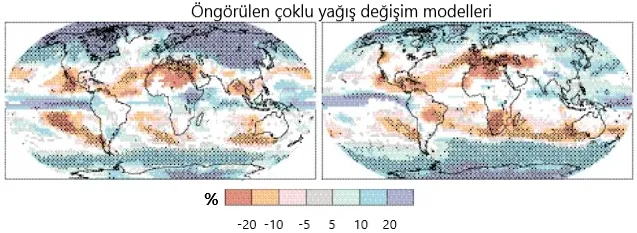
The change in soil water is closely related to the change in precipitation. In current studies, it is predicted that there may be decreases or increases in the amount of precipitation falling in different parts of the world due to climate change (Figure 2). Precipitation is projected to increase by 10% to 40% by mid-century in some high latitudes and some densely populated tropics, and decrease by 10% to 30% in some mid-latitudes arid regions. There is also a highly confident prediction that many semi-arid regions (for example, the Mediterranean Basin, the Western United States, South Africa, and Northeastern Brazil) will experience a reduction in water resources due to climate change. Increasing temperatures will also affect the characteristics of lakes and rivers and will have predominantly negative effects on water quality [3].
Climate Change and the Effects of Changing Precision Regimes on Soil Acidization
Soil pH indicates the alkalinity or acidity of the soil and is closely related to the fertility of the soil. The pH value of the soil solution is the pH value most closely related to the soil and plant biochemical processes. It is expected that there will be changes in soil mineral decomposition and, accordingly, in soil reaction, along with changes in increasing temperature and precipitation intensity due to climate change.
Increase in soil acidification can occur as a result of the production of more biomass due to increased temperatures and the increase in the partial pressure of CO2 in the air. If such plant material decomposes in situ, the alkalinity accumulated in this material returns to the soil, neutralizing the acidity. However, in cases where the produced biomass is harvested and removed from the field, the acidity cannot be neutralized and remains in the soil. On the other hand, increased CO2 partial pressure in soil air alone is unlikely to affect soil pH, since H2CO3 is a weak acid [4].
Evans et al. [5] used a dynamic model (the Basin Groundwater Acidification Model) and climate scenarios of increasing temperature and decreasing precipitation in their study in the UK to predict the effects of climate change on soil and water. They reported that high dissolved organic carbon and high organic acidity due to high temperature are expected to lower soil pH and increase leaching of basic cations into surface waters. Emphasizing the importance of using lime to control acidity in this type of agricultural soils, the researchers stated that soils with high clay and organic matter content are more resistant to pH increases and decreases, whereas sandy soils are more vulnerable to acidification. While it is not possible to change the clay content in the soil, it would be appropriate to take measures to increase the organic matter content.
Effects of Climate Change on Soil Salinity and Alkaline
Salinity is a condition that limits the water uptake of plants by reducing the osmotic potential. In addition, due to its special ion toxicity, it may cause the nutrient balance in plants to deteriorate. It is a very important feature in terms of soil health.
Some basic prerequisites are necessary for salt accumulation in soils. First of all, it needs to be a source of salt. Salts can come from different sources. They can be formed as a result of local weathering by dissolution of soluble compounds of certain rocks, minerals and other geological sediments. Surface and groundwater may contain salt. In addition, salt resources are added to the soil through some human activities such as irrigation, fertilization and the use of various wastes. It is possible to transport these salts to different areas by means of transport agents such as water and wind, and the movement of the solution in the presence of a driving force is also effective in salt transport. If there is a negative water balance in the soil, that is, evapotranspiration is higher than precipitation plus irrigation water, salinization may occur. Limited drainage conditions are also a factor that facilitates the formation of salinity [2].
The salt composition of soil water can be an important factor affecting soil permeability. In sodic soils, the soil structure deteriorates and permeability is greatly reduced. Also, salinization of the soil is considered to be the driving force of desertification [6].
Depending on climate change, possible higher temperatures and periodic rainy and dry periods will accelerate the decomposition of geological sediments, which are the main material of salts, and their dissolution and transport will increase. Thus, there will be the formation of soluble salts in the soil solution and their accumulation over time. In addition, the increased drought due to increasing temperatures and the excess food demand that will occur over time will cause an increase in the number of irrigated lands. This situation will cause soils to be affected by salts due to incorrect irrigation and fertilization practices as it is today [2].
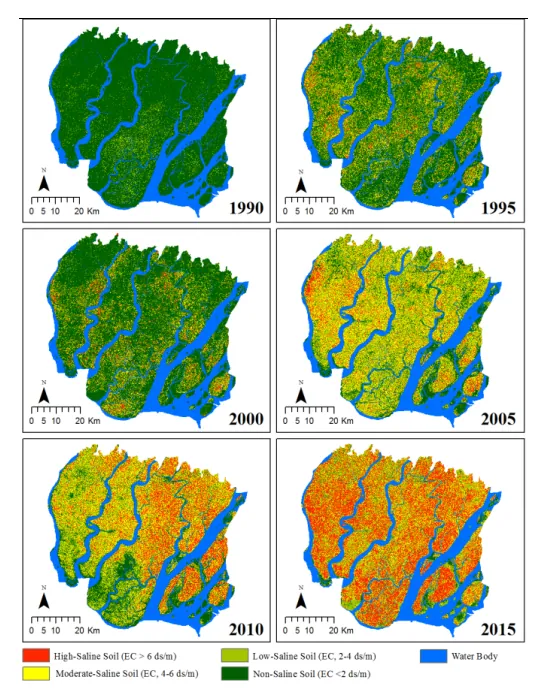
Too much or too little precipitation can have significant effects on soil salinity in the root zone. Groundwater rises due to excessive precipitation. If the ground water falls below two meters, the movement of water towards the surface will occur with capillarity. If there is not enough rainfall for these salts to leach from the root zone, salt deposits are seen on the soil surface during dry times. Similarly, in areas with drought, salt accumulation is possible with the movement of water with capillarity. Another example of drought that causes salinity accumulation in the root zone is the intrusion of water from an aquifer with saline water in the nearby region due to excessive water withdrawal from some wells. The decrease in water resources and the use of more wastewater in the future will cause an increase in the amount of salt in the root zone of the plant. Rising ocean levels due to melting glaciers due to global warming may result in more seawater intrusion [7]. Especially in case of direct salt water intrusion, great changes can be seen in soil salinity values in a very short time. In Figure 3 , the differences in the salt changes of the soils on the Bangladesh coast over a 25-year time period due to sea level rise are shown on the map [8].
Climate Change and Soil Structure
The particles in the soil coming together and clustered in groups form the soil structure. Structure is considered one of the important physical properties of soil due to its effects on water and gas movement. Soil structure, which is not static but dynamic, may change depending on soil properties.
Soil texture is a soil property that plays an important role in agricultural production. At the same time, the degree of erosion of the soil is closely related to the soil structure. It seems inevitable that there will be an interaction depending on climate change on the soil structure, which can be affected by environmental factors. However, the extent of these changes may vary depending on the magnitude of climate changes and soil structural fragility. As a result, the actual impact will be site and soil specific.
It is possible that with climate change, soils will sometimes be exposed to drought, and sometimes will face with more intense precipitation (Figure 4). Under these conditions, the soil becomes more prone to structural deterioration. As a result of climate change, it is expected that the soil structure will deteriorate as a result of cultivating the soil when it is too moist or too dry [9].
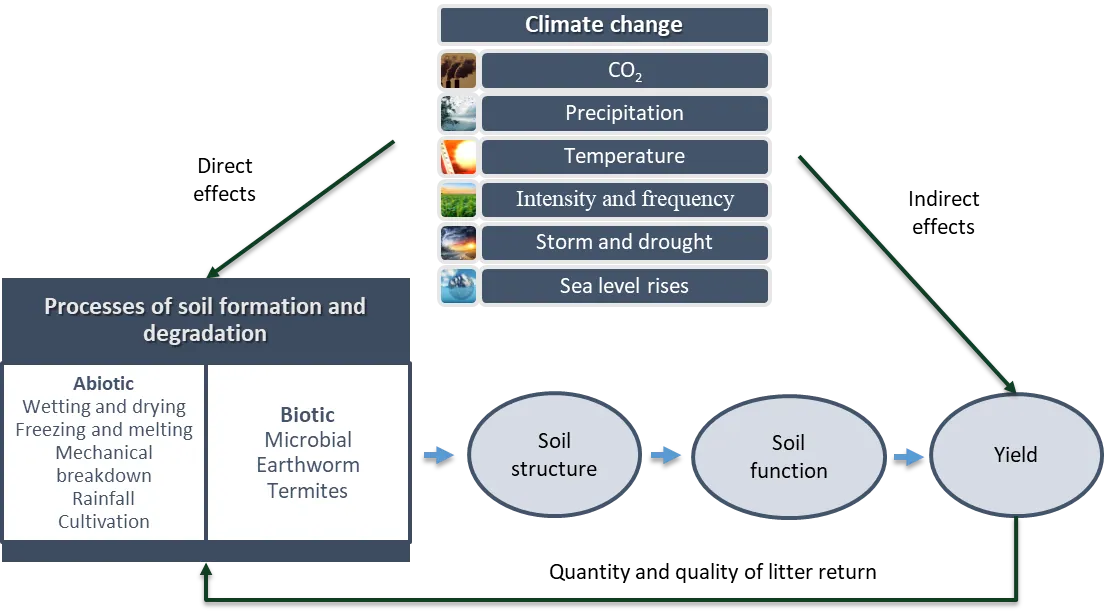
Climate change will trigger more fires and floods. Fire often reduces soil aggregate stability and can induce, increase or destroy the permeability of water depending on the temperature reached and its duration [10].
The effects of climate change on the soil fauna may indirectly affect the soil structure. Soil organisms, especially earthworms and termites, have important effects on the physical properties of the soil. In the absence of these organisms, strong profile differentiations may occur due to insufficient mixing of the soil [11].
Effects of Climate Change on Soil Fauna and Soil Flora
Soil fauna and flora, which are represented in very large numbers even in a very small area, are one of the most basic components of the soil, which is of vital importance for many activities in the soil. The soil is home to a wide variety of bacteria, fungi, and animal species, as well as many plants. Since the main function of these organisms is to recycle soil organic matter, they are absolutely essential for the functioning of terrestrial ecosystems.
It is expected that the changes that will occur in the soil habitat due to climate change will also affect the soil biota. In drought conditions, less microbial biomass is formed and less microbial activity occurs. In addition, extreme drought can also result in the death of some larger soil organisms. In cases where climate change increases the soil's susceptibility to erosion, soil biota may be affected due to erosion [12].
As a result of a study conducted to determine the effects of climate change on soil biota, it was reported that microbial biomass increased significantly due to the increased amount of CO2, but the number of bacteria was negatively affected by warming [13]. In the same study, it was stated that the mushroom biomass increased with increasing precipitation.
In the presence of high CO2, more plant growth occurs due to increased photosynthesis, which leads to increased carbon input into the soil, strongly changing the activity and density of soil biota [14].
CO2 concentrations increase in the atmosphere, although the rate of use of carbon by plants increases, this situation will be limited to the water and nutrients they can get from the soil [15]. In this case, plants that can coexist with mycorrhizae to obtain more water and nutrients may have an adaptive advantage in conditions where insufficient water and nutrients are available.
The Effects of Climate Change on Nitrogen Mineralization, Nitrification and Denitrification Events
There are various factors that limit nitrogen mineralization, which is the conversion of organic nitrogen into inorganic N forms in soils. In addition to the amount of organic matter in the soil, environmental factors related to climate have an important effect on nitrogen mineralization.
The mineralization rate, which remains very low in winter, when the temperature drops below 4°C, occurs in large amounts in late spring and summer [15]. Since increased summer droughts due to climate change will reduce the microorganism activities of the soil, nitrogen mineralization is expected to decrease in these conditions [16]. Since only anaerobic microorganisms can be active in soils with heavy precipitation conditions, oxygen deficiency in such soils limits N mineralization [17].
Nitrification and denitrification processes in soils are the most important processes in determining the inorganic nitrogen concentration. The conversion of ammonium to nitrate ions by some microorganisms in the soil is defined as nitrification. Nitrification is a reaction that requires oxygen.
Reduction of nitrate to free nitrogen gas (N2) after various processes. At the end of this process, there may be significant nitrogen losses from the soils to the atmosphere. Denitrification is a process that takes place in the presence of anaerobic organisms, and poor aeration in soils leads to favorable conditions.
Higher mineralization and denitrification due to increased temperature under climate change may result in greater N2O emissions from soils to the atmosphere [18]. Due to climate change in the future, higher amount and frequency of precipitation, which is likely to occur in some regions, will increase denitrification and, accordingly, N2O flow from the soil [19].
Climate Change and Soil Organic Matter
Soil organic matter, which regulates the physical, chemical and biological properties of the soil, is the main energy source of the soil and is one of the most important elements required for the preservation of soil fertility. Soil organic carbon refers to the carbon formed in organic matter and is the main component of organic matter.
Carbon dioxide levels in the atmosphere have increased by nearly 50% since the industrial revolution. It is reported that at high CO2 levels and especially in the presence of water and nitrogen in the soil, C3 plants perform photosynthesis at increasing rates and produce more biomass [20]. However, C4 plants rarely respond to high CO2 concentrations, even in the presence of high N [21].
It has been suggested that additional nitrogen provided through atmospheric nitrogen accumulation may promote plant growth. Additional nitrogen supply may not only increase the effect of high CO2 concentration on soil organic carbon, but also slow down the rate of organic matter decomposition in some ecosystems [20].
In general, the presence of water in soils together with increased precipitation, especially in areas where water is limited, contributes more significantly to the accumulation of soil organic carbon than temperature. [21]. In a climate change study conducted on this subject in which carbon dioxide, soil moisture and temperature were used as factors, it was reported that soil moisture had a more significant effect on soil organic carbon stock than high CO2 and temperature [22].
There are not many studies examining the changes in soil organic carbon stocks of climate change. In a 25-year study conducted in England and Wales, they reported that the annual loss of soil organic carbon was 0.6% and this was related to climate change [23]. In addition, in another study conducted in the United Kingdom, measurements were made over a period of more than 100 years and it was stated that there was no significant change in carbon stocks [24].
References
Karmakar R., Das I., Dutta D., & Rakshit A., (2016). Potential Effects of Climate Change on Soil Properties: A Review. Sci. Int., 4 (2): 51-73, 2016.
Varallyay, G., 2010. The impact of climate change on soils and on their water management. Agron. Res., 8: 385-396.
IPCC. (2007). Climate Change 2007: Synthesis Report. Contribution of Working Groups I, II and III to the Fourth Assessment Report of the Intergovernmental Panel on Climate Change [Core Writing Team, R. K. Pachauri, & A. Reisinger (Eds.)]. IPCC, Geneva, Switzerland, 104 pp.
Rengel Z. (2011), ‘Soil pH, soil health and climate change’, in B. P. Singh, A. L. Cowie, & K. Y. Chan (Eds.), Soil Health and Climate Change, Soil Biology vol.28, Springer-Verlag GmbH, Berlin, pp. 69–85. https://doi.org/10.1007/978-3-642-20256-8_4.
Evans C. D., Monteith D. T., & Cooper D. M. (2005). Long-term increases in surface water dissolved organic carbon: Observations, possible causes and environmental impacts. Environmental Pollution 137: 55-71.
D’Odorico, P., Bhattachan, A., Davis, K. F., Ravi, S. & Runyan, C. W. (2013). Global desertification: Drivers and feedbacks. Adv. Water Resour., 51, 326-344.
Corwin, D. L. (2020). Climate change impacts on soil salinity in agricultural areas. European Journal of Soil Science. 72(2):842-862.
Rahman, M. S., Di, L., Yu, E. G., Tang, J., Lin, L., Zhang, C., & Gaigalas, J. (2018). Impact of Climate Change on Soil Salinity: A Remote Sensing Based Investigation in Coastal Bangladesh. 2018 7th International Conference on Agro-Geoinformatics (Agro-Geoinformatics). https://doi.org/10.1109/agro-geoinformatics.2018.8476036.
Chan K. Y., (2011). Climate Change on Soil Structure and Soil Health: Impacts and Adaptation. in B. P. Singh, A. L. Cowie, & K. Y. Chan (Eds.), Soil Health and Climate Change, Soil Biology vol.28, Springer-Verlag GmbH, Berlin, pp. 49-68 https://doi.org/10.1007/978-3-642-20256-8_4.
Shakesby R. A., & Doerr S. H. (2006). Wildfire as a hydrological and geomorphological agent. Earth Sci Rev 74:269–307.
Lavelle P., Bignell D., Lepage M., Wolters V., Roger P., Ineson P., Heal O. W., & Dhillion S. (1997). Soil function in a changing world: the role of invertebrate ecosystem engineers. Eur J Soil Sci 33:159–193.
Nearing, M. A., Pruski F. F., & O'Neal M. R., (2004). Expected climate change impacts on soil erosion rates: A review. J. Soil Water Conserv., 59: 43-50.
Blankinship J., Niklaus P., & Hungate B. (2011). A meta-analysis of responses of soil biota to global change. Oecologia 165:553-565.
Phillips R. P., Meier I. C., Bernhardt E. S., Grandy A. S., Wickings K., & Finzi A. C. (2012). Roots and fungi accelerate carbon and nitrogen cycling in forests exposed to elevated CO2. Ecology Letters 15:1042-1049.
Defra (2011). Evaluation of the Occurrence of Soils with pH Higher than 8.3 Observed Within the Countryside Survey.
Borken W., & Matzner E. (2009). Reappraisal of drying and wetting effects on C and N mineralization and fluxes in soils. Global Change Biology 15:808-824.
Deenik J. (2006). Nitrogen Mineralization Potential in Important Agricultural Soils of Hawai‘i. Soil and Crop Management SCM-15.
Abdalla, M., Jones M., & Williams, M. (2010). Simulation of nitrous oxide emissions from Irish arable soils: effects of climate change and management. Biology and Fertility of Soils 46:247-260.
Dobbie K. E., & Smith K. A. (2001). The effects of temperature, water filled pore space and land use on N2O emissions from an imperfectly drained gleysol. European Journal of Soil Science 52: 667-673.
Dalal R. C., Allen D. E., Chan K. Y., & Singh B. P. (2011). Soil Organic Matter, Soil Health and Climate Change. in B. P. Singh, A. L. Cowie, & K. Y. Chan (Eds.), Soil Health and Climate Change, Soil Biology vol.28, Springer-Verlag GmbH, Berlin, pp. 87-106 https://doi.org/10.1007/978-3-642-20256-8_4
Hungate B. A., Hart S. C., Selmants P. C., Boyle S. I., & Gehring C. A. (2007) Soil responses to management, increased precipitation, and added nitrogen in ponderosa pine forests. Ecol Appl 17:1352–1365.
Garten Jr. C. T., Classen A. T., & Norby R. J. (2009). Soil moisture surpasses elevated CO2 and temperature as a control on soil carbon dynamics in a multi-factor climate change experiment. Plant Soil 319:85–94.
Bellamy P. H., Loveland P. J., Bradley R. I., Murray Lark R., & Kirk G. (2005). Carbon losses from all soils across England and Wales 1978–2003. Nature 437:245–248.
Hopkins D. W., Waite I. S. , McNicol J. W., Poulton P. R., MacDonald A. J., & O’Donnell A. G. (2009). Soil organic carbon contents in long-term experimental grassland plots in the UK (Palace Leas and Park Grass) have not changed consistently in recent years. Glob Change Biol 15:1739–1754.