
Module 2 · Chapter 6
Effects of lime applications on greenhouse gas emissions
Soil-improving materials are widely used in the world to increase the yield in agricultural production in soils with acid reaction. In the use of these materials, it is mainly aimed to reduce the acidity of the soil and increase the availability of plant nutrients. In this way, soil fertility is increased and as a result, product yield and quality are improved. The most preferred method for this purpose worldwide is liming of agricultural soils.
Effect of Soil Reaction on Plant Growth
There are many factors that affect the uptake of plant nutrients in the soil by plants. Among these factors, soil reaction is one of the most important. Plants generally need to maintain soil pH. If it is close to neutral reaction, they can make optimum use of plant nutrients. However, acid or alkaline pH increases in the soil solution significantly reduce the solubility of some plant nutrients.
Soil acidity is a term used to express the amount of hydrogen (H) and aluminum (Al) ions in soils. The increase in the amount of hydrogen or aluminum ions means the acidification of the soil and the negatively charged cation exchange capacity (CEC) of the soil will be constrained. This is a detrimental situation for the root growth and normal development of plants. Soil pH is an indicator of "soil acidity" (Figure 1). A pH value of 7.0 is defined as neutral, while below this value is defined as acidic and above it as alkaline. Small changes in pH figures for soil indicate large differences in soil acidity. For example, a soil with a pH of 5 is 100 times more acidic than a soil with a pH of 7 [1].
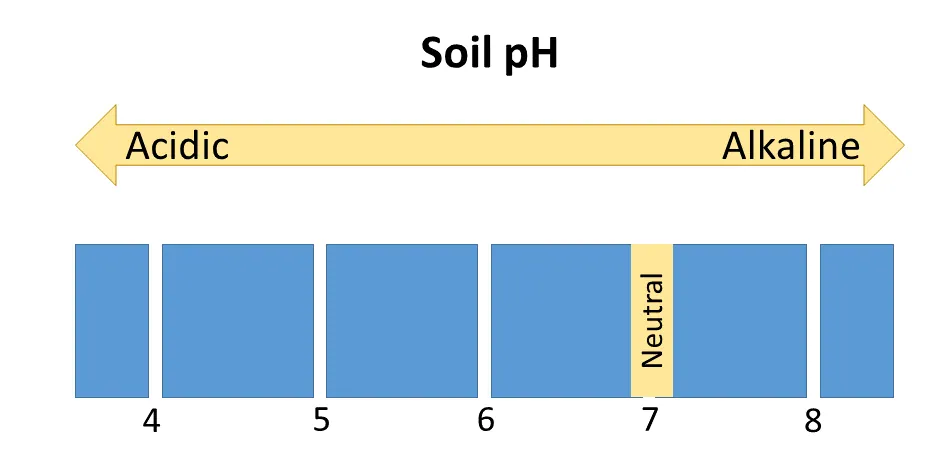
Soils may be acidic during their formation, or they may show acidic properties under the influence of environmental factors. In areas with heavy rainfall, soil acidity increases in cases such as the washing of alkaline ions such as calcium and magnesium in the soil or the continuous use of physiological acidic fertilizers in plant production.
Soil acidity can have negative effects on plant growth in different ways. However, depending on the increase in acidity, the decrease in the intake of some plant nutrients or the effects of toxic ions can be considered as the most important problem. While deficiencies of some nutrients such as phosphorus and molybdenum calcium are observed in acid soils due to the decrease in solubility, ions such as aluminum, manganese and hydrogen can reach levels that can cause toxicity [2].
Acidity is an important factor limiting crop yield in soils and approximately four billion hectares of land in the world is acidic [3]. In an economic analysis, it has been reported that there is a loss of 1.6 Australian dollars per year due to the loss of production in grain cultivation due to acidity [4].
Soils are acidified as a result of the release of protons during nitrification and subsequent leaching of nitrates after nitrogen fertilizer applications or the release of reduced N compounds to natural ecosystems [5]. In the People's Republic of China, it has been reported that as a result of excessive use of nitrogen fertilizers, especially in the form of urea, the pH of the soil decreases in the range of 0.13-0.80 units, depending on the soil properties, and accordingly, the cultivated lands are significantly acidified [6]. It is stated that almost half of the arable land in the world is acidic and these areas are increasing gradually [7].
Liming Applications in Agricultural Soils
In acidic soils, liming is the most commonly used method to neutralize the soil. Liming materials commonly used in deacidification are calcium compounds such as limestone, slaked and quicklime, and dolomite [8]. While calcium cannot increase soil pH when used alone, basic cations in liming materials can be neutralized by hydrogen ions in acid soils [9].
Liming is an important cultural practice that increases productivity in agricultural production by removing acidity in the soil. If done correctly, it provides important benefits in plant production, some of these benefits are as follows [1]:
Show better root development as they will be exposed to less aluminum toxicity.
Depending on the material used in liming, plant nutrients such as calcium and magnesium are added to the soil.
As the solubility of nutrients will increase depending on the increase in soil pH with the application, nutrient uptake through plant roots increases.
With liming, the cation exchange capacity (CEC) of soils increases and this prevents the loss of basic cations, especially potassium, by washing.
Nodule formation in legumes will be supported, an increase in biological nitrogen fixation is observed.
As some herbicides will be easier to break down at optimal soil pH risk of damage to plants during crop rotations will be prevented. Some nematicides work more effectively in liming areas.
Depending on the soil properties, the amount of lime to be given varies. The amount of lime that will neutralize the total acidity in order to ensure optimum plant growth in the soil is expressed as the lime requirement of that soil [10]. Although plants generally show good growth at near neutral pH values, it should be noted that the optimum pH requirement is not the same for all plants. For this reason, the optimum pH demand of the plant grown should be known in addition to the soil properties while liming. It is always possible to see different nutritional problems in case of applying more lime than necessary. Optimum pH requirements of some plants are given in Table 1.
Table 1. Optimum pH demands of some cultivated plants [1].
| Herb | Target pH for liming |
|---|---|
| Sweetcorn | 6.0 |
| Soy | 6.0 |
| Cotton | 6.2 |
| Asparagus | 6.5 |
| Bean | 6.0 |
| Tomatoes | 6.5 |
| Clover | 6.5 |
| Apple | 6.5 |
| Strawberry | 6.0 |
| Fir | 5.5 |
| Blueberries | 4.5 |
In general, liming materials are of two different types. The first group, called calcitic limestone, includes calcium carbonate (CaCO3), calcium hydroxide [Ca(OH)2] or calcium oxide (CaO). Dolomitic limestone [CaMg(CO3)2], which contains a significant amount of magnesium along with calcium, is classified as the second type.
The Effect of Lime Applications in Soils on Greenhouse Gas Emissions
Neutralization in acid soils also has some environmental effects. These effects may differ depending on many variables. CO2 and N2O gases, which are greenhouse gases that cause global warming are more affected by liming applications than CH4. These effects have been tried to be summarized under the following headings.
The Effects of Liming on Carbon Dioxide Release in Soils
Soil degradation has become a major threat on a global scale in recent years. Soil fertility is tried to be increased by using remedial agents such as lime, sulfur, gypsum and various organic compounds in order to improve the soil as a result of deterioration in the soil. While this situation provides improvements on the one hand, it may cause us to encounter different environmental problems on the other hand. The effect of lime and liming on carbon stock has been an issue that has gained importance in recent years.
In general, the effect of liming on carbon concentration in soils varies with environmental characteristics and soil structure. In a study examining the effects of long-term lime applications on the soil carbon content in grasslands, it was stated that a higher rate of organic carbon accumulation was observed in calcareous soils than in non-calcareous soils [11]. The reason for this is explained by the increase in carbon inputs due to increased biomass and biological activity.
Depending on the application of lime on acid soils, increases in the amount of atmospheric CO2 can be observed [12]. This situation has been tried to be explained by the equation shown below:
CaCO 3 + 2H + Ca +2 + CO 2 + H 2 O
Calcium (Ca2+) and bicarbonate (HCO3-) ion concentrations in the exchange complex increase. As a result, Al3+ ions are replaced by Ca2+ ions and an increase in soil pH occurs due to the decrease in the acid hydrolysis of aluminum. In the meantime, carbon dioxide (CO2) and water (H2O) are released when the bicarbonate (HCO3-) ions that are formed react with the H+ ions present in the soil. As a result of these processes, H+ causes acidity in the soil. As the concentration decreases, conditions that hinder plant growth such as toxicity caused by Al3+ ions and Ca2+ deficiency are partially eliminated [13].
As a result, with the application of lime to agricultural soils, some of the carbonate in these materials is released into the atmosphere as CO2. Agricultural lime can be applied as calcite (CaCO3) or dolomite (MgCa(CO3)2). In an analysis to calculate the contribution of agricultural lime to carbon dioxide emissions in the United States, it was stated that net CO2 emissions from agricultural lime applications were 0.059 Mg C for 1 Mg calcite and 0.064 Mg C for 1 Mg dolomite [14]. While the researchers reported that these rates did not match the emission factors given by the IPCC as 0.12 for calcite and 0.13 for dolomite, respectively, they reported annual emissions of 4.4-4.6 Tg CO2 for the USA, depending on agricultural lime applications.
It is stated that CO2 released into the atmosphere due to calcite and dolomite applications in the USA constitutes 1.7% of total agricultural greenhouse gas emissions and 0.13% of total greenhouse gas emissions [15].
In a study conducted in Brazil to calculate the CO2 emissions due to liming of agricultural lands, it was reported that the amount of emissions between 1990 and 2000 ranged between 4.9-9.4 Tg per year, with an average of 7.2 Tg [16].
What needs to be done to reduce greenhouse gas emissions from liming is the application of oxides such as quicklime (CaO) or slaked lime (Ca(OH)2) instead of carbonate-containing materials [17].
Nitrous Oxide Release in Acid Soils
Globally, acid soils make up the majority of arable land, and plant growth is limited as acidity increases. The method used in this type of soil is usually liming of the soil. Liming increases the pH and accordingly increases the productivity of the soil. In addition, it also affects greenhouse gas emissions depending on the soil carbon content and the cycle of elements. In a meta-analysis examining the effects of liming on greenhouse gas flows, over 1500 observations reported in the results of 121 studies were evaluated and their results were shared [18]. According to the data evaluated in the study, the effect of liming on the yield increase in products was 36% and positive. The rate of increase in soil organic carbon stocks was 4.5% annually. There was a 21.3% reduction in N2O emission from soils due to lime applications. On the other hand, in the paddy fields, there was a 19% decrease in the release of CH4 by liming. According to the data obtained by the researchers, the greenhouse gas budget of soils with acid reaction with regular calcification applications was as follows: Annually, 0.60-0.67 Tg reduction in N2O emission from soils and 1.75-2.21 Tg reduction in CH4 emissions in rice fields, while the organic carbon stocks was estimated to increase between 66-110 Tg. However, it has been stated that the CO2 emission due to calcification will occur between 624-656 Tg values annually. According to these results, it is stated that the greenhouse gas balance will be neutral, and it is emphasized that liming will provide a potential benefit globally depending on the yield increases.
It was stated that nitrogen loss and N2O emissions to the atmosphere by liming decreased, but direct CO2 emissions due to liming increased [19]. In the study, it was stated that the greenhouse gas emissions from liming are approximately four times higher than the amount saved by reducing N2O emissions.
Despite the addition of liming materials for the improvement of acidic soils, the effects of changes in soil pH with the addition of these materials on N2O emission have not been fully demonstrated [20]. For this purpose, the researchers investigated the possible effects of four different liming materials on N2O release in a soil with a pH of 5.35. In the study, dolomite - CaMg(CO3)2, calcite - CaCO3, calcium hydroxide-Ca(OH)2 and calcium oxide - CaO were used as liming materials, and as a result of all applications, a decrease in N2O release was observed. Compared to other applications, the highest decrease in N2O release was obtained in Ca(OH)2 application and this was associated with a higher pH increase. According to the results obtained, it was emphasized that the soil pH was more effective than the C and N dynamics of the soil in the reduction of N2O release.
In a study conducted to reveal the effects of greenhouse gas emissions in no-till farming and lime applied areas, N2O and CH4 emissions have been observed from an acidic soil with insufficient drainage. [21]. According to the results of the study while liming, N2O emissions decreased by 61% in the areas where conventional farming practices were applied, no effect was observed in the areas where no tillage was applied. According to the results of the researchers, no-till agriculture can improve the physical properties of the soil and at the same time, they emphasized that it is an important tool to reduce emissions of N2O and CH4.
The N2O emission increases with the application of nitrogen fertilizers during plant development in semi-arid regions following summer rains; a study was conducted to determine the change of these emissions with the application of lime in these regions [22]. For this purpose, one year before the experiment, the pH was increased by applying lime and soil with two different pH (4.21 and 6.34) was formed. In the study, N2O emissions changed from 0 when the soil was dry to 0.065 µg N2ON g dry soil-1 hour-1 after the soil was wet, and this situation was associated with denitrification and nitrification. Increasing soil pH reduced N2O emissions only when losses were associated with nitrification. Researchers have proposed to increase soil pH by liming in order to reduce N2O emissions in semi-arid soils with acidic properties, where the releases originate from nitrification.
Moreover, the net effect of soil pH on N2O emissions is often difficult to estimate [23] and may vary depending on the emission source [24]. According to the results obtained in a study examining the possible effects of liming on N2O emission in a soil with acidic properties, cumulative N2O emissions during denitrification reached very high values compared to nitrification conditions [25]. According to the results of the study, N2O emission during denitrification increased significantly with increasing soil pH.
Biochar Applications on Greenhouse Gas Emissions
Organic compounds that are rich in carbon, resistant to decomposition and have a porous structure obtained by thermo-chemical transformation of biomass under high temperature, oxygen-free or limited oxygen conditions are defined as biochar.
As the produced biochars are mostly alkaline, the studies carried out to date were mostly on acidic soils. It has been the subject of many researches because it causes an increase in the availability of nutrients by increasing the pH of the soil when applied as in liming [26].
Biochar, which has become increasingly popular as a soil conditioner in recent years, will make a significant contribution to the reduction of global warming because it keeps the atmospheric carbon in the soil. However, studies have shown that the effects of biochar applications may vary according to soil, plant and other environmental factors. For example, in a study examining the effects of biochar applications on yield and greenhouse gas emissions in two different areas of paddy and wheat farming, the application of biochar increased the release of CH4 by 37% during the development period in the field of rice production, while the addition of biochar in wheat did not affect the release of CH4 [18]. In addition, depending on the biochar application, N2O emissions decreased by 54% and 53% for rice and wheat, respectively, while the rates of increase in yield were realized as 12% and 17%.
It is possible to come across many studies examining the effects of biochar applications on soil greenhouse gas emissions. In a meta-analysis conducted for this purpose, the effects of biochar applications on CO2, CH4 and N2O emissions were tried to be evaluated based on the results of 91 articles made around the world [27]. According to the results of the study, it was reported that while the soil CO2 emissions increased by 22% depending on the biochar applications, there was a 31% decrease in the N2O emission. However, biochar applications did not show any effect on CH4 emission in soil.
References
Crozier, C., & Hardy D. (2018). Soil Acidity and Liming: Basic Information for Farmers and Gardeners. NC State Extension Publications. https://content.ces.ncsu.edu/soil-acidity-and-liming-basic-information-for-farmers-and-gardeners#section_heading_7189 (Access date: 05.07.2023).
Robson, A. (Ed.). (2012). Soil acidity and plant growth. elsevier
Baligar , VC, Fageria , NK, & He, ZL, (2001). Nutrient use efficiency in plants. Commun . Soil Sci. Plant Anal. 32, 921–950.
Petersen, E., (2015). Economic Analysis of the Impacts and Management of Subsoil Constraints. Report for the Grains Research and Development Corporation Funded Project: DAW00242 Subsoil Constraints-Understanding and Management. Department of Primary Industries and Regional Development, Western Australia. https://agric.wa.gov.au/n/5226 (accessed 7 July 2023).
Wang, Y., Yao, Z., Zhan, Y., Zheng, X., Zhou, M., Yan, G., … Butterbach‐Bahl , K. (2021). Potential benefits of liming to acid soils on climate change mitigation and food security. Global Change Biology, 27(12), 2807–2821. doi:10.1111/gcb.15607
Guo , J., Liu, X., Zhang, Y., Shen, J., Han, W., Zhang, W., Christie, P., Goulding, KWT, Vitousek, PM, & Zhang, F. ( 2010 ). Significant acidification in major Chinese croplands significant acidification in major Chinese croplands. Science, 327, 1008–1010. https://doi.org/10.1126/science.1182570
Dai, Z., Zhang, X., Tang, C., Muhammad, N., Wu, J., Brookes, PC, & Xu, J. (2017). Potential role of biochars in decreasing soil acidification – A critical review. Science of the Total Environment, 581–582, 601–611. https://doi.org/10.1016/j.scitotenv.2016.12.169
Özyazıcı G., Özdemir O., Özer SP, & Kalcıoğlu Z., (2014). calcification material Aspect Used Sugar Industry waste slam Tea of the plant Yield , Quality and Soil What properties effect . Turk J Agric Res (2014) 1: 43-54 TUTAD ISSN: 2148-2306.
Anderson, NP., Hart, JM., Sullivan, DM., Christensen, NW., Horneck, DA. & Pirelli, GJ. (2013). Applying lime to raise soil ph for crop production (Western Oregon).
Kacar , B. (1984). Herb feeding . Ankara University . Agriculture fac . Arrow. No: 899, p. 169-175.
Fornara , DA, Steinbeiss , S., McNamara, NP, Gleixner , G., Oakley, S., Poulton , PR, … Bardgett , RD (2011). Increases in soil organic carbon sequestration can reduce the global warming potential of long-term liming to permanent grassland. Global Change Biology, 17(8), 2762–2762. doi:10.1111/j.1365-2486.2011.02445.x
Majumder , SP, Krishna Chaitanya, A., Datta , A., Padhan , D., Badole , S., & Mandal, B. (2018). Dynamics of Carbon and Nitrogen in Agricultural Soils: Role of Organic and Inorganic Sources. Soil Management and Climate Change, 151–169. doi:10.1016/b978-0-12-812128-3.00011-2
Kalkhoran , SS, Pannell, DJ, Thamo , T., White, B., & Polyakov , M. (2019). Soil acidity, lime application, nitrogen fertility, and greenhouse gas emissions: Optimizing their joint economic management. Agricultural Systems, 176, 102684. doi:10.1016/j.agsy.2019.10268
West, TO, & McBride, AC (2005). The contribution of agricultural lime to carbon dioxide emissions in the United States: dissolution, transport, and net emissions. Agriculture, Ecosystems & Environment, 108(2), 145–154. doi:10.1016/j.agee.2005.01.002
EPA, 2004. Inventory of US Greenhouse Gas Emissions and Sinks: 1990–2002, EPA 430-R-04-003. US Environmental Protection Agency, Washington, DC.
Bernoux , M., Volkoff , B., Carvalho , M. also CS, & Cerri , CC (2003). CO2emissions from liming of agricultural soils in Brazil. Global Biogeochemical Cycles, 17(2), n/a–n/a. doi:10.1029/2001gb001848
Kayıkçıoğlu , HH, & Okur , N., (2012). greenhouse gas in the release agriculture role . Adnan Menderes University . zir . fac . Magazine , 9(2): 25-38
Wang, J., Pan, X., Liu, Y :, Zhang, X. & Xiong , Z., (2012). Effects of biochar amendment in two soils on greenhouse gas emissions and crop production. Plant and Soil volume 360, pages287–298 (2012)
Gibbons, JM, Williamson, JC, Williams, AP, Withers, PJA, Hockley, N., Harris, IM, … Healey, JR (2014). Sustainable nutrient management at field, farm and regional level: Soil testing, nutrient budgets and the trade-off between lime application and greenhouse gas emissions. Agriculture, Ecosystems & Environment, 188, 48–56. doi:10.1016/j.agee.2014.02.016
Shaaban , M., Wu, Y., Wu, L., Hu, R., Younas , A., Nunez-Delgado, A., … Jiang, Y. (2020). The Effects of pH Change through Liming on Soil N2O Emissions. Processes, 8(6), 702. doi:10.3390/pr8060702
García -Marco, S., Abalos , D., Espejo , R., Vallejo, A., & Mariscal -Sancho, I. (2016). No tillage and liming reduce greenhouse gas emissions from poorly drained agricultural soils in Mediterranean regions. Science of The Total Environment, 566, 512-520.
Barton, L., Gleeson, DB, Maccarone , LD, Zúñiga , LP, & Murphy, DV (2013). Is liming soil a strategy for mitigating nitrous oxide emissions from semi-arid soils ?. Soil Biology and Biochemistry, 62, 28-35.
Page, KL, Allen, DE, Dalal , RC, Slattery, W., (2009). Processes and magnitude of CO2, CH4, and N2O fluxes from liming of acidic Australian soils: a review. Australian Journal of Soil Research 47, 747e762.
Clough, TJ, Kelliher , FM, Sherlock, RR, Ford, CD, 2004. Lime and soil moisture effects on nitrous oxide emissions from a urine patch. Soil Science Society of America Journal 68, 1600e1609.
Feng, K., Yan, F., Hütsch , BW, & Schubert, S. (2003). Nitrous oxide emission as affected by liming an acidic mineral soil used for arable agriculture. Nutrient Cycling in Agroecosystems, 67, 283-292.
Gunal , M, Erdem , H., (2018). Biochar ; Definition , Usage and Agriculture in their land Effects . ADÜ ZİRAAT JOURNAL, 2018;15(2):87-93 — doi : 10.25308/aduziraat.405858
He, Y., Zhou, X., Jiang, L., Li, M., Du, Z., Zhou, G., … Xu, C. (2016). Effects of biochar application on soil greenhouse gas fluxes: a meta-analysis. GCB Bioenergy, 9(4), 743–755. doi:10.1111/gcbb.12376