
Module 2 · Chapter 8
Fight against deforestation, desertification and erosion
Climate change is one of the most important global environmental problems today. Due to the increase in greenhouse gas rates in the Earth's atmosphere, average surface temperatures are increasing and this may cause environmental disasters. However, in parallel with the great increase in human population, it causes forests, pasture areas and agricultural areas to gradually decrease.
Deforestation, desertification and erosion are among the most important environmental problems we face today. These interact with climate change and have triggering effects on each other. Although the size of these problems increases due to the effects of climate change, it is vital to prevent deforestation, desertification and erosion in order to prevent climate change.
Deforestation
Global Forest Resources Assessment (FRA) report is being prepared every five years by FAO. According to the latest report prepared and published in 2020, the total of forest areas around the world is 4.06 billion hectares [ 1 ] . This corresponds to one third of the total land area. 20% of the world's forests are located in the Russian Federation, followed by Brazil, Canada, the United States and China (Figure 1).
Figure 1. Forest areas by country [1].
Although the forest area per capita in the world is 0.52 ha, forests are not evenly distributed around the world. The largest share consists of forests located in tropical regions, with a rate of 45%. This is followed by boreal forests with 27%, forests in temperate regions with 17% and subtropical forests with 11% (Figure 2).
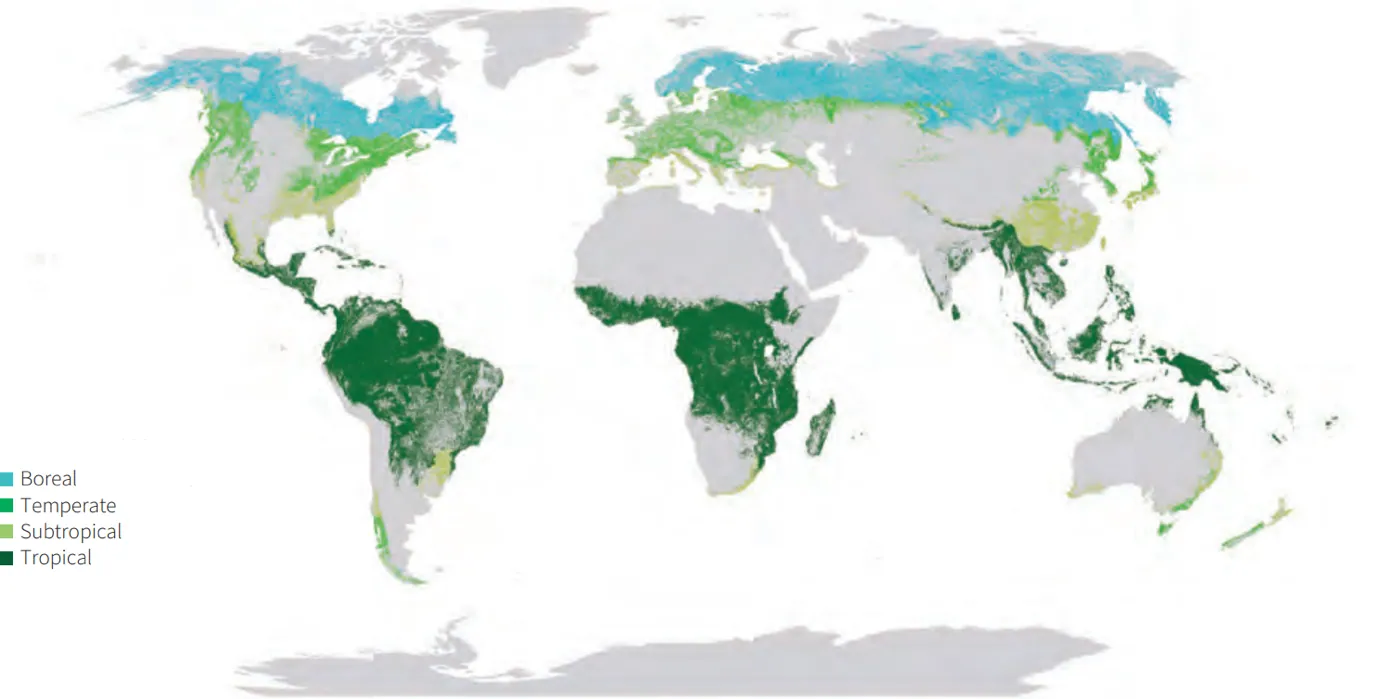
After humans settled down, there has been a continuous decrease of forest areas around the world. It is estimated that 10 thousand years ago there was 6 billion hectares of forest area worldwide [2]. The amount of decrease in forests in the recent past is even higher. This situation has led to the emergence of the concept called deforestation. According to FAO, deforestation is considered as the conversion of forest to other land uses (agricultural land, pasture, settlement, etc.).
The net amount of forest lost worldwide in the last thirty years, after deducting the renewed areas, was 178 million hectares. While this loss rate was 7.8 million hectares annually between 1990 and 2000, it decreased to 5.2 million and 4.7 million hectares respectively, in the other ten-year periods (Figure 3).
Figure 3. Annual average net change in forest areas over the ten-year period between 1990 and 2020 [1]
Although the clear changes seen in forest areas are seen as a decrease in some regions, there are areas where an increase is seen due to afforestation and protection measures. The change, which manifested itself as a decrease in Africa and South America, was seen as an increase in the Asian and European continents (Figure 4).
Figure 4. Annual average net change in forest areas according to regions and periods [1]
The ten countries with the highest increase and decrease in forest areas on a country basis are given in Table 1. Accordingly, while China was the country that increased its forest assets the most, with an area of approximately 2 million hectares annually, the opposite situation occurred in Brazil, with a forest loss of approximately 1.5 million hectares.
Table 1. Countries in terms of annual average net gain and loss in forest areas between 2010 and 2020 [1].
| No. | INCREASE | DECREASE | ||||
|---|---|---|---|---|---|---|
| Countries | Annual net change | Countries | Annual net change | |||
| 1000 ha.year⁻¹ | % | 1000 ha.year⁻¹ | % | |||
| 1 | Chinese | 1,937 | 0.93 | Brazil | -1,496 | -0.30 |
| 2 | Australia | 446 | 0.34 | Congo | -1101 | -0.83 |
| 3 | India | 266 | 0.38 | Indonesia | -753 | -0.78 |
| 4 | Chile | 149 | 0.85 | Angola | -555 | -0.80 |
| 5 | Vietnamese | 126 | 0.90 | Tanzania | -421 | -0.88 |
| 6 | Türkiye | 114 | 0.53 | Paraguay | -347 | -1.93 |
| 7 | USA | 108 | 0.03 | Myanmar | -290 | -0.96 |
| 8 | France | 83 | 0.50 | Cambodia | -252 | -2.68 |
| 9 | Italy | 54 | 0.58 | Bolivia | -225 | -0.43 |
| 10 | Romania | 41 | 0.62 | mozambique | -223 | -0.59 |
Forests, which are one of the most important carbon pools in the terrestrial ecosystem, undertake an important task by taking carbon dioxide from the atmosphere and keeping it in these pools. Carbon can be stored in living and dead tissues in forests, and a significant amount is also retained in forest soil. The total forest carbon stock on a global scale is estimated to be 662 million tons (Table 2). The largest part of it is stored in forests in the American continent.
Table 2. Forest carbon stocks by continents [1]
| COUNTRIES | Forest carbon stock (million tons) | |||
|---|---|---|---|---|
| 1990 | 2000 | 2010 | 2020 | |
| Africa | 94,274 | 90,137 | 85,913 | 80,886 |
| Asia | 77,093 | 78,564 | 81,938 | 84,733 |
| Europe | 158,744 | 162,457 | 168,069 | 172,442 |
| America | 304,949 | 299,048 | 293,489 | 290,964 |
| Oceania | 33,338 | 33,111 | 33,077 | 33,063 |
| TOTAL | 668,399 | 663,316 | 662,485 | 662,088 |
44.48% of the carbon stored in forests is in living biomass, 45.24% is in soil organic matter. The remaining part is located in the dead wood and the cover layer on the soil (Figure, 5).
Figure 5. Forest carbon stock in carbon pools, 2020 [1]
Carbon sequestration in the forest ecosystem occurs through photosynthesis. CO2 taken from the atmosphere by plants is primarily bound in the form of carbohydrates and then converted into other organic compounds [3].
The carbon stored in plants either mixes with the litter on the soil or returns to the atmosphere through the respiration of animals that consume these plants. While the CO2 released as a result of the decomposition of organic matter in the litter returns to the atmosphere, some of these decomposition products leak into the soil and mix. As a result, it becomes possible to store organic carbon in the soil [4].
With the addition of all kinds of dead organisms, the carbon accumulated in the sub-forest soil continues to decompose in the soil with the help of soil creatures such as bacteria and fungi. As a result of decomposition, some of the carbon returns to the atmosphere in the form of CO2. This phenomenon is called soil respiration. If forest areas are converted into agricultural lands, the amount of carbon stored in the soil decreases. The main reason for this is the disappearance of the organic matter source with the destruction of the soil cover, faster organic matter decomposition as a result of soil processing and the transportation of topsoil containing high organic carbon, which becomes vulnerable to erosion [5].
It is obvious that climate change, which occurs due to the increase in greenhouse gases in the atmosphere, is one of the biggest threats faced by the world. Forest ecosystems are one of the most important tools for reducing CO2 in the atmosphere, with their high carbon storage potential in both soil and biomass. Capturing existing greenhouse gases as well as reducing greenhouse gas emissions into the atmosphere is an important approach to reduce the effects of climate change. Because;
To take measures to protect forest assets on a global scale,
To make degraded forest areas productive,
To prevent clearcutting,
To prevent construction and opening of agricultural areas in forest lands,
To prevent damage from illegal cuttings and grazing,
Measures such as afforestation in suitable areas are vital for a more livable world.
Desertification
Desertification is defined in the United Nations Convention to Combat Desertification (UNCCD) as land degradation caused by the complex interactions between physical, biological, political, social, cultural and economic factors, including climatic changes and human activities, in countries affected by severe drought and/or desertification in arid, semi-arid and dry sub-humid areas.
Degradation of soil which can be seen everywhere, is considered desertification if it occurs in arid, semi-arid and dry sub-humid lands. Desertification occurs more frequently and its impact is greater in environments where total precipitation is low, there is insufficient water resources, long and recurring drought events happen, and there are thin soil layers, covered with sparse and sensitive vegetation. Factors linked to climate change may lead to an increase in the vulnerability of land to desertification and an acceleration of desertification processes [6].
Desertification is not limited to irreversible forms of land degradation; It represents all forms and levels of land degradation occurring in drylands. The aridity index (AI) is usually taken into account in the classification of drylands (Figure 6). When calculating the drought index, the ratio of the annual average precipitation amount to the evapotranspiration amount is used. According to estimates, the proportion of dry areas on a global scale is estimated to be around 46% [7]. Arid climate is a long-term climate feature characterized by low average precipitation and is different from drought, which is a temporary climate feature. Extremely dry areas with a drought index below 0.05 are excluded from the definition of desertification [8].
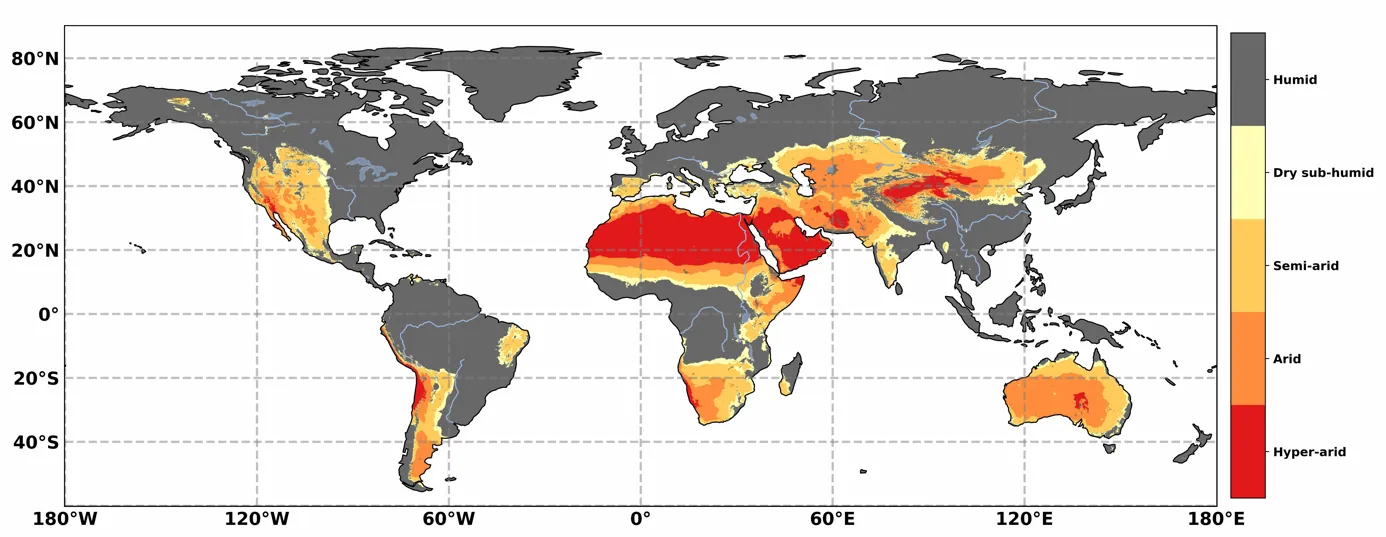
Today, many countries in the world face the danger of desertification. The United Nations Environment Program (UNEP) estimates the global cost of desertification at 42 billion dollars annually. About 70% of the world's dry areas are located in Africa and Asia (Figure 7). Apart from deserts, the largest land use on drylands is grassland, followed by forests and croplands [7].
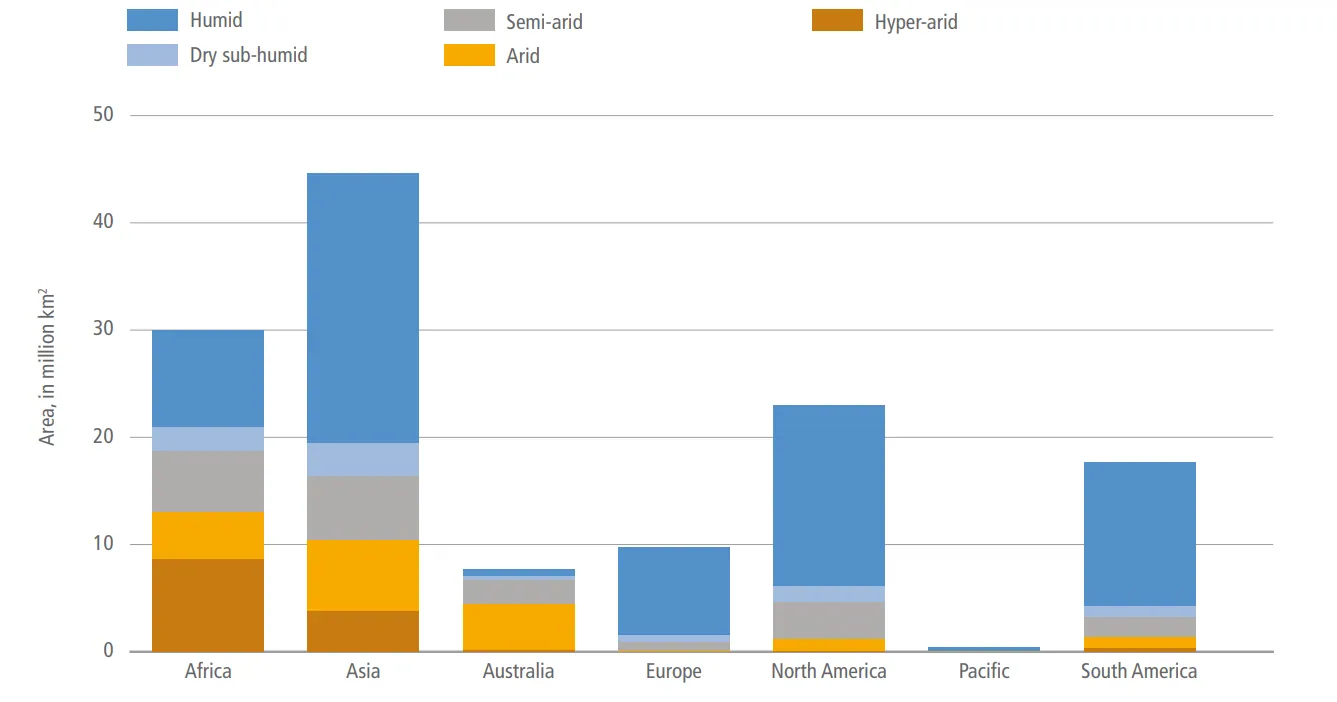
While climate change is considered a factor that triggers desertification, it is possible that desertification can also cause a change in the local climate. The change that occurs locally as a result of this mutual interaction contributes to global climate change by increasing the atmospheric CO2 level [10].
Interactions between climate change and land degradation and precipitation remain inextricably linked. Water resources in the world change depending on the climate. Water availability is predicted to increase by 10-40 % in high latitudes and some humid tropics, while it will decrease by 10-30% in mid-latitudes and dry tropics. Changes in meteorological events such as temperature, precipitation and wind can exacerbate desertification [11].
The most important environmental and sociological effects of drought and desertification, which have many negative effects, are listed below [6]:
Loss of biological productivity in ecosystems and decrease in agricultural production;
The weakening and extinction of natural vegetation;
Reduction of biodiversity;
Creation of suitable conditions for the spread of foreign and invasive plant species;
Strengthening of wind erosion;
Water scarcity, lowering of groundwater levels;
Poverty and hunger among the people of the affected region;
Increase in climate or desertification nomads:
Direct or indirect deterioration in the quality of life in the affected areas.
Although they vary greatly according to geography, important direct and indirect causes of desertification are listed below [6]:
Forest fires and deforestation,
Agricultural activities such as overgrazing, continuous tillage, intensive use of pesticides and fertilizers,
Excessive consumption of all kinds of scarce resources,
Excessive use of water resources and mistakes made in irrigation management,
Construction of large dams and structures, changing and disrupting the flow directions of river channels and beds, excessive consumption of groundwater, drainage of wetlands,
Climatic changes and variability that cause droughts and floods,
Severe competition and problems caused by the widespread international trade regime due to the spread of globalization and market economy rules, etc.
In order to make a common and effective fight against desertification, the United Nations Convention to Combat Desertification (UNCCD) was signed in June 1994, to which many countries are part of. The aim of the convention is to minimize the effects of drought by combating drought and/or desertification in countries affected by it, especially in Africa, through effective actions at all levels.
Erosion
Erosion can be defined as the loss of soil as a result of being carried by different forces such as water, wind and mass movements. The main factors affecting soil erosion are the amount and intensity of precipitation, wind speed, direction and strength, changes in land use, topography and soil properties [6].
Various climate models created due to climate change show that generally increasing precipitation intensity and increases in strong wind events may cause an increase in soil erosion, especially with increased drought events [12]. On the other hand, the impact of erosion on climate change through possible changes in the soil carbon cycle has not yet been adequately measured; because erosion can both increase and decrease CO2 emissions due to increased mineralization and settling of sediments [13, 14].
Accelerated erosion resulting from excessive use of irrigation poses a major threat to soil all over the world. It is stated that 75 billion tons (Pg) of soil are eroded from arable agricultural areas globally every year through erosion, and this corresponds to an economic loss of approximately 400 billion dollars per year [15].
The extent to which soils are affected by erosion around the world may vary. An assessment of global soil erosion is presented on a map from 2012 (Figure 8). In the creation of the study, 202 countries with a surface area of over 125 million km2 were included and the estimates were created by estimating through a RUSLE-based modeling approach. On the map where approximately 84.1% of the world's soil is evaluated, soil erosion rates divided into seven classes symbolize increasing rates from green to red [16].
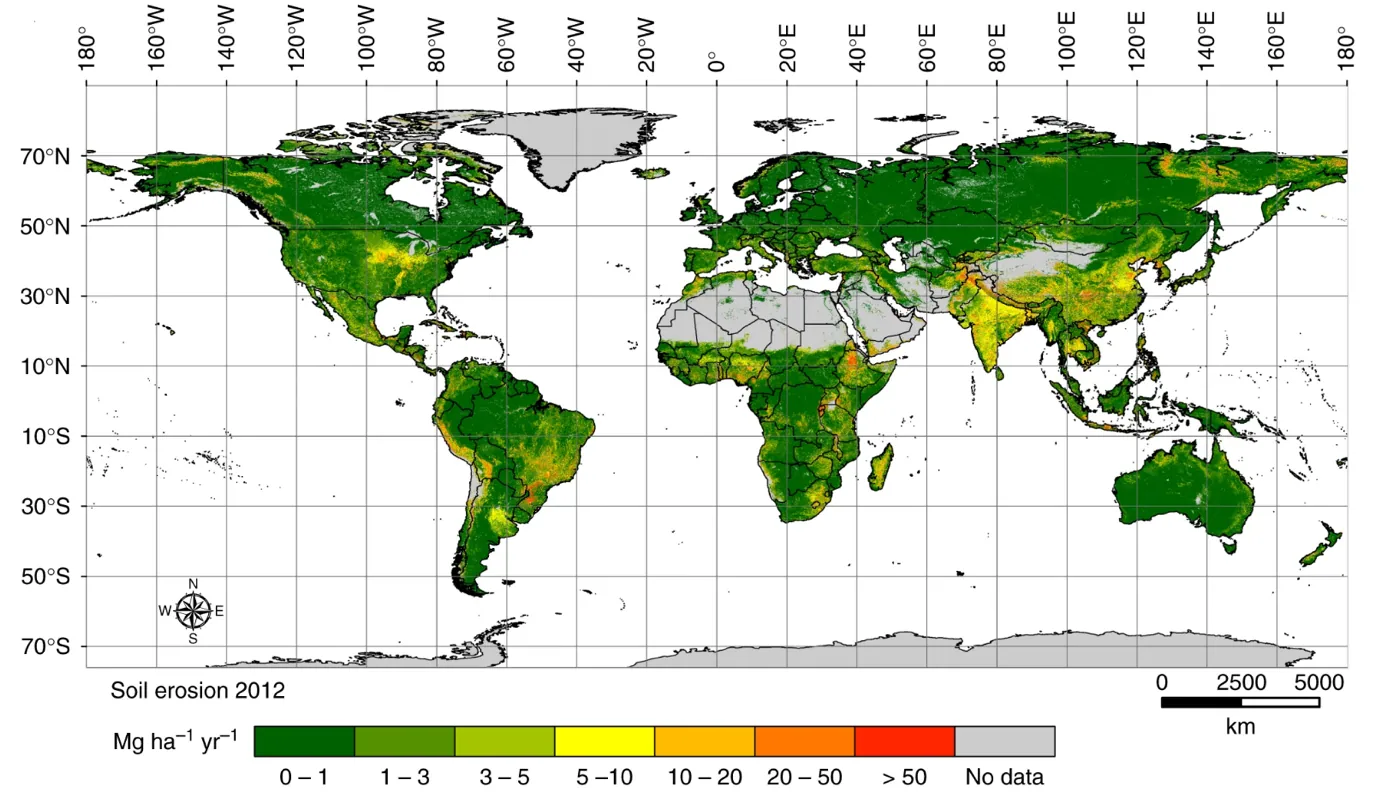
Accelerated soil erosion is primarily due to changes in land use. Soils become more vulnerable to erosion, especially when forest areas are converted into agricultural land. Montgomery [17] stated that data obtained from a global research compilation confirm the claim that erosion rates in agricultural areas with traditional tillage are several times higher than in areas under natural vegetation. According to the researcher, although globally, soil formation and erosion in natural areas occur in a way that balances geological and climatic threats, agriculture based on traditional tillage increases erosion rates to the point of becoming unsustainable. Unlike traditional tillage, no-till agriculture is of great importance for sustainable agriculture as it will create erosion closer to the soil production amount.
When comparing soil erosion according to land use types, it shows great differences. It is estimated that soil erosion in cultivated areas around the world is 77 times higher than forest soils and approximately 7 times higher than natural vegetation soils [16].
It is possible to see a significant decline in soil erosion as a result of protective agricultural practices. For this purpose, in an evaluation made using modeling in the lands of 54 countries reported to FAO, an annual decrease of 7% in soil loss was reported [16]. It has been stated that, on a country basis, soil erosion has been reduced by a maximum of 33% in Argentina through protective agriculture practices. While the reduction rates in soil erosion were higher in less developed countries, the increases in reduction rates were lower in developed economies.
Soil is one of the world's most important natural asset that requires many years to form. The continued existence of life on Earth depends on its existence. Protecting soil as an asset and continuing its use in production will be possible by implementing environmentally sound approaches in human-soil relations, without wasting time. Some precautions that can be taken in this regard are listed below:
Legal regulations must be made to protect soil and water resources, and the deficiencies and problems in existing regulations must be revised and put into practice again.
Soils should be classified according to their properties and land use planning should be made to ensure that the soils are used according to their capabilities.
Protective measures should be taken in agricultural production, especially in areas prone to erosion. For this purpose, no-till or reduced tillage practices should be implemented, and possible soil losses should be reduced by measures such as direct stubble-field seeding method or use of cover crops.
Measures should be taken to protect and improve pasture areas. Also, excessive and uncontrolled grazing should be prevented.
Since surface flows and soil losses will be high in areas with high slopes, agricultural production should be carried out after strips, contours, etc. applications are made in such places.
In places with erosion problems, care should be taken in the selection of products to be grown, and instead of hoe plants, production should be made with plants that require less tillage and grip the soil more tightly.
Making drainage arrangements to prevent water accumulation in the areas which have problematic soils.
References
FAO 2020. Global Forest Resources Assessment 2020 Main Report. https://www.fao.org/3/ca9825en/ca9825en.pdf ( Acces date: 22.09.2023).
FAO, 2012. State of the World's Forests 2012. Food and Agriculture Organization of the United Nations, Rome, Italy
Tolunay D, Çömez A, (2008). in forest lands carbon storage And The situation in Turkey . Spherical Climate Change And This your problems Forests in Solution . 13-14 December 2007, Istanbul, 97-108.
Kantarcı , MD, 2000. Soil İlmi (2nd Edition ), İ.Ü. Publication No. 4261, Faculty of Forestry Publication No.462, Cantay Printing House , Istanbul
Lal, R., (2004). Soil carbon sequestration impacts on global climate change and food security, Science 304:1623-1627
Türkeş , M. (2012). Drought , Desertification And United Nations desertification with my struggle of the Convention A Detailed Analysis . Marmara University Europe community Institute Europe research Journal , 20(1), 7-55.
Mirzabaev , A., J. Wu, J. Evans, F. García-Oliva, IAG Hussein, MH Iqbal, J. Kimutai , T. Knowles, F. Meza, D. Nedjraoui , F. Tena, M. Türkeş , RJ Vázquez, M. Weltz , (2019). desertification In: Climate Change and Land: an IPCC special report on climate change, desertification, land degradation, sustainable land management, food security, and greenhouse gas fluxes in terrestrial ecosystems [PR Shukla, J. Skea, E. Calvo Buendia , V. Masson - Delmotte , H.-O. Pörtner , D.C. Roberts, P. Zhai , R. Slade, S. Connors, R. van Diemen, M. Ferrat , E. Haughey , S. Luz, S. Neogi , M. Pathak, J. Petzold , J. Portugal Pereira , P. Vyas, E. Huntley, K. Kissick , M. Belkacemi , J. Malley, (eds.)]. In press.
UNCCD, 1994: Elaboration of an international convention to combat desertification in countries experiencing serious drought and/or desertification, particularly in Africa. General Assembly, United Nations, 1–58 pp.
Abatzoglou , JT, SZ Dobrowski , SA Parks, and KC Hegewisch, 2018: TerraClimate , a high-resolution global dataset of monthly climate and climatic water balance from 1958–2015. Sci. Data, 5, 170191, doi:10.1038/sdata.2017.191.
Sivakumar, M. V. K. (2007). Interactions between climate and desertification. Agricultural and forest meteorology, 142(2-4), 143-155.
WMO, (2007). Climate change and desertification. World Meteorological Organization, https://www.droughtmanagement.info/literature/WMO_climate_change_desertification_2007.pdf ( Acces date: 28.09.2023)
Hoffmann, M. T., Rounsevell, M., Sehgal, J. and Varally , G. (1996). 'Land degradation and desertification'. RT Watson, M. C.Zinyowera and RH Moss (eds.), Climate Change 1995, Impacts, Adaptations and Mitigation of Climate Change: Scientific-Technical Analyses, Contributing of WG II to the Second Assessment Report of the Intergovernmental Panel on Climate Change (IPCC). New York: Cambridge University Press,171-189.
Lal, R. (2004). Soil carbon sequestration impacts on global climate change and food security. Science 304, 1623–1627
Van Oost, K. et al. (2007). The impact of agricultural soil erosion on the global carbon cycle. Science 318, 626–629
FAO, (2023). Global Soil Partnership endorses guidelines on sustainable soil management. https://www.fao.org/news/story/en/item/416121/icode/ ( Acces date: 02.10.2023)
Borrelli, P., Robinson, DA, Fleischer, L.R., Lugato , E., Ballabio , C., Alewell , C., … Panagos , P. (2017). An assessment of the global impact of 21st century land use change on soil erosion. Nature Communications, 8(1). doi:10.1038/s41467-017-02142-7
Montgomery, D. R. (2007). Soil erosion and agricultural sustainability. Proceedings of the National Academy of Sciences, 104(33), 13268–13272. doi:10.1073/pnas.0611508104