
Module 3 · Chapter 4
Sprinkler irrigation
We have previously shown that surface irrigation, the method widely used, is very inefficient and not sustainable. As newer modern alternatives there are sprinkler irrigation and drip irrigation. Sprinkler irrigation or “artificial rain” has good application efficiency that depends on the climate conditions (e.g., wind, temperature, humidity). The water is firstly distributed with pressure in a system of pipes, then spreads on the soil surface. The method is suitable for small and large fields as well and for all types of crops. The watering equipment can be mobile, semi-fixed, or fixed. It can also be used for moistening, as antifreeze, and with thermal purposes, as well as for improving the quality of fruits [1-4].
Operation Principle
The sprinkler irrigation has many variants, from simple gear-drive sprinklers used to irrigate lawns and gardens, to industrial equipment. A sprinkler system has the following components:
- pump unit – it is usually a centrifugal or turbine pump that provides pressured water (from the water source) into the pipe system. The use of a specific type of pump is chosen depending on the water source; when the source is a deep well, a turbine pump is preferred. Centrifugal pumps are preferred when the distance between the pump and water source is small (less than 8 m)
- main-lines, sub-main-lines, and laterals – main and sub-main lines are pipes that take water from the pump to the laterals, being sometimes buried. The laterals are mobile pipes that take the water to the sprinklers. These pipes are usually made of aluminium or PVC for portable systems, and cement, PVC, wrapped steel for buried laterals or main lines.
- sprinklers – the sprinkler head has the important role of uniformly distributing the water over the field, without runoff or water loss due to percolation. The sprinkler heads can be either fixed or rotating, depending on the necessities, with different distance operation ranges (10 – 70 m). Sprinklers are made of metal, plastic, or a combination of the two. The type, working pressure, sprinkling area, mobility and other parameter differentiate between the sprinklers [5-7].
- optional equipment – to operate a sprinkler irrigation system in optimum conditions, optional equipment can be used. Different information collected can be transmitted remotely, or some parts such as the water flow can be also controlled remotely.
The mobile sprinkler equipment can be built as in-ground sprinkler systems with the following configurations:
a) where high pressure buried ducts are used, for which the pressure necessary to sprinkle the water is created by the sprinkling equipment coupled with hydrants at the pressure duct system
b) where low pressure buried ducts are used, the pressure in the sprinklers being given by some pumps connected to the main-lines and that push the water in the laterals
c) with channels, the working pressure in the laterals being produced with pumping equipment that takes the water from the channels either directly to the laterals or to the mainline.
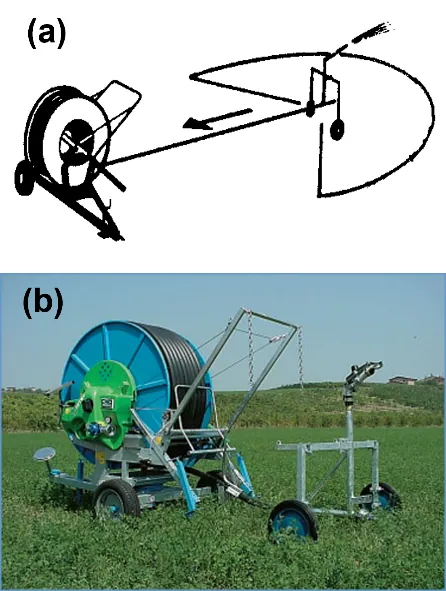
The sprinkler system with drum and hose (Figure 1) is a mobile system that ensures the water needs for any crop. It has the following component parts:
- the metallic frame is equipped with two wheals such as it can be easily moved; it has two supporting legs and an adjustable jack.
- the frame holds a drum, the mainline, a hydraulic system used to operate the drum, suspending frame for the truck and a brake system
- high density polyethylene hose, with a length of 300 to 750 m, an external diameter of 75 to 160 mm and a wall thickness of 8 mm; the hose is rolled on the drum
-the sprinkler system consisting of two reactive sprinklers, ARS – 2, placed on a four wheels truck, that spread the water in a circle sector
When the device has a fixed position, it can irrigate an area with the length equal to that of the hose and 54 m wide. In each working position, before the sprinkling, the hose is spread along a corridor with no plants over a 2.1 m distance, operation performed by moving the metallic supporting truck using a tractor [5]. When the sprinkling starts, the hose is also pulled back to the drum due to the hydraulic engine, which determines the move of the sprinkler support system. Because the irrigation takes place on circle sectors, the truck rolls on dry soil. When the sprinkling system reaches the drum, the water circuit is automatically stopped. The average speed can be tuned depending on the water necessary, working pressure and the types of sprinklers.
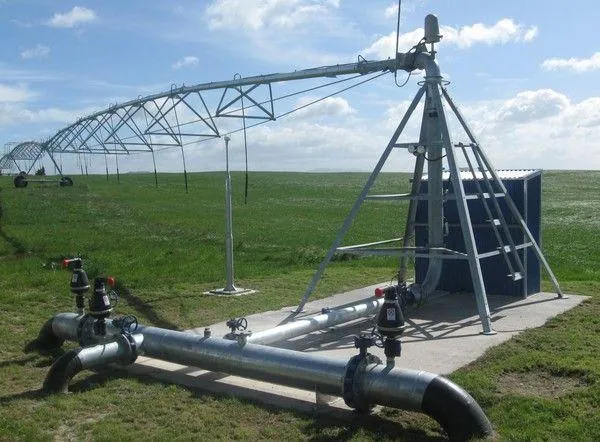
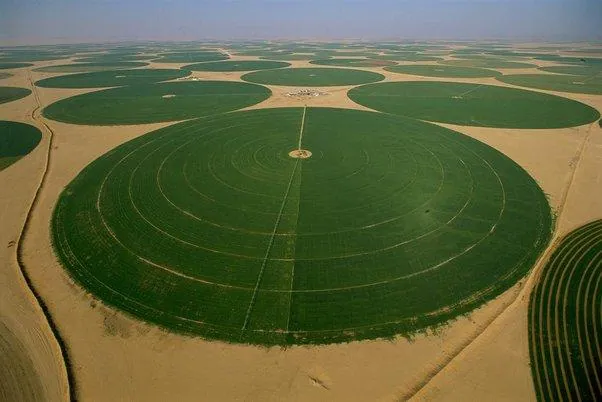
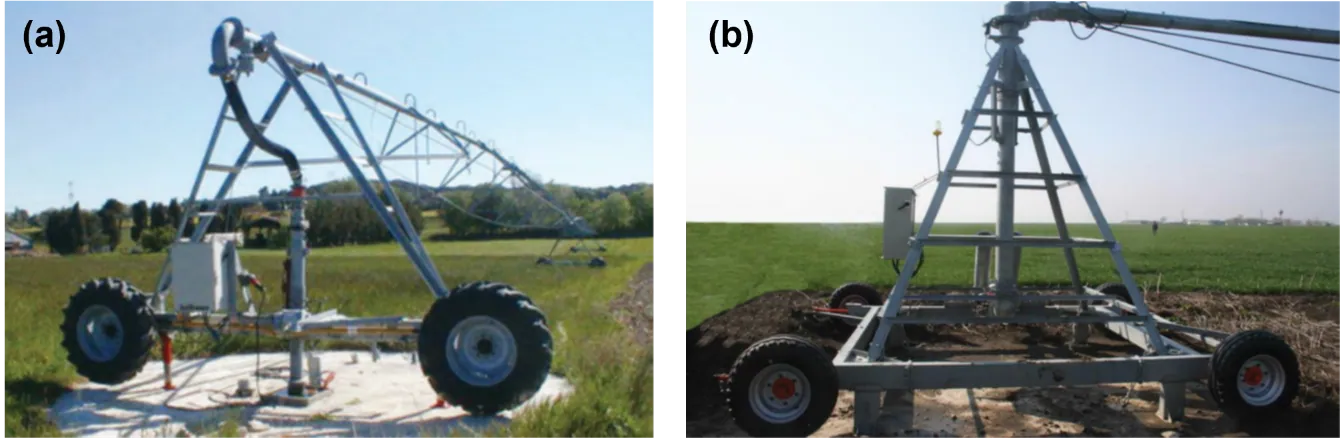
Self-moving sprinkling systems with central pivot (Figure 2) can be used in different configurations made of circles or/and circle sectors, as shown in Figure 3. The length of the wing can vary from 150 to 700 m, while the covered area can be of 5 to 250 ha. The system has a center pivot, with several pipe segments connected together and supported by trusses (spans), and mounted on wheeled towers. The water comes from the main line in the central pivot, that also supports the system. The sprinklers used work at low pressure and are different as function of the irrigated crop. To ensure the uniformity of the water distribution, the systems have pressure regulators in between the spans. The control panels are based on the Computer Aided Management System (CAMS) technology for remote monitoring of the system. In such way it is possible to adjust the intensity of the sprinkled water as function of the speed of the wind, introducing fertilizers or pest control chemicals, and reversing the movements of the system. When the engines start, a system of transducers that estimates the angle between spans controls their operation; based on the information from the transducers the movement of the trucks starts. The speed of the spans can be adjusted to achieve a specific intensity of the rain. There are operational variants for which the center pivot can be moved as it can be seen in Figure 4. In both case the principle is the same, the only difference is the automatic/manually operated movement of the center pivot [5-9].
This sprinkler system can be also used for fertigation; in this case there is a special reservoir in which the fertilizer is placed. The reservoir is connected to the irrigation water. Spreading the fertilizer during the vegetation period is advantageous because it decreases the costs, irrigation and fertilization being done simultaneous; the leaves and/or roots assimilate better the nutritive elements dispersed in water, increasing the efficiency of the fertilizers.
Fertigation is advantageous especially for the crops that behave better if fertilizers are applied during the vegetation but due to vegetation it is hard to perform the process using other mechanical means [10, 11]. Fertigation should be performed at specific times, the most important conditions being as follows:
- should be applied for crops with high minerals and water requirements during the vegetation stage. As an example, maize in the second crop, can be fertigated in all growing stages starting sowing.
- application mostly of nitrogen-containing fertilizers, because during the vegetation stage the plants usually behave better to addition nitrogen doses than phosphorus or potassium. In sugar beet crops, potassium-based fertilizers applied through fertigation favour the increase of sugar content of the roots.
- using highly soluble fertilizers is wanted, due to the fact that undissolved matter can clog the sprinklers
- the span of applying fertilizers should be short, 30 to 60 minutes, to ensure the controlled and uniform distribution. Moreover, the fertigation should take place at the end of the irrigation period, but before it ends such as the nutrients have the possibility to be absorbed and to avoid damages of the system through corrosion
- the sprinkler rain should have a good uniformity; thus, the fertigation should not be performed during windy periods.
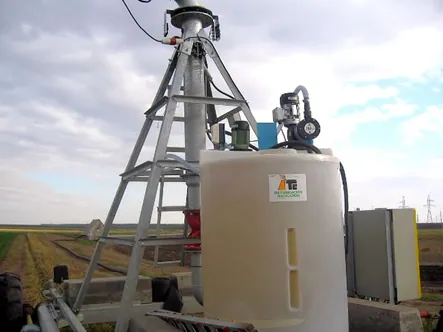
The fertigation equipment is shown in Figure 5. It is a tank with two flexible pipes, one to introduce the water, and the other to inject the water in the sprinkler system. The amount of fertilizer is calculated as function of the concentration of active substance and the dose to be distributed over the soil surface.
The sprinkler systems can be automatized such as to assess the water need in real time, and activate/stop the water flow. Variable rate irrigation (VRI) is an automatic irrigation technology based on a matrix of sensors that detect the soil humidity. It is employed in precision agriculture to optimize the irrigation mainly by using center pivots. The change in the water amount is done by controlling a system of valves. Thus, optimized irrigations are performed, reducing the water consumption and increasing the production. VRI can be successfully be applied for fertigation and other chemigation methods with the use of supplementary equipment that inject the chemicals in the mainline, and a pump system to send the solution at the correct pressure [12-14].
Linear move irrigation systems ensure high uniformity and efficiency, being suitable for rectangular shape fields. The system moves back and forth across a field. The water source can be diverse from lakes, rivers to channels and pipes. Several spans are connected in line; the system is moved by two or four carts. Compared to center pivot systems, they also cover the corners of the field. The movement of the line spans can be done also using cables. Water can be provided from the sides or from the middle of the system through high density polyethylene hoses.
There are several types of linear systems. The ideal system is a two wheeled linear, usually used in small size fields. A dich feed system uses the water from an earth ditch or canal as water source. Such a system is ideal for large fields, are easy to operate since the system is moving along the water channel. Hose feed uses water from a pressurized system. Due to the presence of the hose, it is more suitable for smaller than larger fields.
Errosion Due to Sprinkler Irrigation
In the case of sprinkler irrigation, the water hits the soil at some speed, thus making possible the detachment of soil aggregates and fragments, which are then transported in the overland flow, and, at some points they are deposited. To avoid this situation, it is necessary to properly design and operate the sprinkler systems. Centre-pivot systems apply water with high debit which increases the potential to cause runoff and erosion. The most important component involved in erosion is the sprinkler type. The use of low-pressure sprinklers reduces the runoff, but only the application rate is reduced. The size of the water drops is also important. For the lateral moving systems, the runoff is common in wheel tracks if they run in parallel with the slope of the field. To limit or avoid erosion, many measures could be taken, such as attention in choosing the sprinkler type, the pressure, diameter (that determines the size of water drops), to decrease the flow rate, and limit the erosion without decreasing the efficiency of irrigation. Overall, this might be a difficult task.
Advantages and Disadvantages Of Sprinkler Irrigation
Implementing a sprinkler irrigation system does not require terracing or field levelling, being independent of the field topography [15-19]. The water necessity of the plants can be easily covered for any type of crop and soil, being also possible to simultaneously make fertiliser or pesticides treatments [20-21]. The use of a pressurised system requires a large amount of energy consumption, larger than the other irrigation technologies, as well as a considerable investment in equipment. Plants are prone to diseases since the water wets the surface of the leaves. The water consumption efficiency decreases in windy areas due to the water increased evaporation from the surface of the soil. Same as for drip irrigation, the system can experience clogging.
References
Daccache, A., Knox, J.W., Weatherhead, E.K., Daneshkhaha, A., & Tess, T.H., Implementing precision irrigation in a humid climate-recent experiences and on-going challenges, Agricultural Water Management, 2015, 147, 135-143.
Deines, J. M., Kendall, A. D., Crowley, M. A., Rapp, J., Cardille, J. A., & Hyndman, D. W., Mapping three decades of annual irrigation across the U.S. High Plains Aquifer using Landsat and Google Earth Engine. Remote Sens. Environ., 2019, 233, 111400 https://doi.org/10.1016/j.rse.2019.111400.
Current perspective to predict actual evapotranspiration D. Bucur Ed., IntechOpen, Croatia, 2017, https://doi.org/10.5772/65621.
Advanced Evapotranspiration Methods and Applications, D. Bucur Ed., IntechOpen, London, UK, 2019, https://doi.org/10.5772/intechopen.73720.
Li, Y.; Hui, X.; Yan, H.; Chen, D. Effects of Travel Speed and Collector on Evaluation of the Water Application Uniformity of a Center Pivot Irrigation System. Water 2020, 12, 1916. https://doi.org/10.3390/w12071916.
Silva, L.L. The effect of spray head sprinklers with different deflector plates on irrigation uniformity, runoff and sediment yield in a Mediterranean soil. Agr. Water Manage. 2006, 85, 243–252,
Rovelo, C.O.R.; Ruiz, N.Z.; Tolosa, J.B.; Felix, J.R.F.; Latorre, B. Characterization and simulation of a low-pressure rotator spray plate sprinkler used in center pivot irrigation systems. Water 2019, 11, 1684
Abd El-Wahed, M.H.; Medici, M.; Lorenzini, G. Harvesting water in a center pivot irrigation system: Evaluation of distribution uniformity with varying operating parameters. J. Eng. Thermophys.-Rus. 2015, 24, 143–151
Wang, Z.; Jiang, Y.; Liu, J.; Li, H.; Li, H. Experimental Study on Water Distribution and Droplet Kinetic Energy Intensity from Non-Circular Nozzles with Different Aspect Ratios. Agriculture 2022, 12, 2133. https://doi.org/10.3390/agriculture12122133.
Peña, D.; Martín, C.; Fernández-Rodríguez, D.; Terrón-Sánchez, J.; Vicente, L.A.; Albarrán, Á.; Rato-Nunes, J.M.; López-Piñeiro, A. Medium-Term Effects of Sprinkler Irrigation Combined with a Single Compost Application on Water and Rice Productivity and Food Safety. Plants 2023, 12, 456. https://doi.org/10.3390/plants12030456.
Liu, J.; Wang, X.; Liu, Q.; Hussain, Z.; Zhao, Y. Optimization of Key Hydraulic Structure Parameters of a New Type of Water–Pesticide Integrated Sprinkler Based on Response Surface Experiment. Water 2023, 15, 1486. https://doi.org/10.3390/w15081486.
Kumar, R.; Naresh, R.K.; Bhatt, R.; Chandra, M.S.; Kumar, D.; Alamri, S.; Siddiqui, M.H.; Alfagham, A.T.; Kalaji, H.M. Tillage Crop Establishment and Irrigation Methods Improve the Productivity of Wheat (Triticum aestivum): Water Use Studies, and the Biological Properties and Fertility Status of Soil. Agronomy 2023, 13, 1839, https://doi.org/10.3390/agronomy13071839.
Cooley, D., Maxwell, R.M., Smith, S.M. Center pivot irrigation systems and where to find them: a deep learning approach to provide inputs to hydrologic and economic models, Frontiers in Water, 2021, 3, https://doi.org/10.3389/frwa.2021.786016.
Liakos, V., Vellidis, G., Tucker, M., Lowrance, C., A decision support tool for managing precision irrigation with center pivots, In: Precision agriculture’15, pp. 677-684, Wageningen Academic Publishers, 2015, http://dx.doi.org/10.3920/978-90-8686-814-8_84.
Dusadeerungsikul, P.O., Liakos, V., Morari, F., Nof, S.Y., Bechar, A. Smart action, in Agricultural internet of things and decision support for precision smart farming, 2020, pp. 225-277, https://doi.org/10.1016/B978-0-12-818373-1.00005-6.
Fastellini, G., Schillaci, C. Precision farming and IoT case studies across the world, in Agricultural internet of things and decision support for precision smart farming, 2020, pp. 331-415, https://doi.org/10.1016/B978-0-12-818373-1.00007-X.
Haacker, E. M., Kendall, A. D., & Hyndman, D. W., Water level declines in the High Plains Aquifer: Predevelopment to resource senescence, Groundwater, 2016, 54(2), 231-242. https://doi.org/10.1111/gwat.12350
King, B.A., Stark, J.C., & Wall, R.W., Comparison of site specific and conventional uniform irrigation management for potatoes. Applied Engineering in Agriculture, 2006, 22(5), 677-688.
Longchamps, L., Khosla, R., Reich, R., & Gui, D.W., Spatial and temporal variability of soil water content in leveled fields. Soil Science Society of America Journal, 2015, 79, 1446-1454.
Smidt, S. J., Haacker, E. M., Kendall, A. D., Deines, J. M., Pei, L., Cotterman, K. A., Hyndman, D. W., Complex water management in modern agriculture: Trends in the water-energy food nexus over the High Plains Aquifer. Sci. Total Environ., 2016, 566-567, 988-1001. https://doi.org/10.1016/j.scitotenv.2016.05.127
Svedin, J.D., Hansen, N.C., Kerry, R., Hopkins, B.G. Modelling spatio-temporal variations in crop water stress for variable-rate irrigation. In J.V. Stafford (ed.) Precision Agriculture ‘19, 2019, Proceedings of the 12th European Conference on Precision Agriculture. Wageningen, the Netherlands: Wageningen Academic Publishers. pp. 687-693.