
Module 3 · Chapter 8
Cloud seeding
As a result of climate change, the precipitation pattern has been affected, making vulnerable many countries due to the decrease of water resources. Drought has become a regular event in many parts of the world, thus governments around the world have been focusing on plans for drought management, since the drought has more than an agricultural impact, but strongly affects communities, health, education, and nutrition. It adversely influences the moisture of the soil, surface runoff, and all water resources with social and economic negative consequences.
As we discussed in previous chapters, water reserves are scarce, and new technologies and methods are being targeted to provide agriculture with the water needs. One way to achieve this is to stimulate the production of precipitation by cloud seeding [1-7]. Some areas in the world, such as the United Arab Emirates, have already been using this method commonly. In other parts, such as Australia, Russia, China, India, Israel, the United States, but also Romania, the implementation was started a short time ago [3]. On one hand, cloud seeding stimulates the production of precipitation, and, on the other hand, can help avoid the production of hail which is another major problem for agriculture resulting from climate change, with potential negative impact, especially for cultures that take a couple of years to be productive such as vineyards and orchards.
Modern weather modification technology started in the 1940s when Schaefer and Vonnegut found that supercooled water droplets could be turned into ice after seeding. In warm clouds, the rain was initiated using large, hygroscopic particles [4]. Not all the available moisture from the clouds is transformed into precipitation, but a small amount, fact that presented the possibility of exploring increasing the water supply by cloud seeding. Despite the research performed in the past century, the complexity of the atmospheric processes directly influences the repeatability of cloud seeding experiments. Considering the high costs involved due to the necessary equipment, the cost-to-benefit ratio is influencing the undergoing research programs regarding cloud seeding.
Explanation of the process
Precipitation occurs after evaporated water in the atmosphere collects through condensation around particles in the atmosphere, leading to the saturation of the air when it can’t hold the moisture and the droplets formed fall.
Cloud seeding represents the dispersion of artificial substances into a cloud to change its development or increase its precipitation. Enhancing the precipitation is done by making several weather modifications to increase the number of condensation nuclei in the atmosphere by providing aerosol particles into the clouds, beyond the natural background population which can be scarce and have smaller size. The water content of the cloud condenses into liquid droplets, increasing the depth of the cloud, lifetime, and intensity of the rainfall.
The process is very complex. The substances introduced in the clouds serve as cloud condensation nuclei, aiding the formation of precipitation. Based on the ice-nucleating abilities of the glaciogenic materials (silver iodide and dry ice), several types of cloud seeding modes have been proposed [2]:
In the static mode, condensation nuclei (usually silver iodine or dry ice) are added to increase the rainfall. These crystals act as condensation nuclei for the moisture already present in the clouds, increasing the efficiency of dispersing the water in the cloud. Experiments have shown that the opportunity window for this seedling method is limited at least by the availability of supercooled water in the cloud. The success rate of cloud seeding in static mode is variable since the environmental conditions are hard to replicate.
In the dynamic mode, the vertical air currents are enhanced by adding a much larger quantity of condensation nuclei to the cloud. This concept is based on seeding supercooled clouds with huge quantities of nuclei (about 100 times more condensation nuclei) to produce the rapid formation of ice particles, the released latent heat increasing buoyancy invigorating the cloud updrafts, and resulting in the growth of the cloud and yielding more precipitation. The latter could produce strong downdrafts and interactions with the environment leading to a more active convection phenomenon. Dynamic seeding is a more complex process than static one, depending on several events, about 11 stages of the process being identified [6]. Any interference with the sequence of events can seriously affect the final result, making the method less reliable than static cloud seeding.
In hygroscopic seeding, the nuclei are salt crystals on which water condensates until they are large enough to cause precipitation. It is associated with warm cloud seeding. The promotion of rainfall is due to the enhanced coalescence process. In the initial form, the method had some drawbacks, such as the large salt quantity of salt needed, which had to be dispersed over areas large as the cloud inflow. Moreover, the growth rate of rain particles must match the updraft profile. Later on, the approach changed to seeding the warm clouds below using pyrotechnic flares producing under micro-meter sized salt particles, resulting in a broader size spectrum. This approach makes use of smaller quantities of salt, while the target area can be easily determined at the base of the cloud.
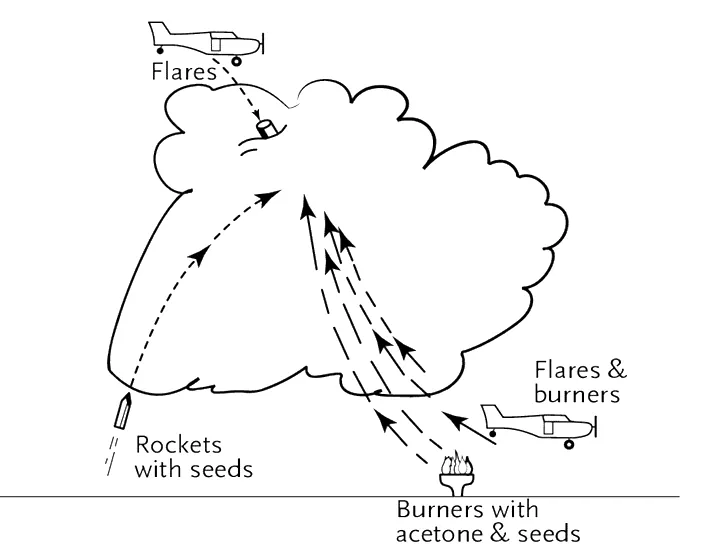
The methods for cloud seeding can be (Figure 1):
-airborne – planes are used to spread the nuclei in the clouds with special pyrotechnic equipment (cartridges and blocks)
-ground-based systems are used for the same purpose as planes. Such systems can be generators, rockets, pyrotechnic flares, hail cannons, artillery seeding, etc. A reagent is burnt and then reaches the clouds by updraft currents.
Besides the technological means necessary for direct seeding, others are required as well to monitor the clouds (radar systems, satellite image transmission networks, meteorological stations, etc.) and rainfall.
The natural background of condensation nuclei is represented by dust particles, sea salt, soot, and other particles coming from natural processes or have an anthropogenetic nature. The water molecules in a cloud condense on these nuclei, or so-called cloud seeds, and the size of the cloud drops increases as they accumulate more water by condensation or collision with other drops. The artificial cloud seeds speed up the process and give the water more material on which to condense, particles growing faster and precipitation being facilitated.
The seeding can be done by two methods as also shown in Figure 1:
-in the upper area of the cloud by directly injecting the nuclei using flares containing a hygroscopic (CaCl2 nanoparticles) or glaciogenic (AgI) substance, mounted on the belly of a plane
-at the lower part of the cloud by spreading seeding nuclei using fixed stations that shoot rockets, or from torches mounted on the wings of a plane.
The substances used for cloud seeding have high ice-forming capacity in the presence of supercooled water and consist of ice-forming aerosols and reagents for cooling. Some of these are hygroscopic, used mainly for warm clouds. Powder reagents are mainly used for the dissipation of convective clouds, through the introduction of strong downdrafts. The most common ice-forming substance is silver iodine (AgI); it has a crystalline structure similar to the ice crystals, being very effective as an ice nucleus at temperatures lower than -4°C. The combustion of 1 g of mixtures containing 8% AgI leads to the production of 51012 nuclei at a temperature of -10°C [7].
Other substances used as seeding nuclei are as follows:
-for cold clouds: AgI, liquid propane and liquid acetone, dry ice (CO2)
-for warm clouds: urea, cement, fine salt
-for complex clouds: AgI, NaCl, KCl, CaCl2
The powder reagents have different efficiencies depending on their composition, hydrophilicity (influences the ability to interact with the cloud droplets), dispersion (the optimum value is 3000 cm2/g), specific weight (determines the distribution and behavior inside the cloud due to the currents) [7].
The seeding effects can vary from a couple of minutes to longer periods, depending on the seeding delivery method. The direct injection is immediate but requires the use of a plane flying at high altitude which might be expensive. In the case of updraft seeding at the base of the cloud, the seeding substance needs to be carried out by the updraft current into the cloud to become effective, taking a longer time.
Convective clouds are seeded from the top using aircraft; when their top is above the service level of the used planes, the reagent is dispersed in the cloud at the maximum flight height of the aircraft. When a multitop convective system is seeded, up to tens of cartridges are used, the seeding for each top being similar to that for one cloud. When stratiform clouds are seeded to produce rainfall, the seeding takes place on a perpendicular line to the movement direction, the seeded zone being a couple of km, the reagent being transported by the turbulent phenomena in the atmosphere. Thus, the precipitation will be also limited in the targeted area.
The effectiveness of cloud seeding has been continuously increasing. World Meteorological Organization (WMO) reported that airplane seeding has become more effective than most ground-based methods. Still, evaluating the efficiency is complicated due to the complex properties of the atmospheric phenomena, mostly cloud evolution. Multiple experiments have been conducted and a statistical approach has been applied, in control-target models. The rainfall is recorded in control areas while there is no seeding of the clouds, and a regression equation is used to emulate the natural rainfall. Then, the potential seeding impacts can be evaluated by comparing the regression model with the observed phenomena. Using this approach, it was determined that the annual precipitation increased by up to 10% as a result of the cloud seeding.
To study in detail the atmospheric phenomena involved, radar detection is paramount. It can offer a high-resolution, real-time measurement of clouds and estimation of precipitation; thus, it is used to aid in the seeding process and also in its study.
Case study – UAE cloud seeding program
In the United Arab Emirates, cloud seeding is a governmental strategy to deal with the climatic conditions of the country. The program has been implemented since 2002 by the National Center of Meteorology of UAE, and it follows a conventional approach: natural salts, mainly potassium chloride (KCl), are launched using flares at the base of convective clouds in the vicinity of the updraft core [1]. A target-control regression method was applied and found a mean annual increase of 23% in rainfall, with increases in the storm echo volume of up to 159%, area cover of about 72%, and lifetime of about 65% [1]. UAE case is a special one, with about 300 seeding missions yearly and a goal to optimize the effectiveness of the process towards the benefit of water security in the country. The program is necessary since the average annual precipitation is below 100 mm, with rising temperatures and shifting weather patterns.
Impact and perspectives of cloud seeding technologies
Environmental implications from the pollution point of view haven’t been found, even in the case of silver iodine aerosols or other particles such as cement and clay [2,6,7]. The concentration of silver in the rainwater is much below the acceptable environmental value of 50 μg/L. There is also no impact on climate change; the seeding modifies individual clouds or groups of clouds with only local effects. The disadvantages of the technology are that it is not foolproof and involves high costs.
Cloud seeding technology has great potential for precipitation enhancement, being strongly linked to water resources management. It is important to consider the potential agricultural benefits of precipitation enhancement through cloud seeding. It can significantly improve the living conditions in arid areas, regulating precipitation through hail prevention. The research so far has shown that cloud seeding can be used as a long-term water resources management tool, alongside with water storage and crop irrigation.
References
Farahat, A.; Abuelgasim, A. Effect of cloud seeding on aerosol properties and particulate matter variability in the United Arab Emirates. International Journal of Environmental Science and Technology, 2022, 19 (2): 951–968. doi:10.1007/s13762-020-03057-5
Bruintjes, R.T., A review of cloud seeding experiments to enhance precipitation and some new prospects, Bulletin of the American Meteorological Society, 80(5), 1999, 805-820.
Ćurić, M.; Lompar, M.; Romanic, D.; Zou, L.; Liang, H. Three-Dimensional Modelling of Precipitation Enhancement by Cloud Seeding in Three Different Climate Zones". Atmosphere. 2019, 10 (6): 294. doi:10.3390/atmos10060294
Schaefer, V.J. Snow and Clouds in the Sky, 1947, General Electric – Project Cirrus.
Al Mazroui, A., Farrah, S. The UAE Seeks Leading Position in Global Rain Enhancement Research, 2017. The Journal of Weather Modification 49 (1): 54-55.
Malik, S.; Bano, H.; Rather, R.A.; Ahmad, S. Cloud Seeding; Its Prospects and Concerns in the Modern World – A Review, International Journal of Pure & Applied Bioscience, 2018, 6(5): 791-796, http://dx.doi.org/10.18782/2320-7051.6824
Korneev, V.P., Potapov, E.I., Shchukin, G.G. Environmental aspects of cloud seeding, Russian Meteorology and Hydrology, 2017, 42: 477-483, DOI: 10.3103/S106837391707007X