
Module 3 · Chapter 6
Irrigation management and scheduling
The presence of water in the soil is important from many points of view:
ensures the necessary amount of moisture for seed germination and growth;
decreases the temperature of soil and surroundings;
deals with the salts accumulated at the surface, diluting and washing them out;
aids tillage by making the soil softer;
irrigations help the crops grow even during the lack of precipitation.
Most of the water in soil comes either from precipitation or underground waters. Most of the time the existing moisture is not enough for successful agricultural use of the lands and to ensure agricultural production, the water deficit could be overcome by supplying water artificially through irrigation. Sometimes it is difficult to supply exactly the necessary amount of water, thus several issues appear, such as the soil being saturated in water, a situation when the excess is damaging the crops. To overcome this issue, drainage systems are used, if natural drainage is not present [1]. Keeping the optimum amount of water in the soil means balancing between irrigation and drainage.
Applying irrigation at the optimum moment in connection to the plant needs, is one of the major desiderata of any irrigation practice. The moment is established as a function of many factors, starting with the type of irrigation system. In the case of local irrigation systems where the water distribution is discontinuous and on-demand, the optimum moment is determined by the farmer responsible for the irrigated crop based on observations and measurements performed on the crop field. For very large irrigation systems, the moment is established by the technical irrigation advisory centre coordinating the respective system.
Establishing the time of the first irrigation application of the season during the crop vegetation or the start of the irrigation campaign is done in strong correlation with the soil water content, and does not depend on the type of irrigation system. To determine the optimum moment for irrigation, there are approximative methods (empirical) as well as more precisely (using scientific data).
Empiric Methods Used to Establish the Timing of Irrigation Application
Empiric determination of the ideal moment to start the irrigation of a specific crop is based either on the vegetation stages of the crop or on the analysis of some morphological indicators of the plants.
The first method, based on the phenological stages, considers that, for each plant, the water need is higher in some vegetation phases, called critical phases [2]. For example:
For wheat, the critical phases for water needs are floral initiation (double ridge), terminal spikelet, stem extension, heading, and ripening;
For maize: 6 – 8 leaves, kernel development, grain filling;
For sugar beets: leaves development, thickening of the roots, sugar accumulation.
It was observed that the crop state directly depends on the soil moisture during the critical development stages, making an irrigation plan that gives water to the crops a short while before such a stage starts seems to be a rational decision, as long as the whole crop can be irrigated in 2 to 3 days.
Despite being empirical, only based on observations with no measurements, this technique has the advantage of obtaining a production comparable to that on fields where the irrigation schedule is strictly determined through rigorous criteria. The disadvantages are related to the increased water use, labour, and equipment involved.
Establishing the irrigation schedule based on the observation of the general aspects of the plants due to the lack of water (turgescence loss, changing the colour of the leaves, flower falling, etc.) is not efficient because once these changes are observed, the plants have already been suffering, a fact that influences the yield and quality of the crop.
Scientific Methods to Establish the Irrigation Schedule
The scientific way to establish the irrigation schedule is based on information gathered from measuring the soil moisture and water holding capacity, some physiological indices of the crop or the average daily water need [1,2].
Establishing the irrigation schedule according to soil moisture is a rational method if the water content can be measured precisely, fast, and involving low costs. The water content of the soil can be determined by different methods such as thermal, electromechanical, neutronic, etc. To do this, some control areas are established which are equal to the crop surface or with the surface occupied by the crop that is irrigated.
Studying the technical and functional parameters of soil tensiometers
To determine the water moisture of the soil, two types of methods can be used:
1. volumetric measurements which represent the measurement of water percentage of some volume of soil;
2. tensiometric measurements which measure the soil water tension, meaning the physical force necessary to retain water in soil, measured in centibars (cbar) or kilopascals (kPa) of water tension in soil.
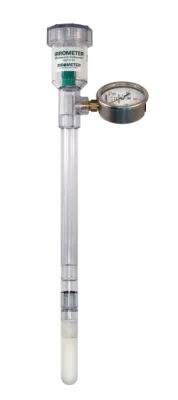
In irrigated fields, the suction can be highlighted with the tensiometer. The tensiometer (Figure 1) consists of a porous vessel filled with water, in hydraulic connection with a vacuum meter that registers the depression created inside the instrument to balance the soil suction, when the porous vessel is inserted into the soil. Tensiometers work well, ensuring the precise determination of soil suction, in the range of humidity easily accessible to plants.
 |
 |
|---|
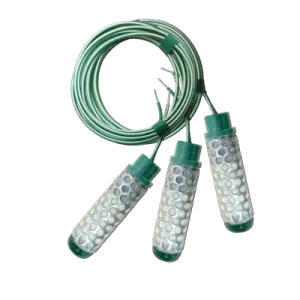
The Watermark sensor (Figure 2), also known as a granular matrix sensor, detects the quantity of water absorbed through a combination of carefully chosen materials. This mixture is a buffer for the sensor against different environmental factors such as salinity, and has a long life. The measurements from the Watermark sensors are calibrated to correspond to the levels that a tensiometer would measure. They do not need maintenance, have an estimated lifetime of more than 5 years, and, compared to the tensiometers, can maintained on the field all the time. The Watermark sensors are suitable for recording data or IoT devices and require a minimum amount of operational power to read.
Table 1. General characteristics of each sensor.
| Sensor type | Soil texture | Crop sensitivity | Tension range (cbar) |
|---|---|---|---|
| SR | Light to medium | Medium | 15 - 75 |
| LT | Coarse or sandy | High | 5 - 20 |
| Watermark | Medium to heavy texture | Medium to tolerant | 30 - 200 |
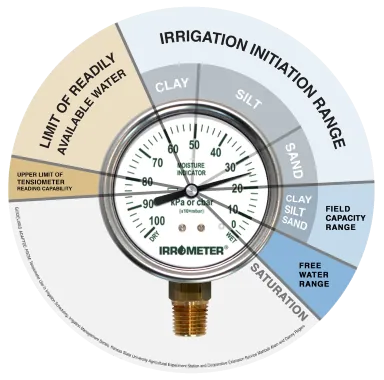
The readings in Figure 3 are used as basic guidelines as follows for Irrometer equipment or the Watermark sensors as follows:
In the range of 0 to 30, centibars, the soil is suitably moist (with the exception of coarse sands, which dry out).
The typical range for irrigation on most soils is 30-60 centibars.
The typical range for irrigation in heavy clay is 60-100 centibars.
100-200 centibars of pressure means that the soil is dangerously dry
Beyond broad recommendations, taking the effort to read and comprehend the data results in more precise irrigation thresholds and a more realistic picture of what is occurring in the root system of the specific crop to be irrigated. To make a correct interpretation of the data, it is crucial to understand a few fundamental ideas:
The volume of water that remains in the soil after extra water has been drained out and the velocity of downward movement has slowed down is referred to as the field water capacity.
The amount of water in the soil that a plant must have in order to avoid withering is known as the withering coefficient. Its standard normal value is 1500 centibars/kPa.
The range between field capacity and wilting point is typically used to determine useful (available) water capacity, which is the amount of water that can be stored in a soil profile and that is available to growing crops.
The amount of water that can be reduced before irrigation and is necessary to minimize crop stress is known as allowable depletion.
Choosing management thresholds
Thresholds are benchmarks that specify upper and lower bounds for controlling permissible depletion. This range depends on the type of soil, the crop, how plants develop, and the cultural practices used to manage fields, but a reasonable starting point is to regulate available water depletion between 10% and 40% wet and dry, respectively.
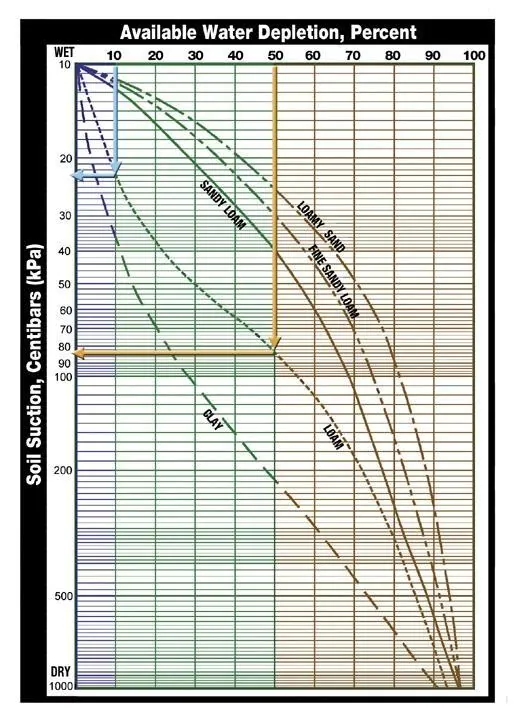
Each type of soil has a variable range of stress due to its different capacity to retain water, hence the amount of water accessible varies for each soil type. In other words, 84 centibars of soil water tension would represent 50% depletion in a pure clay and 40 centibars in a sandy clay. These interactions are represented graphically in the graph shown in Figure 4, which also serves as a guide for choosing the right threshold values.
Based on this chart, a calculator created by Cambridge University can be accessed online where one may choose a soil type, enter an acceptable run-off level, and then input sensor readings to determine whether irrigation is advised. Similar calculators providing information on the soil in different regions are available as apps.
The graph in Figure 4 illustrates the connection between soil water tension and permissible depletion. One should choose the soil type that most closely reflects the field from the chart to use. The soil type curve and the left axis with the label "soil water tension" are connected vertically at 10% available water depletion (shown by the blue/green boundary) to get the UD reference value. The lower (wetter) threshold line will be determined by this. This value would be 23 in this example of clay soil (shown by the blue arrow).
Next, a vertical line is built from the curve for the soil type down to the 50% available water depletion (shown by the green/brown border), and then a horizontal one across the left axis designating soil water tension to arrive at the DRY reference value. A higher (dryer) threshold line will be the result of this. This value would be 84 in this example of clay soil (as shown by the brown arrow). The 50% threshold is a general suggestion, it should be highlighted. Normal depletion thresholds range from 30% to 50%, with irrigation techniques that use less water per irrigation (such as center pivots) favouring the 30% to 40% range. For the best recommendations, agronomic expertise and knowledge are required.
Tensiometer types
The industry standard for precise soil moisture monitoring is the Irrometer tensiometer (Figure 1), which offers farmers a low-cost and trustworthy way to gauge soil moisture for irrigation scheduling. The Irrometer is unaffected by salinity and doesn't require on-site calibration because it offers a real measurement of soil water potential. Depending on the rooting depth of the particular crop, the Irrometer can be found in a variety of versions with typical lengths of 6", 12", 18", 24", 36", or 48". On request, further lengths are available.
The preferred tool for usage in medium to heavy soils is the "SR" Irrometer. The device features a reservoir, an airless measurement chamber, and a changeable threaded tip. In order to help producers increase irrigation effectiveness, the SR Irrometer was developed and produced first in 1951. Regardless of the type of soil, this instrument gives the user precise information on the soil moisture state. Centibars (cb) or kilopascals (kPa) are used by the instrument to measure soil water tension. The indicated value reflects the power expended by a plant's root system to draw water from the ground. Understanding soil moisture activity enables the user to plan irrigation systems intelligently, improving output and quality while saving money on water, fertilizer, labour, and energy.
Operational method: The Irrometer functions similarly to a tensiometer, which gauges soil water tension. As a plant takes in the water it needs, the plant applies to the soil a tension. Centibars (cb) or kilopascals (kPa) of tension are used to measure this force, with a high value signifying the dry end of the scale and a low reading signifying the wet end.
A sealed tube that is filled with fluid and has a porous ceramic tip and a vacuum gauge make up the Irrometer tensiometer. The tips are inserted into the ground at the specified depth of the root zone during installation. The fluid is extracted from the tool when the earth dries out (tension increases). As a result, the liquid volume decreases and a partial vacuum is created, which is recorded on the gauge. The gauge measurement rises as the earth becomes drier. This process is reversed by irrigation or precipitation. Lower gauge readings are the result of tension being released into the soil and into the instrument as the water flows back into the soil (and into the Irrometer). The gadget actually shows how hard the roots are working. Under typical operating conditions for various soil types, the Irrometer's unique operating principle means that no calibrations are necessary. Whether the crop is sown in sandy or clay soil, the roots are removing the same quantity of moisture, according to a reading of 50 cb (kPa).
Applications include the manual assessment and monitoring of the soil moisture state for the majority of soil types using Model SR Irrometers. Measurement and tracking devices with optional electronic output and data logging capabilities can be automated. Electronic measuring alternatives or automatic switching devices that can turn on auxiliary equipment at appropriate soil water tension levels can be used in place of the model's conventional vacuum gauge. For simple field maintenance, the SR model employs a replaceable tip. It is intended for widespread use with fields, trees, and rows of crops.
The LT (low tension) Irrometer is made for conditions in which tensions greater than 30 cb (kPa) are infrequently anticipated. It works best for very coarse soils, non-soil container media, or when it's important to keep track of sudden changes in the water status of the soil. The instrument features a reservoir, an airless measurement chamber, as well as a Quick-Flo replacement threaded tip.
The LT model was created to function on soilless growth media and coarse sandy soils. This instrument, which has a range of 0–40 centibars (cb) or kilopascals (kPa), is designed for use in conditions where forces greater than 30 cb (kPa) are infrequently anticipated. When finer precision close to saturation is required, measurement increments of 1 cb (kPa) are advantageous. This instrument model is also ideal for situations where soil moisture requirements must be satisfied despite rapid changes in those conditions. For simple identification, the "Quick-Flo" ceramic tip is coloured blue.
Applications include the manual assessment and tracking of soil moisture conditions in crop situations and coarse sandy soils using Model LT Irrometers. Measurement and tracking are automatic when using optional electronic output and data-logging devices. This model's low tension vacuum gauge can be changed out for electronic metering alternatives or automatic switching mechanisms that can turn on auxiliary equipment when the soil water tension is at a particular level. For container media like peat, bark, sand, perlite, and vermiculite, the LT model is the best option. When moisture is regulated near to field water capacity, it can also be employed in any soil [1].
The "MLT" (Miniature Low Tension) Irrometer is made for uses that are comparable to those of the "LT" variant previously mentioned. The tool works best when used with media for soilless containers and very gritty soils. It is the finest option for greenhouse applications because of its small size and interchangeable "Quick-Flo" tip.
Technical details: To help with irrigation scheduling decisions, the Irrometer Model MLT Soil Moisture Indicator combines soil moisture indicators. According to the tensiometer concept, the soil moisture indicator must display the soil water tension in units of centibars (cb) or kilopascals (kPa), depending on the application. It must feature a ceramic sensing tip, a stainless-steel indicator, and a sturdy plastic tube that is resistant to chemical attacks from soil. It must be made with the greatest accuracy possible for low tension applications. All connections between ceramic and plastic must be secure.
References
Finkel, H.J. ed. CRC Handbook of Irrigation Technology, CRC Press, Taylor & Francis Group, Boca Raton, USA, 2018.
Dobriyal, P., Qureshi, A., Badola, R., Hussain, S.A., A review of the methods available for estimating soil moisture and its implications for water resource management, Journal of Hydrology, 2012, 458-459, 110-117, https://doi.org/10.1016/j.jhydrol.2012.06.021.