
Module 3 · Chapter 5
Drip irrigation
Introduction
Traditional surface irrigation methods are not efficient, and thus, new irrigation technologies have been developed to satisfy the water need of plants and have increased productivity. One of these methods, based on pressurized irrigation, is drip irrigation. Also called trickle irrigation it works with slow flows of water that is dripping on the soil near the roots of the plants. The technology can be easily adapted to different kinds of soils and fields with different slopes. It is a very efficient method since water is distributed only in the immediate root area of the plants [1-4].
Drip irrigation also offers the possibility to be used in combination with a water treatment plant. The amount of water needed is lower than for the other technologies by up to 50%, which is beneficial also since there will be reduced weed growth. The system can be also used to apply fertilizers, in this case, the technique is called fertigation [1-5].
Basic Principle
The water flows through a distribution pipe system in which water circulates and reaches the soil through some special slow-release devices, located on the circulating pipes at different distances (Figure 1). In this way, water is efficiently applied to the plant roots, it limits evaporation and the problem of drainage. A very important part of the drip irrigation is a filter system for water because it ensures the flow without any clogging. Because there is a small flow rate of water application, the irrigation is done more frequently than with the other methods [5].
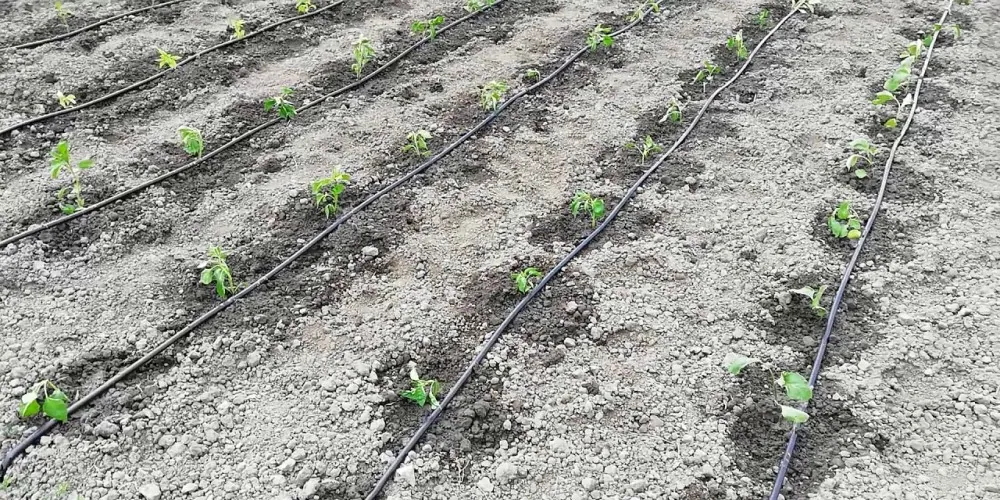
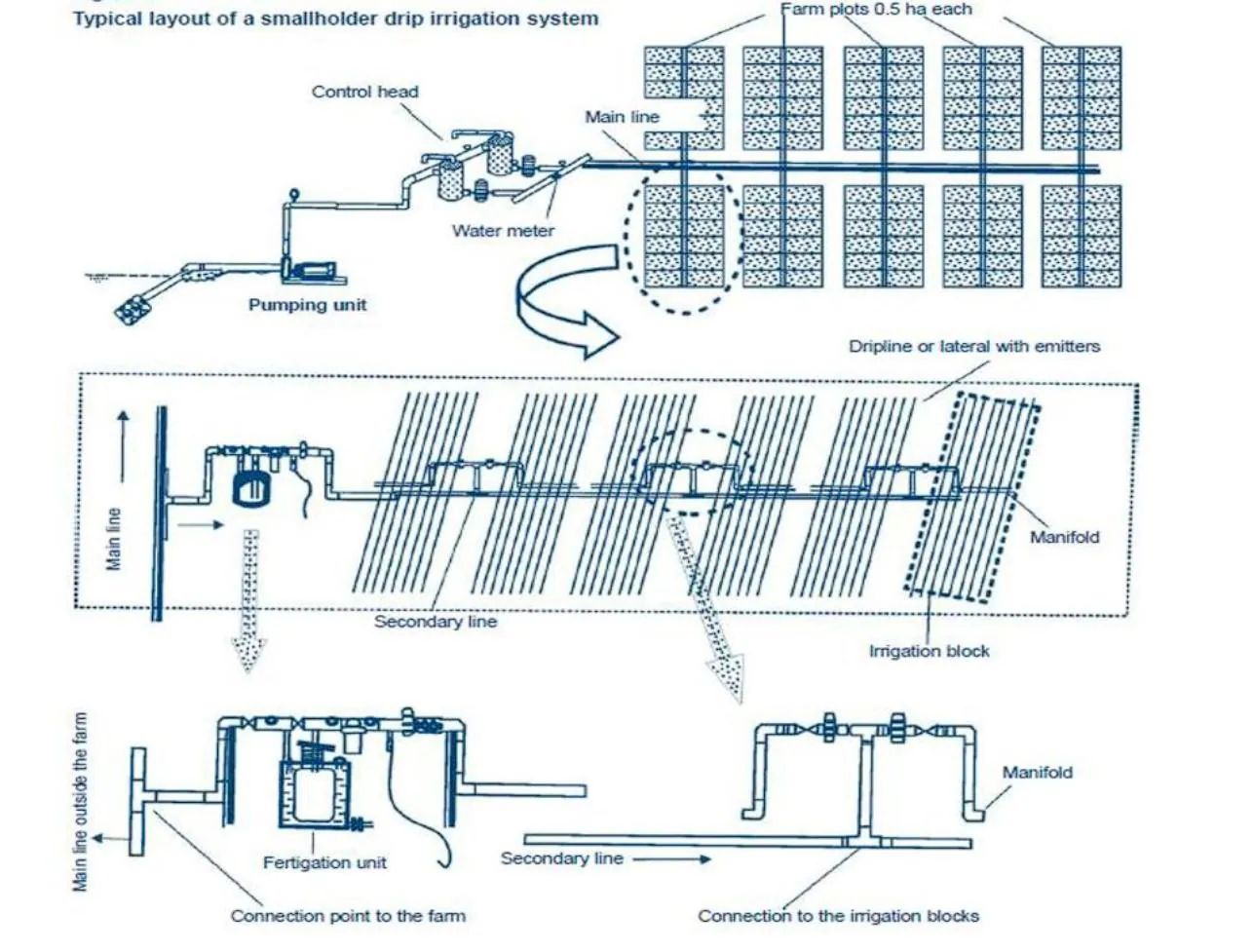
A typical drip irrigation system consists of a pump that ensures the right pressure for the water to be delivered through the pipe system, a control head, which is composed of a filtering system, a water measuring system, and a valve system that regulates the pressure, some could also have a tank for the fertilizer, as we shall later discuss, mainlines, sub-mainlines, and laterals that guide the water into the field, and drippers, some devices used to control the water discharge to the plants. The distance between the emitters depends on the type of crop and is given by the spacing of the plants in the field. The schematic representation of a drip irrigation system is represented in Figure 2.
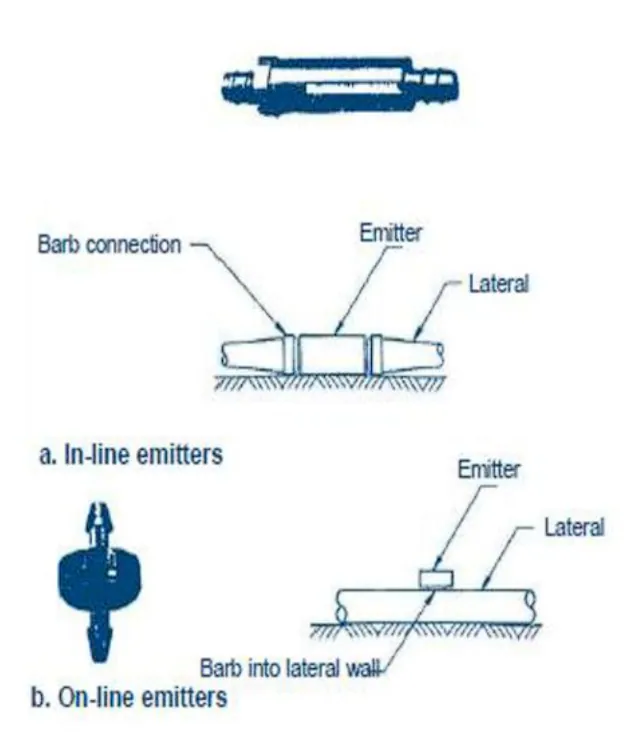
The emitters control the amount of water as well as flowing rate delivered to the plants, being an essential part of the irrigation system [5]. They can be divided into two large categories, depending on their connection to the lateral (Figure 3):
1. on-line drippers are found on top of lateral pipes, mostly used in groves, orchards, and sometimes for in-pot irrigation; they can have different diameter sizes (12 to 22 mm) and are usually mounted on top of polyethylene pipes through manual punch.
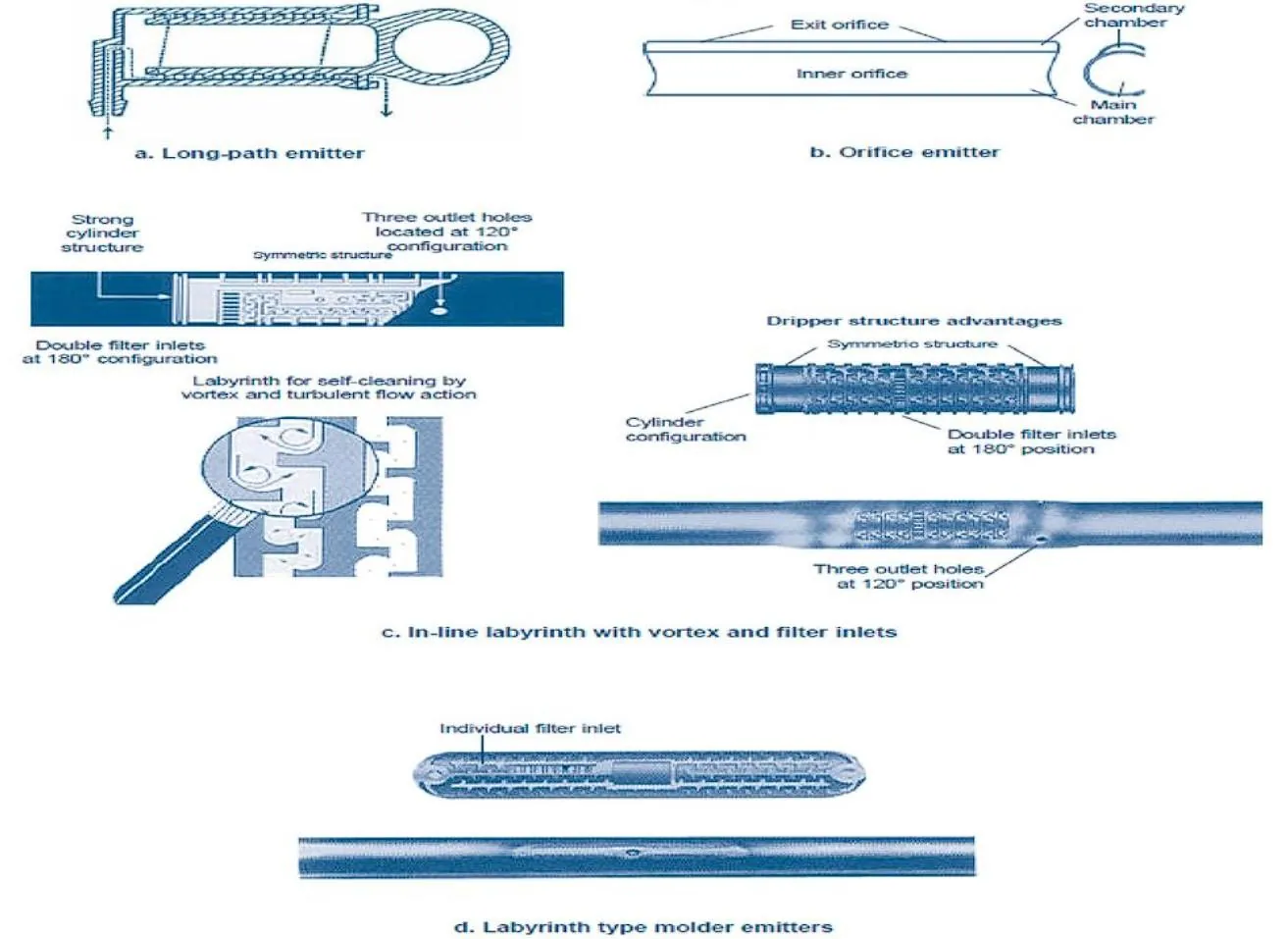
Depending on the mechanism used to dissipate the pressure (Figure 4), the emitters can be:
- long-path emitters – large-size emitters that have long water paths circling around a centre point. They are characterized by a laminar flow
-short-path emitters – the water path is shorter, and these emitters work well in small pressure systems allowing the fall of water due to gravity
-turbulent flow emitters – they have relatively long flow paths or short paths but large cross-sections such as the flow regime is turbulent
-vortex emitters – the water flows through a round cell that produces a circular flow and, thus, the pressure is reduced, decreasing the rate of flow drops. The circular motion takes place because the water enters tangential to the outer wall, producing a fast rotation movement that creates a vortex. That is why it is called a vortex emitter. This configuration allows the use of large openings; thus, the system is less susceptible to clogging
-diaphragm emitters – these emitters use a flexible diaphragm, sometimes with holes, which reduces the flow and pressure. A disadvantage is that the membrane can become distorted in time
-adjustable flow emitters – design wise they are similar to short-path emitters, allowing a high flow rate than the other types
-mechanical emitters – use a chamber that fills with water and then it releases it at specific times
2. in-line drippers, also called “driplines” – are an actual part of the laterals. These emitters are used in fields where there is a high density of plants such as different crops, dense orchards, and underground irrigation. They come from the factory with specific flow rates and release intervals.
-low-density polyethylene piping (LDPE) – this type of pipe is the most expensive but also the most professional one; they have a cylindrical shape and are found inside the drip lines (see Figure 3 (c)).
-flat LDPE – to save space during transportation, sometimes the pipes come in flat or oval shape. These emitters have a small profile and thus they do not affect the flow.
-drip tape – is used in large fields, mostly for field crops, and also can be employed in underground drip lines.
Sizing the emitters is necessary because the plant needs for water depend on many factors as previously discussed in another lecture (e.g., plant development stage, climate, soil parameters). Except for these parameters, one should also consider the spacing of the emitters, the length of the pipe system, the topography of the field, and crop spacing, the least. Considering these facts, the type of emitters can be optimally chosen.
Despite the fact that all emitters are able to regulate the pressure, there is another classification:
1. pressure-compensating emitters – these are emitters that can discharge the water at a uniform rate on a large range of water pressure. Diaphragm emitters are part of this category. A silicone membrane restricts the flow cross-section as the value of the pressure is increasing. This type of emitter is useful when there is a high elevation difference (>0.5m) or when long drip pipes are used.
2. non-compensating emitters – when the water pressure variates, these are not able to regulate it as the pressure-compensating emitters do
Drip irrigation technology can be applied to most of the crops, with high performance. A simple drip system can be realized using a water tank placed at some height above ground level to ensure the pressure and water flow in the system. First, the water is filtered and reaches the mainline, then the secondary lines, which can be made by simple PCV pipes or other local materials such as bamboo. The flow is regulated with a valve. For small farms, the costs are relatively low, while the systems for big farms with industrial productions need very expensive systems. Maintenance is mandatory; the drip hoses must be lifted from the ground such as soil particles do not enter the system clogging it. In order to remove any clogging agents, the analysis of water must be performed before deciding on the appropriate water treatment. Periodically flushing the system is also a good practice to ensure its optimum functioning, as well as periodically monitoring the flow and pressure [5].
The clogging of the emitters is a serious problem that can have a multitude of causes:
-physical clogging due to the presence of sand, silt, metallic flakes, plastic chips
-chemical clogging due to the precipitation of salts, iron, fertilizers, etc.
-biological clogging due to the growth of algae and bacterial slime.
Most of the time there is a combination of these clogging sources, especially when using surface water or when the water is pumped from opened reservoirs, or when saline water and fertilizers are used. Saline water contains a lot of cations and anions that can easily precipitate and deposit. From the chemical point of view, high pH, high concentrations of ions, and increased hardness are prone to create issues.
Subsurface Drip Irrigation
There is a variant of drip irrigation that uses buried drip pipes (Figure 5). Regulating the phreatic levels (sub-irrigation) is suitable only for areas where the phreatic layer is relatively shallow (1-4 m). By supplying water, brought through a network of pipes or channels from an external source, the water table can be raised in such a way as to ensure the water supply of the plants by capillary ascent. Also, the method is recommended in the version with drains or perforated watering lines buried in the soil at the base of the root system of the plants, for irrigation using waste water.
The method is more efficient than simple drip irrigation, saving water by reducing water evaporation and the incidence of different pests, and providing uniform wetting in the area of the plant roots. A subsurface drip irrigation system is suitable in areas where the water evaporation increases due to climate conditions (arid, high temperatures, high wind), and mostly on sandy-type soils. The application of water underground eliminates several of the issues of surface irrigation such as soil water saturation, ponding, runoff, and soil erosion.
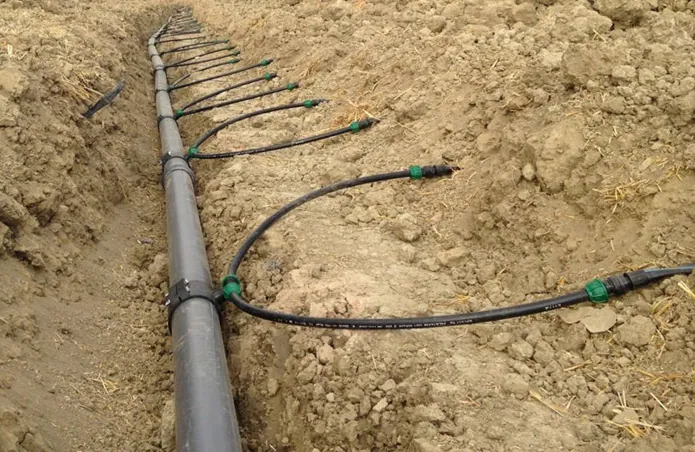
The technology can be adapted to any kind of crop; however, it is used for high-value vegetable crops, turf, and landscape. If it is used with plastic mulches, it was shown to considerably enhance production. Compared to surface drip irrigation, the use of underground piping makes them less exposed to sunlight and other factors that can destroy them. The technique can be used much closer to the cutting date because the surface of the soil remains dry all the time, and thus can be easily managed. In some cases (alfalfa) subsurface drip irrigation can stimulate germination as well.
The layout of a subsurface irrigation system is similar to the simple drip irrigation one. For easy drainage, a system with vacuum pumps and valves is used to release the trapped air that can disrupt the water flow. The tubes are put below the surface of the soil at about 12 to 50 cm, depending on the crop and type of soil. Placing the system underground also facilitates the tillage of the soil. The emitters are installed upward. The system needs a filtration unit as well for the reasons already discussed for drip irrigation.
Both drip and sub-surface drip irrigation methods have been studied in parallel to determine the most efficient one. Analyses have been made regarding the properties of the soil, the water use efficiency, cropping techniques, irrigation scheduling, yields, and other parameters. From all the studies it seems that sub-surface drip irrigation is more efficient than drip irrigation method, with higher production, improved plant quality, water saving (up to 20%), which recommends it to be used in areas where the water resources are scarce and need to be conserved
Fertigation represents the use of fertilizers combined with the water for irrigation. In such a way, not only the water and fertilizers are reaching the plants, but there is less leaching of nutrients. Except for the water needs of the crop, in this case, some other things must be also considered for efficient fertigation such as the ability of the crop to uptake the nutrients, how much nutrients are in the soil at a specific time, and how much nutrients should be in the water used for fertigation.
Conclusions
Drip irrigation is an efficient irrigation method, involving relatively low costs and small labour, that can be used for fields with irregular shapes without any need to level it as required for example in surface irrigation, can use recycled water, the water can be distributed very uniformly over the field, it operates al low pressure, meaning that the energy costs are reduced, and it implies reduced loss of fertilizers due to local application of water, thus reducing the erosion as well [3-6]. Despite the many advantages, a drip irrigation system requires high initial costs, and needs high maintenance, especially of the filtration system. The pipe system can be affected by the sunlight, shortening its life, thus in some cases sub-surface irrigation is preferred.
References
van der Kooij, S., Zwarteveen, M., Boesveld, H., Kuper, M. The efficiency of drip irrigation unpacked, Agricultural Water Management, 2013, 123, 103-110, https://doi.org/10.1016/j.agwat.2013.03.014.
Martinez, J., Reca, J., Water use efficiency of surface drip irrigation versus an alternative subsurface drip irrigation method, Journal of Irrigation and Drainage Engineering, 2014, 140, https://doi.org/10.1061/(ASCE)IR.1943-4774.0000745.
J.P. Venot, M. Kuper, M. Zwarteveen, Ed., Drip irrigation for agriculture, Routledge, New York, 2017.
Jamrey, P.K., Nigam, G.K. Performance evaluation of drip irrigation systems, The Pharma Innovation Journal, 2018, 7, 346-348.
Shi, K.; Lu, T.; Zheng, W.; Zhang, X.; Zhangzhong, L. A Review of the Category, Mechanism, and Controlling Methods of Chemical Clogging in Drip Irrigation System. Agriculture 2022, 12, 202. https://doi.org/10.3390/agriculture12020202.
Grant, F., Sheline, C., Sokol, J., Amrose, S., Brownell, E., Nangia, V., Winter, A.G. Creating a solar-powered drip irrigation optimal performance model (SDrOP) to lower the cost of drip irrigation systems for smallholder farmers, Applied Energy, 2022, 323, 119563, https://doi.org/10.1016/j.apenergy.2022.119563.