
Module 4 · Chapter 7
Decreasing negative impacts on the environment and people
WHAT ARE PLANT PROTECTION PRODUCTS
Plant protection products (PPP) are preparations used in agriculture to protect plants and crops from pathogens, weeds and pests. Before placing them on the market, it is necessary to evaluate their active ingredients, which contain substances that may have dangerous properties, and to determine their acceptable use in order to ensure the protection of people and the environment. The process of evaluating active substances and preparations is called registration. We try to reduce the risk to human health and the environment as much as possible by controlling the traffic and use of plant protection products. In Slovenia, as well as other EU members, we mainly support other methods of plant protection before the use of plant protection products, even though we are aware that plant protection products are still important for today's agricultural production. (1)
USE OF PLANT PROTECTION PRODUCTS
The way plant protection products are used plays an important role in preventing potential negative impacts of PPP on the environment and human health. PPP must be used in a manner that does not contaminate groundwater and surface water and to prevent reliance of PPP on adjacent surfaces. This should also be done when preparing the spray slurry, removing the remains of the spray and packaging. During use, personal protective equipment is mandatory to protect the user's health. (1)
THE EFFECT OF THE USE OF PLANT PROTECTION PRODUCTS ON PEOPLE
PPP can enter the body in different ways, such as by inhaling aerosols, dust and vapors containing pesticides; by oral exposure through consumption of food/water; and by direct contact skin exposure. PPP are released into the soil and groundwater, which can end up in drinking water, and pesticide sprays can drift and pollute the air. The effects of plant protection products on human health depend on the toxicity of the chemical and the length and extent of exposure. Farm workers and their families are most exposed in direct contact with PPP. Every person contains PPP in their fat cells. In humans, children are the most vulnerable group because they are still developing and their immune system is not yet as developed or weaker than that of an adult. In any case, with improper handling of PPP, these can bioaccumulate in the body. (2)
PPP can be divided according to their dangerous properties for human health in case of acute exposure into:
- harmful to health - such PPP cause damage to various organs (liver, kidneys, ...) and organ systems (nerves, bones, ...). Damage mainly occurs after ingestion, skin contact or inhalation
- irritant - this type of PPP cause suffocation due to irritation of the respiratory tract (lungs, trachea, nose), can cause coughing, watery eyes, irritation of the skin and mucous membranes, which can manifest as inflammation of the skin and mucous membranes.
- Caustic - this type of PPP causes ulcers and burns of the skin and mucous membranes. (3)
REDUCING THE IMPACT OF PPP ON HUMAN HEALTH
In order to reduce the negative impact of PPP on human health, it is necessary to follow the basic rules of safe use of PPP. The fact is that PPP are not dangerous when used correctly and thus reduce the negative impact on human health as well as on the environment. At the same time, the following steps must be taken into account:
- Before purchasing PPP, we always first check the stocks and at the same time remove all those PPP that have expired. We take such resources to the nearest hazardous waste collection center
- PPP are always stored in appropriate rooms, which must be locked
- We always buy registered PPP. When transporting, we ensure that PPP are transported separately from animals, food, agricultural products and feed, and we ensure the safe transport of PPP to the place of use
- Before use, carefully read the instructions for use
- During the preparation and dosing of PPP, we always wear personal protective equipment, which we also use during spraying and later when cleaning devices for applying PPP. Always wash the gloves after use. (4)
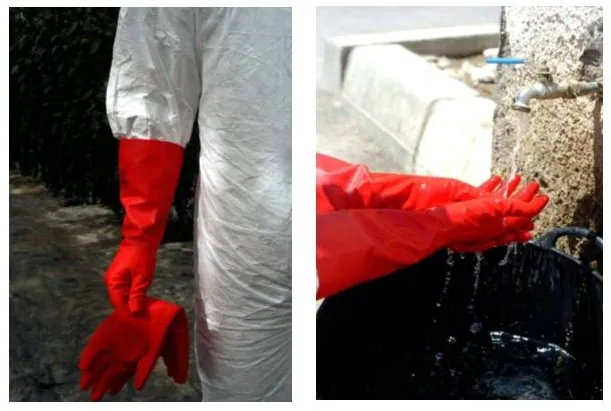
Figures 1: Personal protection equipment
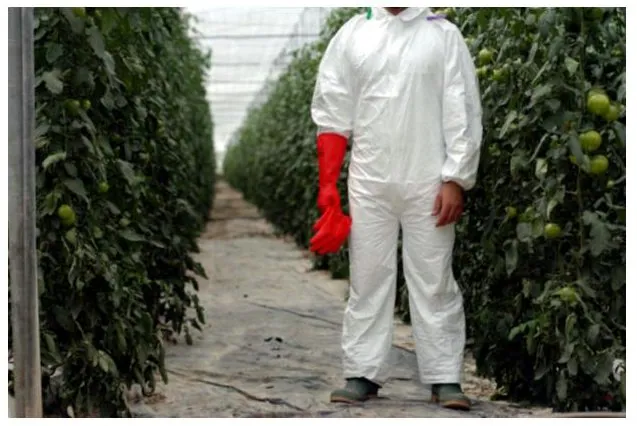
Figures 2: Personal protection equipment
- We use modern and technically impeccable spraying devices, which prevent point pollution and drifting of the spraying slurry. (4)
- After use, empty PPP are properly stored until they are sent to the collection point (4)
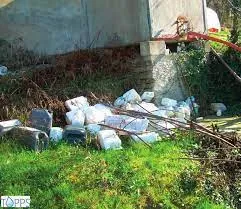
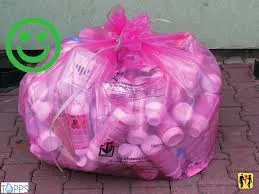
Figures 3 in 4: An example of correct and incorrect storage of waste packaging of plant protection products
IMPACT OF THE USE OF PPP ON THE ENVIRONMENT AND BIODIVERSITY
In the long term, the well-being of agricultural economies mainly depends on the ecosystem services of living organisms, water, air, soil quality and other natural resources. Good management must therefore include the protection of the environment if we want to ensure the preservation of all these resources, which are important for all living beings. PPP are indispensable in food production nowadays, but their improper use can have a very heavy impact on the environment. In addition to the positive effects of PPP against harmful organisms, their use can have many environmental impacts: they can contribute to the pollution of water sources, air and soil, and due to their toxicity to non-target organisms, they affect important functions of ecosystems, such as natural pest control or pollination. It is important to be aware of the main causes that can lead to negative impacts on the environment. These causes are: improper disposal of waste PPP and packaging, inappropriate application of spray slurry, spreading of spray slurry outside the treatment area and spills. (3)
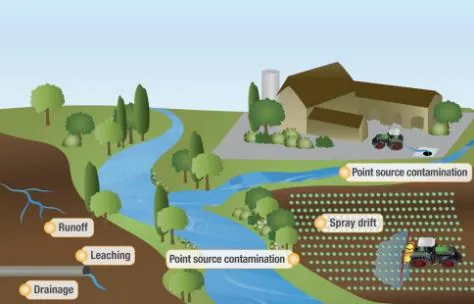
(Source: Basic principles of good agricultural practice Plant protection and use of PPP)
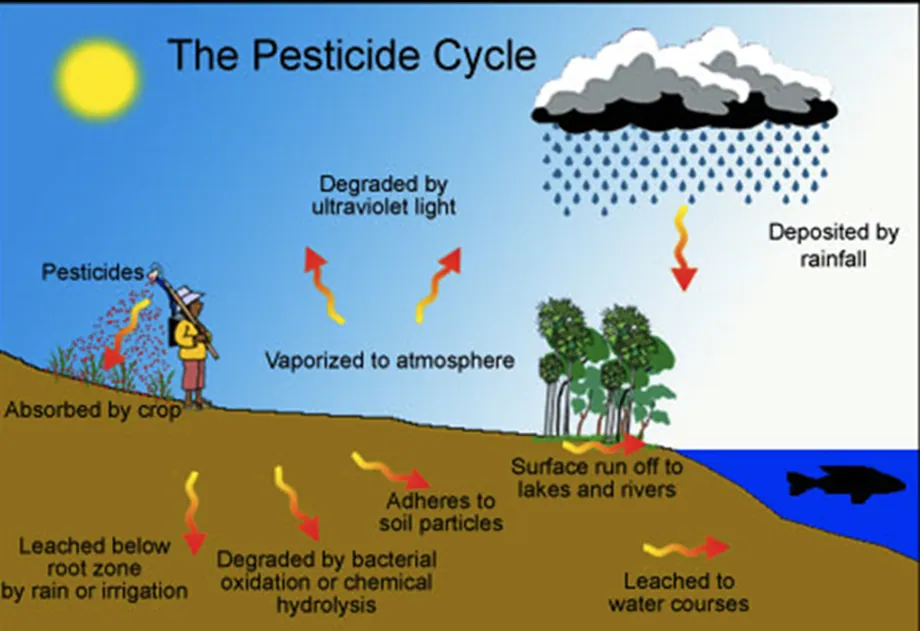
REDUCING THE IMPACT OF PPP ON THE ENVIRONMENT AND BIODIVERSITY
In order to reduce the negative impact of PPP on the environment and biodiversity, it is necessary to take measures into account: it is necessary to prevent reliance on neighboring agricultural and non-agricultural areas, on nearby water sources by properly planning the correct application of PPP, by using appropriate spraying machinery and by following the instructions for correct use of PPP.
Insofar as the application of PPP is carried out over-relying only on these, the amount of PPP that must be applied to the target organisms is reduced. As a result, the spraying efficiency is reduced.
It is also recommended to establish so-called green belts in the vicinity of agricultural areas, which are overgrown with dense plant cover, which helps us to reduce the reliance of PPP on e.g. nearby water sources, to neighboring agricultural areas and help prevent surface erosion of spray slurry.
Prescribed measures and more detailed methods of correct use of PPP to reduce risks to the environment due to their use must be defined in the national legislation of each country. (3)
MEASURES TO REDUCE RISK WHEN USING PPP PRODUCTS
When implementing measures to reduce risks in the use of PPP, it is necessary to adopt certain general measures that must be taken into account, regardless of whether a risk assessment for PPP has also been made regarding safe use and application. (3)
These measures are as follows:
- When using PPP, care must be taken to never spray over bodies of water (ditches, wells, melioration channels, drainage ditches, etc.).
- It is necessary to establish an untreated safety belt on agricultural land, for the protection of aquatic organisms. For example, in Slovenia, safety zones are at least 5 meters from 2nd order waters and 15 meters from 1st order waters (rivers, lakes, seas).
- The selection, application and use of PPP must be adjusted according to the hydrological and climatic conditions of the area and soil properties.
- There is a greater possibility of surface runoff and erosion on non-vegetated terrains, which can be prevented by establishing green belts, by plowing in layers or across the slope of the inclined terrain, by using minimal cultivation techniques, by mulching during the vegetation period, by covering the soil, by ensuring an adequate supply of organic matter.
- The use of PPP is not permitted on flooded and frozen soil.
- When implementing irrigation, it is necessary to plan irrigation very carefully and appropriately, taking into account the condition of the soil, the physical and chemical properties of the soil and weather factors.
- Soil irrigation after PPP application increases leaching and surface runoff similar to rainfall. (3)
It is very important that when using PPP we take into account all the measures we have listed, and at the same time it is important that each user of these resources keeps accurate records of the use of PPP.
Preparation:
Katarina Kresnik