
Module 4 · Chapter 1
Integrated pest management (IPM)
Integrated plant protection has been developed with the aim of managing harmful organisms, which should not be based on and depend solely on the use of chemical substances. Integrated plant protection means the systematic and planned management of harmful organisms and combines various approaches to plant health, based on a combination of biotic, processing, physical, biotechnical and chemical methods of plant protection. Integrated plant protection also means reducing the risk to the economy of agricultural production, human health, environmental protection and reduction of negative effects on non-target organisms.
In the Regulation on the placing of plant protection products on the market, the concept of integrated plant protection is described on the basis of the FAO definition: The Integrated Plant Protection Program takes into account all available ways of plant health protection against harmful organisms and is also open to further integration of measures that prevent the development of harmful organisms, the use of plant protection products and other plant protection measures at the level necessary to keep the population and reduce the risk to human health and the environment. Integrated plant protection also aims to promote natural plant protection mechanisms against harmful organisms.
The Plant Protection Products Act (UL RS 83/12) states: Integrated protection of plants against harmful organisms means careful consideration of all available methods of plant protection, which results in the integration of appropriate measures that prevent the development of populations of harmful organisms. In integrated pest management, the use of plant protection products should be at an economically and ecologically sound level, with the aim of reducing the risk to human health and the environment. Integrated pest management emphasizes the growth of healthy plants with minimal impacts on agricultural ecosystems and promotes natural mechanisms for protection against harmful organisms.
Integrated plant production of crops, fruit, grapes and vegetables is carried out in Slovenia under constant professional supervision by organizations for the control and certification of integrated production. If the cultivation is carried out in accordance with all requirements, the organization for the control and certification of the grower issues a certificate, which is guaranteed that the labeled crops correspond to a higher standard of cultivation.
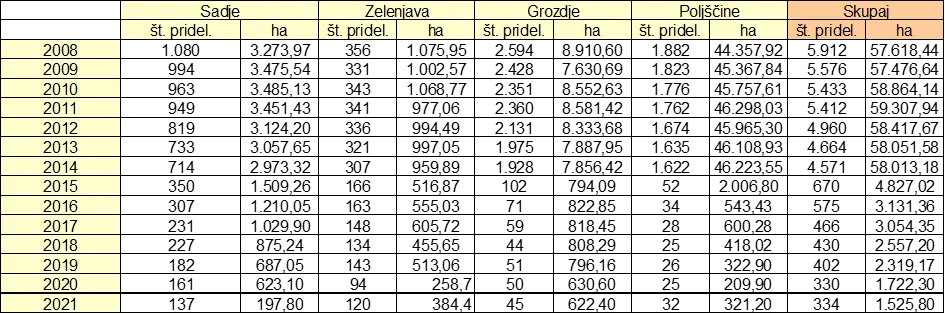
Table 1: Number of growers and fields (ha) included in various schemes of integrated cultivation from 2008.
Integrated pest management principles and guidelines
Integrated plant protection is a process based on knowledge and experience and is open to new ideas, scientific knowledge and technological advancement. It is based on the detection, identification and precise definition of the size of the population of harmful organisms and on the assessment of the economic damage that these organisms can cause.
Integrated plant protection should focus on the objectives of sustainable crop production, where non-chemical, environmentally friendly, plant protection methods and the targeted and cost-effective use of plant protection products are preferred.
The most important principle of integrated plant protection is that we do not decide on the use of plant protection products only when other pest control measures are not effective enough. In this regard, the helpers of "Observation and Forecasting Services", which are based on the on-going monitoring of harmful organisms, weather conditions and the development of plants, are helpful to growers.
Integrated plant protection requires a good knowledge and understanding of the farming system and the combination of smart knowledge of old, existing and new technologies, since the natural balance in crops can not be achieved only by simply reducing the use of plant protection products.
Integrated plant protection is a process that is constantly being upgraded and incorporates many innovative solutions that are adapted to the place and time of crop production and significantly contribute to reducing the dependence of agricultural production on the use of plant protection products.
In the effort to reduce the negative impacts of the use of PPP on humans and the environment, most European countries have developed guidelines for integrated crop production. This is regulated by the Rules on integrated production of crops, vegetables, fruits, grapes and wine (UL RS 110/10). Each year the Ministry of Agriculture, forestry and food published detailed technological instructions for integrated production. Chapters dealing with plant protection mainly contain brief technological instructions and data on authorized plant protection products for the control of individual diseases, pests and weeds.
Basic principles of integrated pest management
Integrated plant protection instructions prepared in most countries are similar to those of some international organizations dealing with plant protection (IOBC - International Organization for Biological Control), mainly refer to the eight so-called basic principles that are also defined in European legislation (Directive 2009/128/EC).
Preventive measures
With proper selection of the site (location of the site, soil structure…), appropriate ring and method of production (soil treatment, sowing time, sowing / planting density, cut, educational forms, weed control techniques, sowing of mixed or intermediate crops (where applicable use of resistant / tolerant cultivars, planting or sowing of certified planting / seed material, appropriate fertilization, liming, irrigation or drainage, hygiene measures, creating conditions for the development and dissemination of useful organisms, eg creating so-called ecological niches) , we take care of the good condition of plants and contribute to their better resistance to harmful organisms.
Monitoring of harmful organisms
Regular inspection of crops or monitoring the occurrence, development and spread of harmful organisms is one of the key elements of integrated plant protection. The acquisition of information on the health status of agricultural plants and the development of harmful organisms, the size of the population, the extent of the attack / infection and the biological and potential economic impact of the harmful organism is carried out with producer direct observations directly on the ground and with the help of information "Observatory forecasting services for plant protection" agricultural advisors. In determining the time and space of the most effective integrated plant protection measure, the correct identification (identification) of a harmful organism based on morphological characteristics or in more complex biological, chemical or genetic analyzes is of paramount importance for the selection of the appropriate. On the basis of officially collected biotic data, weather conditions, and on the basis of information and warnings from the "Observation and Forecasting Plant Protection Service", we decide when and when and how we will act.
Thresholds of harm
Integrated plant protection programs are based on the consideration of economic thresholds of harmfulness, critical numbers (if available). Based on the results of the monitoring of harmful organisms and taking into account the levels of harm, producers decide whether to act at a given moment or not.
Use of non-chemical methods of plant protection
Biotic, physical, biotechnical and other non-chemical methods of plant protection have priority over the chemical control of harmful organisms, prior to the use of the plant protection product in case they provide sufficient management of harmful organisms. It is only in cases where, despite the use of non-chemical methods, the level of a harmful organism is unacceptable for the normal production of agricultural plants, we use the use of chemical plant protection products.
Targeted use of the plant protection products
Any use of plant protection products should be targeted as far as possible (use of specific plant protection products) and minimize harm to human health, non-target organisms and the environment.
Reducing the use of plant protection products to the lowest extent
The use of plant protection products, including other plant protection measures, is limited to the level strictly necessary to ensure adequate plant health (eg reduced doses of plant protection products, reduced spraying frequency, partial or target application of plant protection products - eg in species). In doing so, the risk to agricultural crops, as well as the risks to the development of potential resistance of harmful organisms, should be acceptable. Synthetic plant protection products should therefore only be used when necessary, when all other possible methods of controlling harmful organisms, these are ineffective from the point of view of the economy of crop production.
Anti-resistance strategy
The use of an "anti-resistance" strategy, based on the use of plant protection products with different methods and spectrum of action, is particularly important in cases where there is a need for repeated (repeatedly) pest control and for organisms that have already emerged resistant biological breeds.
Observation, monitoring, recording and verification
Through regular and thorough monitoring of harmful organisms and keeping records of the use of plant protection products and other measures of protection, growers regularly check the effectiveness of the plant protection measures applied.
Advantages and disadvantages of integrated pest management
Advantages of integrated pest management
-A more in-depth knowledge and monitoring of harmful organisms and cultivated plants allow a timely and appropriate selection of appropriate measures;
-Due to the reduced use of plant protection products or the use of eco-toxicologically more suitable and narrow-acting plant protection products is a reduced risk to human health, the environment and non-target organisms and reduced exposure of plant health providers;
-Reduced use of plant protection products in the long term leads to financial savings in comparison with conventional plant protection;
-Favorable environmental impacts lead to more stable agricultural production in the long term;
-Integrated plant protection reduces the likelihood of the occurrence of resistant pests of pests against plant protection products.
Disadvantages of integrated pest management
-Integrated plant protection requires more time and knowledge compared to conventional plant protection;
-Greater coordination and the efforts of operators to ensure proper and effective plant protection;
-Integrated plant protection is initially more expensive than conventional plant protection;
-Higher risk of uncontrolled development of harmful organisms.
Requirements for integrated pest management
- Only authorized plant protection products may be used;
- Authorized plant protection products should only be used in the prescribed manner and at the prescribed doses;
- The entry of plant protection products must correspond to the maximum prescribed number of treatments in relation to the preparation;
- Withholding periods must be taken into account;
- About the plant protection products used, producers are obliged to keep records and keep accounts where all the PPPs that have used them must be entered;
- The application of plant protection products must comply with the standards in these instructions and adapted to the growing form and the state of vegetation;
- It is necessary to ensure that the loss of the spray broom due to drift, evaporation or leakage of the sprinkler slurry on and into the ground is minimized;
- Appliances for the application of plant protection products must be tested;
- The users of the PPP must have a valid certificate of acquiring knowledge from phytomedicine;
- Proper storage of plant protection products and the management of their waste. waste packaging;
- The purchase of plant protection products in foreign countries, as well as their use, are not permitted under the Plant Protection Products Act.
The rules on the duties of users of plant protection products (Official Gazette of the RS, no. 62/03, 5/07, 30/09, 83/12 – ZFfS-1, 43/14 and 71/14) stipulate that the user must ensure that the plant protection product does not come into direct contact with humans and that the spray slurry does not get into watercourses, lakes and other waters, into groundwater, into facilities for drinking water supply, neighboring cultivated plants, land and warehouses of agricultural products, into storage facilities and processing of plants, facilities for breeding and care of animals, if such use may endanger human and animal health. Plant protection products should be used in accordance with the instructions for use, observing the indications and warnings on the label. When spraying is have to be done, it is necessary to use the method that is most appropriate from the point of view of good agricultural practice and environmental protection. The user must handle with plant protection products in such a way as to comply with the provisions of the regulations governing safety and health at work. When spraying at night in the vicinity of settlements, regulations governing public order and peace must be observed. Spraying must be carried out in a way that prevents reliance on neighboring plots or neighboring cultivated plants, taking into account the speed and direction of the wind. If the field is adjacent to a road or path, where people are walking or transporting bees during the spraying period, who may be exposed to the negative impact of plant protection products, the user must temporarily stop spraying. Users, whose fields are adjacent to kindergartens, schools, children's and sports playgrounds, medical facilities, retirement homes or other similar facilities must notify the local administration of the facility in writing at least 24 hours before using the plant protection products. The notification must include the trade name of plant protection product, method, date and estimated time of spraying. Tractor sprayers and motorized backpack sprayers must be used at a distance of at least 20 m from the apiary, buildings from the previous paragraph, or residential buildings and their functional lands where people stay or agricultural crops are grown. The flowering undergrowth in permanent orchards must be mowed during the spraying with plant protection products, which are dangerous for bees, or must be prevented in some other way so that the plant protection products can reach it. The use of systemic, bee-dangerous plant protection products is prohibited during the flowering period of cultivated plants. The use of contact, bee-dangerous plant protection products is allowed during the flowering of cultivated plants at night from two hours after sunset to two hours before sunrise. The user of plant protection products must observe the restrictions of use on certain soils due to the protection of groundwater and groundwater, as shown in the label and instructions for use of plant protection products and the use of plant protection products in certain areas in accordance with the regulations governing the protection of water. Spraying, preparation of the spray mixture and washing of plant protection products application devices are not allowed in the immediate vicinity of springs, watercourses, lakes, other waters and drinking water supply facilities. It is not allowed to flush plant protection products residues into wells, cesspools (outlets), septic tanks and sewers. The water used to clean the devices must be sprayed on the already treated surface or on another, biologically active surface. When spraying fields are located near water, the safety zone have to be determined in accordance with the regulations the protection of water and the information on the label or in the instructions for use.
The prescribed measures in integrated pest management
- The purchase of plant protection products in foreign countries, as well as their use, are not permitted under the Plant Protection Products Act.
- Mechanical measures: removal of infected parts or whole plants, removal of parasitic plants, mechanical weeding of weeds, use of blinds and covers...
- Biotic measures: The producer creates favorable living conditions for the development of beneficial organisms by: preserving and planting hedges, shrubs and other varieties of plants; cultivates a variety of underpasses; for the shelters of useful animals they are regulated by rocks and piles of branches; sets hatcheries for useful birds; installing high poles to attract birds of prey; observing, introducing and controlling a useful fauna (especially predatory mites, mates, tremors, tanners, swarms, pickles ...).
- Biotechnical measures: use of pheromone baits, acoustic appliances, methods of confusion and other possibilities of catching insects (eg mass catches).
- Chemical measures: Where, despite the application of the above-mentioned measures, the threshold of harmfulness is exceeded, plant protection products may be used.
References
- IPM Portal: https://www.ivr.si/.
- IPM: https://www.gov.si/teme/integrirana-pridelava/.
- Rules on integrated pest management: http://www.pisrs.si/Pis.web/pregledPredpisa?id=PRAV11530
- Rules on the responsibilities of users of plant protection products: http://www.pisrs.si/Pis.web/pregledPredpisa?id=PRAV3724
- Rules on the proper use of plant-protection products: http://www.pisrs.si/Pis.web/pregledPredpisa?id=PRAV11541