
Module 5 · Chapter 2
Indirect impact of climate change on livestock production
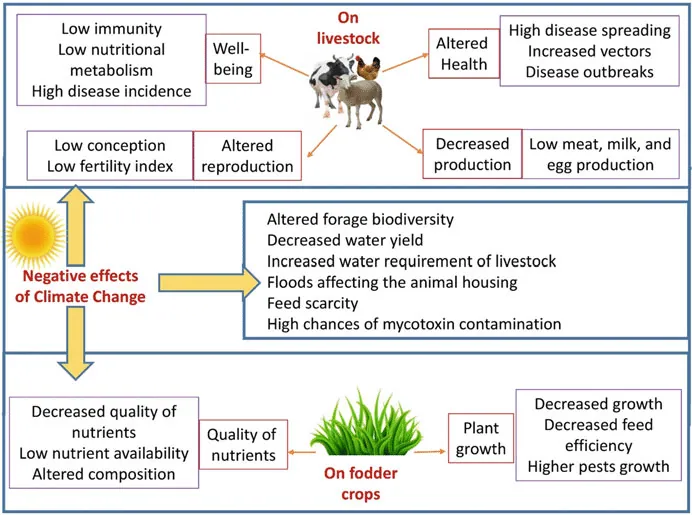
Various scenarios of climate change predict a temperature increase of 1.1°C to 6.4 °C by the end of this century [1]. Along with global warming, changes in the precipitation regime and increasingly frequent extreme climatic events represent a potential danger for the provision of food and water in farm animals breeding. In addition to the direct impacts discussed in the previous chapter, the indirect effects of climate change on soil fertility and degradation, availability of water, fodder yield, quality and availability, and the spread of pathogens must also be taken into account.
Forage Quality
Adequate nutrition is essential for animal health, desirable growth, production and reproduction. Increases in atmospheric CO2 and temperature, as part of climate change, change the quantity and quality of forage, with the intensity of these changes depending on the animal husbandry system, location and species [2]. In addition to the above, significant influencing factors are precipitation patterns, extreme climatic events, variations in production and water supply.
The direct impact of climate change on livestock nutrition (food intake and digestive processes) has already been discussed. Indirectly, climate change can affect livestock nutrition through changes in the physical and chemical characteristics of plants that are part of livestock feed. In this way, climate changes also affect the quality of feed for livestock (cereals and roughage). Depending on the degree of warming and the severity of the drought, plants respond to heat stress in different ways physically and chemically. Acidic and neutral detergent fibers, crude protein, nitrogen, water-soluble carbohydrates, and minerals (Ca, P, Mg, K) are typical nutritional parameters taken into account when forage quality is discussed [3].
Variations in nitrogen and water-soluble carbohydrate concentrations are influenced by dry conditions and high temperatures [4]. Extreme weather conditions cause tissue to age prematurely, which can dramatically lower the quality of the forage. Specifically, plants mature faster and the water content in their tissues is reduced more quickly even under mild heat stress. Lignification and an increase in the stem-to-leaf ratio negatively affect the digestibility and quality of forage. Lee et al. [5] warn that an increase in temperature reduces the nutritional value of animal feed, which can result in higher methane production. However, in certain circumstances (higher CO2 values), the effect of high temperatures can be reversed, that is, digestibility can increase, which indicates the complexity of the interaction between climatic factors [6-7]. Figure 1 shows the average influence of elevated CO2 on the main indicators of forage quality in different groups of plants [7].
The literature that investigates the impact of climate change on crop production is very large, but a special aspect is the effects of climate change that are reflected exclusively on the provision of feed consumed by livestock.
Forage can be defined as "edible parts of plants that can provide food for grazing animals or that can be harvested for food" [8]. Legumes and grasses make up the two main types of forage plants. Based on leaf anatomy, plants can be divided into cold season (C3) and warm season (C4) groups [9]. CO2 has been found to affect crop growth. While yields of C4 crops (maize and sorghum) may not directly respond to elevated CO2 but may indirectly benefit from drought, yields of C3 crops (soybean and wheat) improve under increased CO2 concentrations. Rainfall, temperature, and extreme weather conditions like drought are other climatic variables that influence the availability of feed. For rice, soybeans, sorghum, and corn, more rain is advantageous [10-11]. Temperature rises favor C4 species more, however, these benefits vary by location, plant species, and production technologies [12].
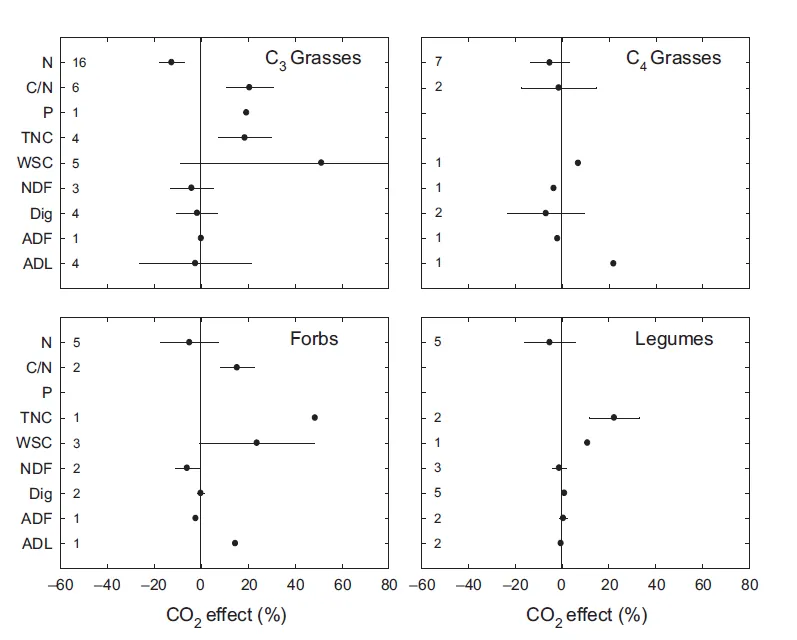
Drought causes a significant reduction in yields, especially in warm regions. Recent research in Europe has shown that drought stress is a major driver of maize and winter wheat losses, particularly during poor yield years [13]. It is difficult to separate the effects of these climate conditions on vegetation growth because they are frequently combined. For instance, whereas greater temperatures at higher latitudes may boost crop adaptability and lengthen the growing season, higher temperatures at lower latitudes may be linked to water stress.
Besides the fact that higher temperatures and drier conditions favorizing C4 species, they can also cause increased toxicity in some plants. Also, an elevated concentration of CO2 in some plants can reduce the concentration of proteins and minerals, while in some it can cause greater toxicity. The danger of elevated CO2 values is also in the favoring of C3 plants and the spread of trees at the expense of grasses [14].
The distribution of biomes and the composition of grasslands and pastures are significantly altered by the rise in average temperature. Shorter intervals of pasture growth may result from changes in rainfall patterns and more frequent droughts. According to several research, fluctuations in temperature, CO2 concentration, and nitrogen deposition lower pasture productivity [15].
In addition, pasture systems are especially vulnerable to climate change due to limited adaptation possibilities. In particular in arid and semi-arid grazing systems, increased temperatures, as well as less rainfall, are anticipated to decrease pasture yields and exacerbate soil degradation [16, 17].
Water
Water is in short supply everywhere, and the severity of water shortages varies according to its availability and demand. Agriculture, with a share of 69% is the greatest single consumer of water on the planet [17]. Water is used in the livestock industry for animal consumption, the manufacturing of feed, and the processing of products. About 22% of the world's total evapotranspiration from agricultural land and 41% of the overall water use are driven by animal husbandry [18]. With increasing human population and growing demand for livestock products, water scarcity is likely to become an increasingly important limiting factor for agricultural production.
Water availability and livestock water use are projected to alter as a result of climate change [19]. An increase in temperature will probably enlarge water consumption per head and per hectare, as well as irrigation water consumption [20].
Another issue, brought on by increasing sea levels is water desalination [21]. In the upcoming years, competition for water between livestock, crops, and non-agricultural uses will intensify, necessitating highly effective production technologies to handle water shortages [19].
In addition to the quantity, there is also concern about the quality of raw water, which according to predictions may also be reduced [14]. This can be caused by rising temperatures and sea levels or higher loads of sediment, nutrients and pollutants from heavy rainfall. Poor water quality can reduce water and feed consumption in animals and endanger their health.
Seasonal Variations and Extreme Climate Events
The seasonal pattern and availability of resources and crops may alter due to climate change, having additional effects on the livestock. It is to be expected that animals will experience more heat stress as heatwave frequency and duration rise. According to Knee et al. [22], there are significant seasonal variations in the amount of glycogen in beef muscles. They have found that better beef quality is associated with rearing on nutrient-rich springtime pastures compared with rearing on poorer, summertime pastures. Furthermore, grazing and livestock management may face new difficulties due to changes in the seasonal patterns of forage supply. The production of animal feed is threatened by the rising threat of extreme drought, so adaptive measures are required to deal with such extreme events. Additionally, alterations in snowmelt timing modify the patterns of water availability throughout the year, which also has an impact on feed supply [23].
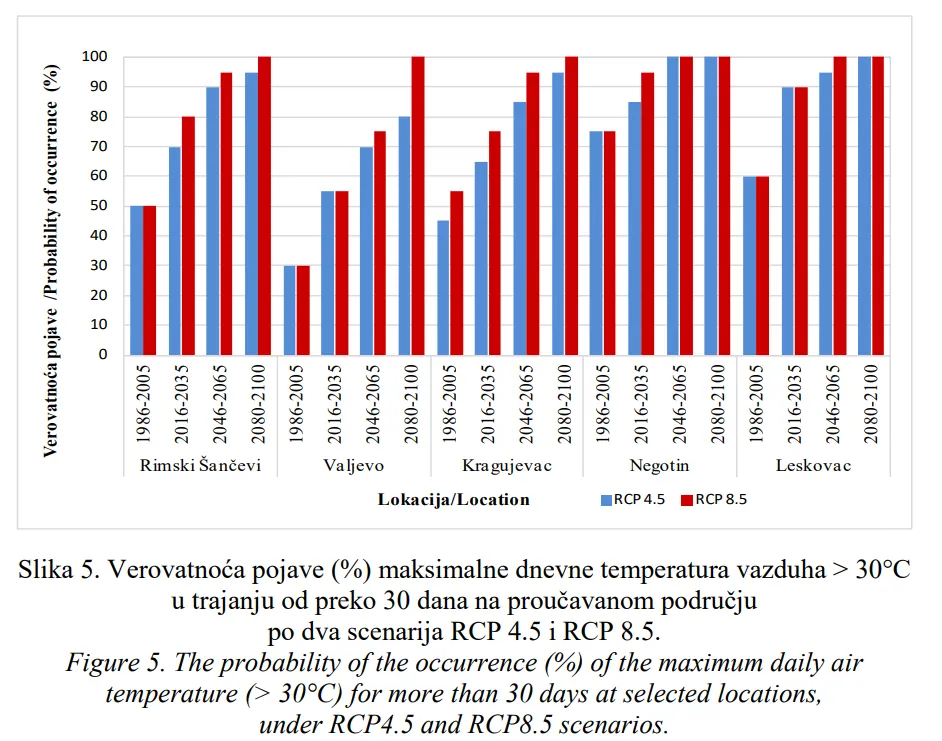
Recent research has shown that heat waves and droughts in the continental climate region of the Pannonian Plain, which extends into Hungary, Serbia, Bulgaria and Romania, have a particularly serious impact on natural grasslands. Stričević et al. [24] performed a predictive analysis of climate change at five localities in Serbia, for two selected scenarios of greenhouse gas emissions - RCP4.5 and RCP8.5. The obtained results indicated that in the coming period, the vegetation of natural grasslands will be exposed to changes in climatic conditions, frequent droughts and frequent occurrences of extremely high temperatures (table 1, figure 3).
Table 1. Simulated number of drought days on selected localities in Serbia [24]
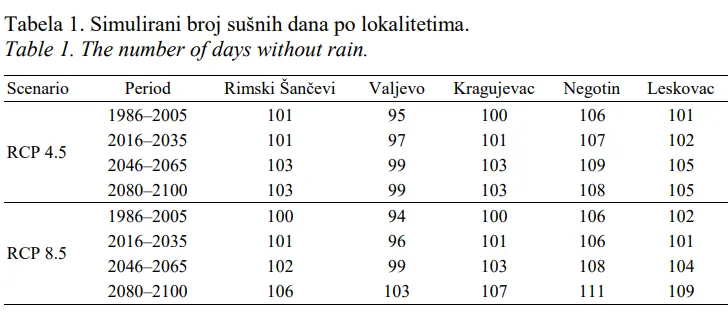
This can lead to endangering the survival of grass plant species, especially species of northern temperate climate, which are the main components and bearers of the yield of sown lawns for the production of coarse fodder in the meadows and arable fields of Serbia. On the other hand, drought tolerance will develop by natural diversity and the spread of species resistant to high temperatures and water deprivation, such as weeds and lower quality species.
It is important to mention here the effect that seasonal variations and extreme climatic events can have on increasing the morbidity and mortality of livestock. In particular, prolonged droughts cause a shortage of water and pasture, which reduces the immunity of livestock against infectious diseases. Additionally, pursuit of resources, triggers the movement of grazing animals into places with a higher danger of infectious diseases, like wildlife reserves. In this case, closer animal-to-animal interaction between domestic and wild animals increases the chance of disease transmission [25]. Also, livestock may be exposed to the risk of new pathogens due to increased contact with wild animals in the grazing areas established by deforestation and changes in land use [26].
References
Nardone, A., Ronchi, B., Lacetera, N., Ranieri, M. S., & Bernabucci U. (2010). Effects of climate changes on animal production and sustainability of livestock systems. Livest. Sci. 130, 57–69.
Rust, J. M. (2019). The impact of climate change on extensive and intensive livestock production systems. Anim. Front. 9, 20-25.
Collins, M., Nelson, C. J., Moore, K. J., & Barnes, R. F. (2017). Forages Volume 1: An Introduction to Crass/and Agriculture. John Wiley & Sons: Hoboken, NJ, USA, 432.
Hopkins, A., & Prado, A. D. (2007). Implications of climate change for grassland in Europe: Impacts, adaptations and mitigation options: A review. Grass Forage Sci. 62, 118-126.
Lee, M. A., Davis, A. P., Chagunda, M. G. G., & Manning, P. (2017). Forage quality declines with rising temperatures, with implications for livestock production and methane emissions. Biogeosciences 14, 1403-1417.
Picon-Cochard, C., Teyssonneyre, F., Besle J. M., & Soussana J. F. (2004). Effects of elevated CO2 and cutting frequency on the productivity and herbage quality of a semi-natural grassland. European Journal of Agronomy 20, 363–377.
Dumont, B., Andueza, D., Niderkorn, V., Luscher, A., Porqueddu, C., & Picon-Cochard, C. (2015). A meta-analysis of climate change effects on forage quality in grasslands: Specificities of mountain and Mediterranean areas. Grass Forage Sci. 70, 239-254.
Allen, V. G., Batello, C., Berretta, E. J., Hodgson, J., Kothmann, M., Li, X., Mclvor, J., Milne, J., Morris, C., Peeters, A., & Sanderson, M. (2011). An international terminology for grazing lands and grazing animals. Grass Forage Sci. 66, 2-28.
Pearcy, R. W., & Ehleringer, J. (1984). Comparative ecophysiology of C3 and C4 plants. Plant Cell Environ. 7, 1-13.
Cho, S. J., & McCarl, B. A. (2017). Climate change influences on crop mix shifts in the United States. Sci. Rep. 7, 40845.
Kukal, M. S., & Irmak, S. (2018). Climate-Driven Crop Yield and Yield Variability and Climate Change Impacts on the U.S. Great Plains Agricultural Production. Sci. Rep. 8, 3450.
Thornton, P. K., Van de Steeg, J., Notenbaert, A., & Herrero, M. (2009). The impacts of climate change on livestock and livestock systems in developing countries: A review of what we know and what we need to know. Agric. Syst. 101, 113-127.
Webber, H., Ewert, F., Olesen, J. E., Muller, C., Fronzek, S., Ruane, A. C., Bourgault, M., Martre, P., Ababaei, B., Bindi, M., Ferrise, R., Finger, R., Fodor, N., Gabaldón-Leal, C., Gaiser, T., Jabloun, M., Kersebaum, K. C., Lizaso, J. I., Lorite, I.J., . . . Wallach, D. (2018). Diverging importance of drought stress for maize and winter wheat in Europe. Nat. Commun. 9, 4249.
Godde, C. M., Mason-D’Croz, D., Mayberry, D., Thornton, P. K., & Herrero, M. (2021). Impacts of climate change on the livestock food supply chain; a review of the evidence. Global Food Security 28, 100488. https://doi.org/10.1016/j.gfs.2020.100488.
Hopkins, A., & Prado, A. D. (2007). Implications of climate change for grassland in Europe: Impacts, adaptations and mitigation options: A review. Grass Forage Sci. 62, 118-126.
Hoffman, M., & Vogel, C. (2008). Climate change impacts on African rangelands. Rangelands 30, 12-17.
Jack, A. A., Adegbeye, M. J., Reddy, P. R. K., Elghandour, M. M. M. Y., Salem, A. Z. M., & Adewumi, M. K. (2022). Ruminant Productivity Among Smallholders in a Changing Climate: Adaptation Strategies. In: M. Lackner, B. Sajjadi, W.Y. Chen (Eds.) Handbook of Climate Change Mitigation and Adaptation (pp. 1-41). Springer. Cham. https://doi.org/10.1007/978-3-030-72579-2_148
Heinke, J., Lannerstad, M., Gerten, D., Havlik, P., Herrero, M., Notenbaertn, A. M. O., Hoff, H., & Muller, C. (2020). Water Use in Global Livestock Production-Opportunities and Constraints for Increasing Water Productivity. Water Resour. Res. 56, e2019WR026995.
Cheng, M., McCarl, B., & Fei, C. (2022). Climate Change and Livestock Production: A Literature Review. Atmosphere 13, 140. https://doi.org/10.3390/atmos13010140
Fader, M., Shi, S., von Bloh, W., Bondeau, A., & Cramer, W. (2016). Mediterranean irrigation under climate change: More efficient irrigation needed to compensate for increases in irrigation water requirements. Hydro. Earth Syst. Sci. 20, 953-973.
Tully, K., Gedan, K., Epanchin-Niell, R., Strong, A., Bernhardt, E. S., BenDor, T., Mitchell, M., Kominoski, J., Jordan, T. E., Neubauer, S. C., & Weston, N. E. (2019). The invisible flood: The chemistry, ecology, and social implications of coastal saltwater intrusion. BioScience 69, 368-378.
Knee, B. W., Cummins, L. J., Walker, P., & Warner, R. (2004). Seasonal variation in muscle glycogen in beef steers. Aust. J. Exp. Agric. 44, 729-734.
Hajek, L. L., & Knapp, A. K. (2021). Shifting seasonal patterns of water availability: Ecosystem responses to an unappreciated dimension of climate change. N. Phytol. 233, 119-125.
Stričević, R., Simić, A., Vujadinović-Mandić, M., & Sokolović, D. R. (2021). Uticaj klimatskih promena na potrebe prirodnih travnjaka za vodom u Srbiji. Journal of Agricultural Sciences 66, 3, 291-307.
Pinto, J., Bonacic, C., Hamilton-West, C., Romero, J., & Lubroth, J. (2008). Climate change and animal diseases in South America. Revue Scientifique Et Technique 27, 2, 599-613.
Lubroth, J. (2012). Climate change and animal health. In A. Meybeck, J. Lankoski, S. Redfern, N. Azzu& V. Gitz, (Eds.) Building resilience for adaptation to climate change in the agriculture sector in Proceedings of a Joint FAO/OECD Workshop (pp. 63-70), Rome, Italy.