
Module 5 · Chapter 4
Indirect effects of livestock production on GHG emissions
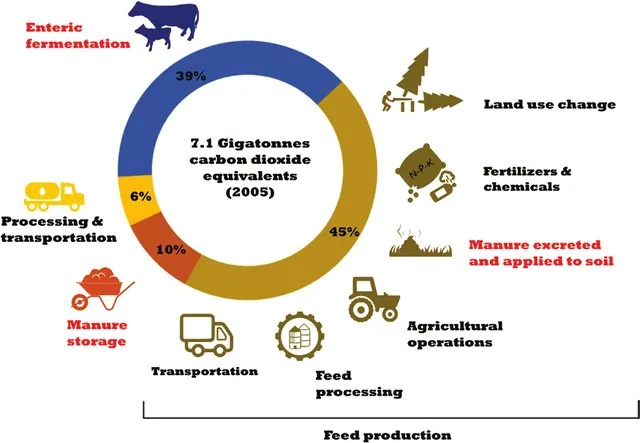
The production of animal feed has a significant impact on greenhouse gas emissions and is a major contributor to the overall carbon footprint of livestock production. These emissions include all three major greenhouse gases: CO2, N20, and CH4. Fertilizer and pesticide production for growing, processing, and transporting feed, fuel use in production, and associated land use changes are responsible for emitting the largest amounts of CO2. N20 emissions come primarily from fertilizer use and manure application and, to a lesser extent, from the cultivation of forage legumes (e.g., alfalfa, clover, soybeans, peas, rice). The amount of CH4 emissions from animal feed production is much lower than C02 and N20 emissions [1]. In addition, the production of animal feed is often associated with land use change due to the clearing of forests or other natural habitats, which may further exacerbate the climate change problem.
It is estimated that about 50% of emissions are from N20, which is generated from fertilizing forage crops, and CH4, which is generated from manure spreading on pastures. A quarter of the total emissions are related to changes in land use [1].
Feed Production
The production of feed, its processing, and its transport generates greenhouse gas emissions, which are estimated to account for about 45% of total emissions from livestock production [1]. Feed production in poultry (meat and eggs) and pig farming contributes 60-80% of GHG emissions, and 35-45% for cattle (milk and meat) [2].
The assessment of greenhouse gas emissions from livestock production has shown that the cultivation, processing and transportation of feed, as well as the efficiency of its utilisation in the animal organism, are the most important factors influencing the amount of emitted gases [3].
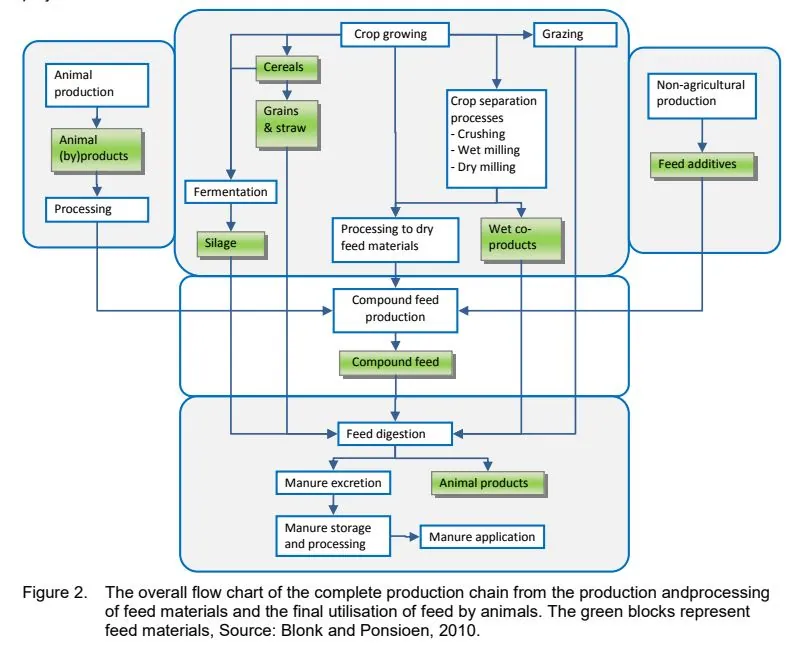
The production of feed is a complex process consisting of a whole series of interconnected (horizontal and vertical) technological processes. At each stage of feed production, a certain amount of harmful gases is emitted. The peculiarities of agroecological conditions and feeding and rearing technologies contribute significantly to the differences in emission levels generated by feed production at regional and local levels. Therefore, the models used to evaluate this type of emissions are very complex, as it is necessary to include a large number of factors that are important for the analysis, as well as a large amount of information describing each of them [4].
Figure 1. shows a schematic representation of the whole production and processing process in the production of livestock feed. The variety of animal feeds is quite large. Some nutrients are consumed directly where they are grown, which is the case, for example, with grassland for grazing ruminants. In this case, there is no storage or transportation of nutrients and no corresponding emissions from these processes. In contrast, canned feeds, such as silage and hay, must be stored and in some cases processed, which affects the value of emissions from the production of these feeds.
Feed mixtures are multicomponent structures composed mainly of cereals and various additives, and their production requires industrial processing. Even though most of the nutrients for feeding farm animals are based on agricultural products, modern animal husbandry often uses by-products of animal origin as well as synthetic substances such as vitamins, minerals, amino acids, enzymes, etc. The production of each of the above components consumes certain inputs and energy that affect greenhouse gas emissions. Storage and transportation are additional emission sources that occur between almost every phase in the structure shown in Figure 1.
In all links of the production chain, we can distinguish between inputs, activities, and side effects, all of which have their own emission characteristics. Therefore, the total emission of a given link is the result of the inputs and activities used. Correct calculation and input data are required to calculate emissions.
In general, it can be said that in most cases, the total emission results from the emissions generated by the following feed production processes:
cultivation of crops
transportation
storage
fertilization (use of manure, artificial fertilizers and crop residues)
use of machinery
use of pesticides
industrial processing
use of fossil fuels and electricity
other
For a better understanding of the technology of feed production and the corresponding GHG emissions, the sequence and interrelationships of the individual production processes are shown in Figure 2.
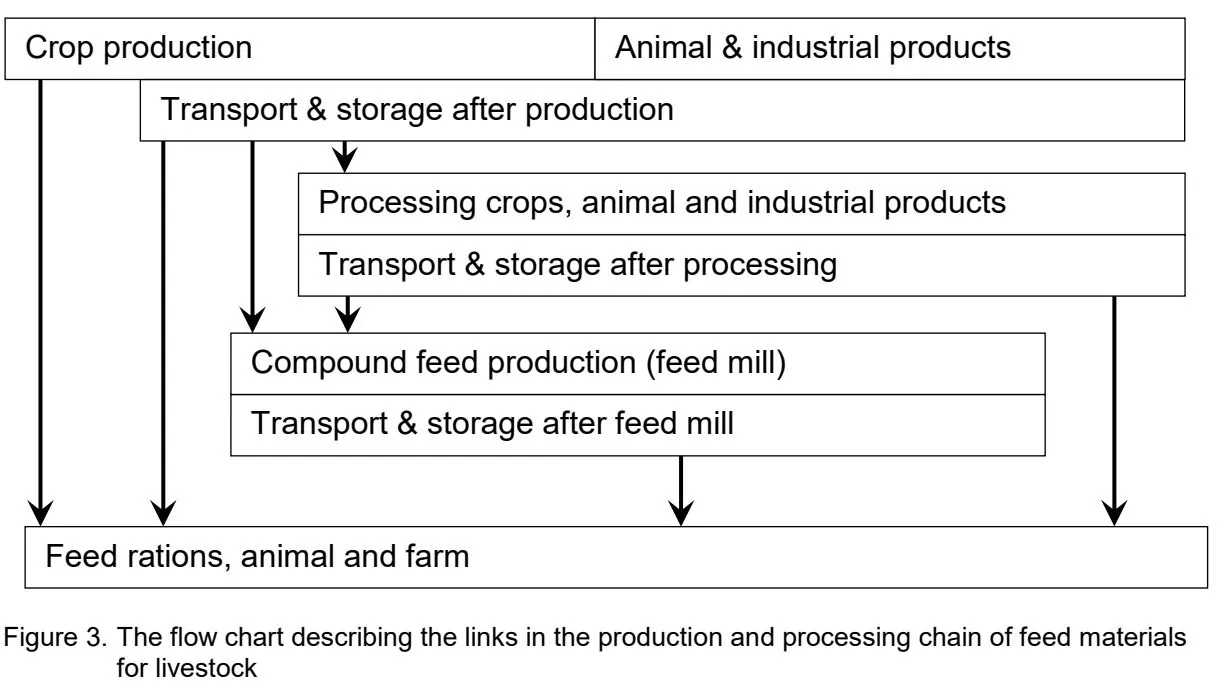
Crop production includes both cultivation of crops itself and its connection with other links in the overall production chain: seed and young plant material production, fertilizer production and application, manure transport and placement, pesticide production and use, cultivation equipment production and maintenance, fossil energy use for cultivation activities, soil N2O and CH4 emissions associated with N application and peat soil drainage, etc, Use and energy losses during storage prior to further use in industrial processing and the production of livestock mixtures [4].
A number of inputs such as fertilizers, pesticides, and fuels are used to grow crops. Some of these inputs cause greenhouse gas emissions during the consumption phase, such as nitrogen, which causes nitrogen oxide emissions, and fuels, which cause carbon dioxide emissions. Others, such as pesticides and phosphate or potash fertilizers, are not considered to cause GHG emissions during the consumption phase. The use of various machines for plowing, fertilizing, etc. requires energy consumption during use in agricultural production and causes associated GHG emissions. Table 1 shows the estimation of GHG emissions during the production of various forages such as grass, corn, and alfalfa.
Table 1. Estimated GHG emissions in the production of grasses, corn and alfalfa (in grams of CO2-eq per kilogram of product) [4].
|
Grass, fresh |
|
|
|
|
Lucerne, fresh |
Lucerne, silage |
Lucerne, dried |
|---|---|---|---|---|---|---|---|---|
|
163 | 474 | 918 | 301 | 909 | 200 | 403 | 910 |
|
||||||||
|
87 | 240 | 201 | 49 | 49 | 68 | 149 | 68 |
|
35 | 35 | 35 | |||||
|
3.39 | 3.39 | 3.39 | |||||
|
682 | 166 | 231 | |||||
|
0 | 0 | 1168 | 0 | 1157 | 0 | 0 | 1168 |
|
1885 | 1358 | 1434 | |||||
|
||||||||
|
||||||||
|
||||||||
|
0 | 0 | 10 | 0 | 10 | 10 | 10 | 10 |
As mentioned earlier, the carbon footprint of animal feed can vary depending on a number of factors, including the type of feed, the production methods used, and the geographic location of feed production. However, there are some types of feed that have a larger carbon footprint than others. One of the main factors contributing to the carbon footprint of feed production is the use of nitrogen-Based fertilizers [1; 4; 7]. These fertilizers are typically used in the production of crops such as corn, soybeans, and wheat to increase the yields of these crops.
Nitrogen fertilizer production is very energy-intensive and can release nitrous oxide, a potent greenhouse gas whose warming potential is about 300 times greater than that of carbon dioxide [4;7]. In addition, the production and transportation of nitrogen fertilizers themselves also contribute to greenhouse gas emissions. Consequently, food crops that require large amounts of nitrogen fertilizer tend to have a larger carbon footprint [8].
Greenhouse gas emissions per ton of nitric acid vary from 2.8 t CO2 eq/t nitric acid in Europe, North America, and the rest of the world to 3.6 t CO2 eq/t nitric acid in China and India. It is important to note that in the application of synthetic fertilizers, three types of nutrients are distinguished: N, P, and K, with zero GHG emissions from the application of phosphorus and potassium [4].
Soil organic matter can be maintained only by a constant supply of fresh organic matter from crop residues, green manures, and animal manures.
Manure is an important source of organic matter, especially on cropland. However, the application of manure as fertilizer for forage crops and its deposition on pastures causes a significant amount of nitrogen oxide emissions, accounting for about half of these emissions [9]. When animals are kept on pastures, their excreta (urine and feces) are disposed into the soil. Therefore, GHG emissions from grazing should be counted as part of total GHG emissions from animal products.
When manure is applied in large quantities, the high N content can have negative effects. This manifests itself in high levels of nitrate leaching and ammonia emissions, and thus eutrophication and acidification. When manure is applied to grassland or cropland, it (partially) replaces the use of synthetic fertilizers (N, P and K), and theoretically emissions from the production of synthetic fertilizers can be avoided [4].
Although feed production often leads to increased nitrogen concentrations in agricultural soils, good manure management can reduce the need for artificial fertilizers.
Feed is often transported long distances to the animals that will consume it. This transportation results in greenhouse gas emissions, particularly CO2 and nitrogen oxides emitted by trucks and other vehicles. Emissions resulting from the transport of feed and its components vary widely, but the recommendation of Welling et al [4] is an implementation of a unique standardized calculation method independent of the components that make up the feed. Blonk et al [5] also report variations in the contribution of GHG emissions from transportation to total GHG emissions in beef production. These authors found that for beef production in the cow-calf system in Ireland, the contribution of transport to total GHG emissions was less than 4%. Pork production contributed four times more to total emissions (16%).
Emissions from fossil fuels and electricity in feed production occur at almost all stages of production but are still mainly associated with transportation and operation of machinery [4; 8]. Fossil fuels are generally used to transport feed and the inputs used in its production (to power trucks, ships, and other transport vehicles). Greenhouse gas emissions are primarily caused by the combustion of these fuels, directly releasing CO2. This can be particularly significant for inputs and feeds that are produced in one part of the world and then transported long distances to feed mills, warehouses, or farms. In addition to these combustion emissions, greenhouse gas emissions (including methane and N2O emissions) are generated during the production and transportation of these fuels, the production of capital equipment, and the production and operation of the distribution network [4]. The contribution of associated emissions can range from 5% to nearly 40% of emissions from combustion alone [5]. Electricity is generated from fossil fuels and other energy sources such as nuclear power and hydropower. The combination of energy sources for electricity generation is different for each power system. The efficiency of converting fossil energy into electricity varies depending on the type of technology used [4].
Industrial feed processing can have a significant impact on greenhouse gas (GHG) emissions, both directly and indirectly. Direct impacts mainly relate to the consumption of electricity and fossil fuels associated with the use of industrial machinery and mechanization in the technological processes of processing and production, and to the transportation of feedstock and nutrients. In addition, GHG emissions generated at other stages of feed production may be closely related to emissions generated during industrial processing (e.g., production of additives, supplements, enzymes, etc.). As an example, the production of one kilogram of the synthetic amino acid threonine leads to the emission of 16978 grams of CO2-eq [4]. In this context, it is important to mention the influence that the use of industrially processed feeds can have on the properties of manure. Namely, the more nutrient-rich composition of such feeds is also reflected in the properties of manure, which can lead to increased emissions of CH4 and nitrogen oxides (N2O). It can be concluded that within the animal feed production sector, the industrial processing stage is an important area in efforts to reduce the carbon footprint.
In summary, feed production has a significant impact on greenhouse gas emissions, and efforts to mitigate climate change must address this issue. Strategies to reduce the carbon footprint of feed production can include increasing the efficiency of fertilizer use, promoting sustainable land use practices, and shortening transportation distances of feed crops and other inputs. Ultimately, a holistic approach that encompasses the entire livestock supply chain is needed to reduce greenhouse gas emissions and mitigate the effects of climate change.
Land Use Change
Agricultural land occupies almost 40% of the total land area of which about 60% is for feeding livestock [10]. Due to the projected population growth, the demand and consumption of livestock products is expected to increase. This would inevitably lead to an increased demand for arable land needed to grow crops used to feed livestock. This is a process whose scenario is already known from a historical point of view, since the intensification of all agriculture, including animal husbandry, has been taking place since the beginning of the 20th century. The negative side of this process is certainly the change in land use, which mainly refers to the conversion of forests and grasslands into arable land for feed production. This may lead to an increased release of carbon dioxide into the atmosphere, while on the other hand, the process of carbon dioxide absorption and storage becomes disabled. In summary, in this way, the balance of the carbon cycle in nature is disturbed, which in modern conditions of accelerated industrialization has disastrous effects on the environment, especially in terms of climate change.
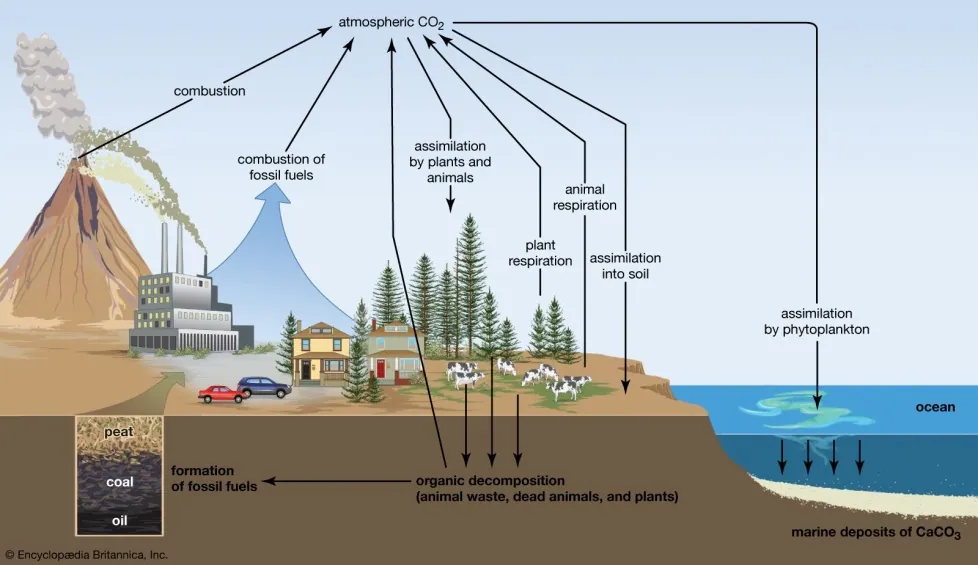
Namely, through the process of photosynthesis, plants absorb carbon dioxide from the atmosphere and store it in above- and below-ground biomass. It is important to emphasize that forest land has a better ability to absorb carbon compared to cropland and pasture, making it the main reservoir along with the ocean (Figure 4).
Table 2. GHG еmissions due to land use change (gray fields) - comparison of different assessment methodologies [4]
Wheat France |
Soy bean Brazil |
Rape seed Germany |
Palm fruit Malaysia |
|
|---|---|---|---|---|
|
29 | 41 | 62 | 27 |
|
119 | 3 | 200 | 130 |
|
6565 | 2442 | 3610 | 21300 |
|
3764 | 0 | 0 | 0 |
|
0.78 | 1 | 1 | 1 |
|
337 | 477 | 1032 | 604 |
|
||||
|
141 | 483 | 327 | 55 |
|
171 | 585 | 396 | 67 |
|
0 | 7690 | 0 | - |
|
35 | 1099 – 1207 |
153 | - |
Conversion of forest land to cropland and pasture results in a large amount of stored carbon being released into the atmosphere. According to the literature, several methods have been developed to estimate GHG emissions caused by land use change, but there is still no consensus among scientists on their reliability. Table 2 shows a comparison of emission values obtained by different selected assessment methods [7].
Even though land use change in modern times has already contributed significantly and negatively to climate change, research shows that improvements are still possible [1; 8]. According to the Intergovernmental Panel on Climate Change (IPCC) [12], timely and continuous implementation of improved agricultural practices and forestry measures is important for mitigating climate change, as they can contribute significantly to the removal of carbon dioxide from the atmosphere. First and foremost, this includes improved management of cropland and pasture-for example, more efficient use of fertilizers to prevent leaching of unused nitrates, tillage practices that minimize soil erosion, restoration of organic soils, and restoration of degraded soils.
References
Gerber, P. J., Steinfeld, H., Henderson, B., Mottet, A., Opio, C., Dijkman, J., Falcucci, A., & Tempio, G. (2013). Tackling climate change through livestock: A global assessment of emissions and mitigation opportunities. Tackling Climate Change through Livestock: A Global Assessment of Emissions and Mitigation Opportunities. https://www.cabdirect.org/cabdirect/abstract/20133417883
Sonesson, U., C. Cederberg, & M. Berglund. (2009). Greenhouse gas emissions in milk production. Decision support for climate certification. Report 2009:3. Available from http://www.klimatmarkningen.se/wp-content/ uploads/2009/12/2009-2-feed.pdf
de Vries, M., & de Boer, I. J. M. (2010). Comparing environmental impacts for livestock products: A review of life cycle assessments. Livestock Science, 128(1), 1–11. https://doi.org/10.1016/j.livsci.2009.11.007
Vellinga, T. V., Blonk, H., Marinussen, M., Zeist, W. J. van, & Starmans, D. a. J. (2013). Methodology used in FeedPrint: A tool quantifying greenhouse gas emissions of feed production and utilization (No. 674; p. 121). Wageningen UR Livestock Research. https://library.wur.nl/WebQuery/wurpubs/438366
Blonk, H., Cabbage, A., Luske, B., Waart, S. De, Pierick, E. Ten (2012). Environmental effects of Dutch consumption of protein-rich products: consequences of replacing animal proteins in 2008. WUR. https://www.wur.nl/nl/publicatie-details.htm?publicationId=publication-way-333639373832
Blonk, T.J. and Ponsioen, 2010. Towards a tool for assessing carbon footprints of animal feed.Report Blonk Milieu Advies, November 2009, Gouda, the Netherlands, 62 pp.
Cheng, M., McCarl, B., & Fei, C. (2022). Climate Change and Livestock Production: A Literature Review. Atmosphere, 13(1), Article 1. https://doi.org/10.3390/atmos13010140
Grossi, G., Goglio, P., Vitali, A., & Williams, A. G. (2019). Livestock and climate change: Impact of livestock on climate and mitigation strategies. Animal Frontiers, 9(1), 69–76. https://doi.org/10.1093/af/vfy034
Gerber, P. J., Hristov, A. N., Henderson, B., Makkar, H., Oh, J., Lee, C., Meinen, R., Montes, F., Ott, T., Firkins, J., Rotz, A., Dell, C., Adesogan, A. T., Yang, W. Z., Tricarico, J. M., Kebreab, E., Waghorn, G., Dijkstra, J., & Oosting, S. (2013). Technical options for the mitigation of direct methane and nitrous oxide emissions from livestock: A review. Animal, 7(s2), 220–234. https://doi.org/10.1017/S1751731113000876
Land use in agriculture by the numbers | Sustainable Food and Agriculture | Food and Agriculture Organization of the United Nations. (n.d.). Retrieved 31 March 2023, from https://www.fao.org/sustainability/news/detail/en/c/1274219/
Carbon Sequestration | Definition, Methods, & Climate Change | Britannica, 2023. Retrieved 31 March 2023, from https://www.britannica.com/technology/carbon-sequestration
AR6 Climate Change 2022: Mitigation of Climate Change—IPCC. (n.d.). Retrieved 31 March 2023, from https://www.ipcc.ch/report/sixth-assessment-report-working-group-3/