
Module 6 · Chapter 1
Energy
The energy demand is increasing rapidly due to factors such as the growing global population, urbanization, industrialization, and technological developments. Since it is a fundamental component of all products and is used in almost every aspect of daily life, energy is a crucial component for raising the welfare level of societies. It is directly related to all aspects of human welfare, including necessities, agricultural issues, health care, employment, education, and sustainability [1]. The percentage of people who have access to electricity worldwide increased from 83% in 2010 to 91% in 2020. The number of individuals without access to electricity decreased throughout this time, from 1.2 billion to 733 million. Only 92% of the world's population would have access to electricity in 2030 if things continue as they are, leaving 670 million people without power [2]. Energy service delivery must be safe, affordable and have minimal negative environmental effects for development to be sustainable [3].
Energy Sources
Energy is defined as the ability to perform tasks. It comes in a variety of forms, including mechanical (potential and kinetic), thermal, electrical, chemical, and nuclear energy. It can also be converted from one form to another for use in a variety of applications, and it can be categorized in a variety of ways [4].
Primary energy contains all energy sources that have not been transformed, exploited directly, or imported. As presented in Figure 1, there are two different kinds of primary energy sources: non-renewable and renewable. Oil, coal, gas, uranium, and all other forms of renewable energy, such as hydropower and wind, are examples of primary energy. While renewable energy is produced from resources that can be replenished naturally over time and are thus suitable for use, non-renewable energy sources have a finite supply because they typically take a long time to replenish [5, 6]. Secondary energy is created when primary energy is transformed or processed; examples include the production of electricity from the combustion of natural gas or the processing of hydroelectricity. The production of oil products like gasoline from the refining of crude oil and the production of coke from coal are two additional examples of secondary energy [7].
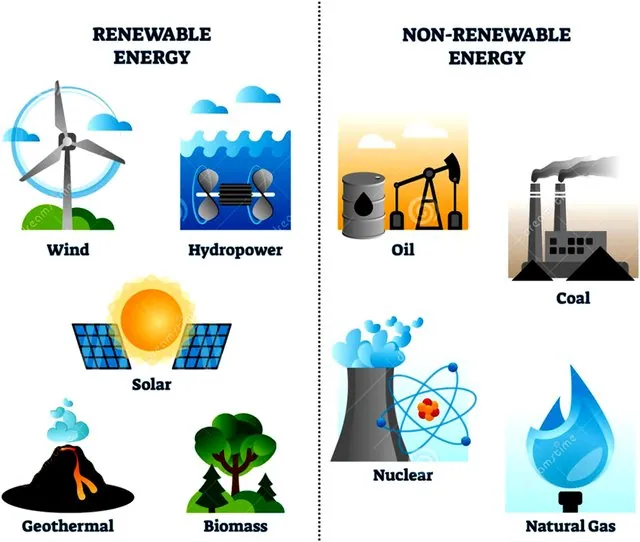
Non-renewable energy sources
Non-renewable energy comes from resources that either cannot be replenished in the near future or whose rate of replenishment is significantly slower than the rate of use. Because these primary energy sources are found in limited quantities in nature, they are considered non-renewable resources. Non-renewable energy resources include fossil fuels (coal, oil and gas) and radioactive minerals, which are used in nuclear power generation [5].
Coal is a sedimentary rock that is black or brownish-black in colour and can be burned to generate energy. Although coal can be used to produce heat in industry, its main purpose is to produce electricity, and many nations rely on its availability for a consistent source of energy. Petroleum is a mixture of hydrocarbons that can be found in liquid, gaseous, and solid states. Liquid and gaseous petroleum, the two most prevalent types of petroleum, are typically extracted from reservoirs by drilling wells and pumping the finished product to the surface. Diesel is a crude oil product that is widely used in energy-related applications such as transportation, heating, and electricity generation. Natural gas is a gas that can be found both separately and dissolved in crude oil. It has more energy per unit of fuel and typically has less of an impact on the environment than crude oil or its products, which is its main advantage. Natural gas has a variety of applications ranging from residential to commercial to industrial. Residential applications include cooking and heating, while commercial applications include space and water heating. Radioactive minerals (uranium or plutonium) release energy within their atoms when the nucleus is broken apart by nuclear fission, releasing heat that can then be used to generate electricity [1, 6]. Burning coal, oil, or gas at fossil fuel power plants produces heat in the form of steam, which powers massive turbines that generate electricity. These machines consistently generate electricity for extended periods [3].
Renewable energy sources
Renewable energy sources are those that can be replenished naturally, making them virtually limitless. The sun, the Earth's heat, wind, and water are just a few examples. Biomass-derived energy is also considered renewable [9]. Renewables have enormous potential to provide all necessary energy services. Further developing and utilizing renewable energy sources using modern conversion technologies would improve global energy security, lower the long-term price of conventional fuels, and conserve fossil fuel reserves for other applications and future generations [10].
A wide range of technologies are available or in development to provide affordable, dependable, and long-term renewable energy services [10]. Solar energy is created by converting sunlight into heat or electricity. Solar energy is used in a variety of technologies. These include solar heating, photovoltaic cells, and solar thermal electricity generation technology. By burning biomass, energy can be produced from biomass in two ways: directly as heat or electricity, or indirectly as a liquid or gas that can produce energy. Wood, corn, sugarcane, animal waste, and municipal solid waste are a few examples of biomass. Energy can also be derived from landfill gas, or methane, which results from the decomposition of biomass in landfills. Biomass technologies include biomass power systems and transportation biofuels. Wind turbines can transform wind energy into electrical or mechanical power. In order to harness the power of the wind, wind turbines typically consist of blades mounted on shafts and towers. Flowing water creates energy that can be captured and converted into electricity, making hydropower the cleanest and most efficient way to generate electricity. Using geothermal technology, heat from the earth's subsurface is extracted and either used directly for heating and cooling purposes or transformed into electricity [3, 9, 11].
Table 1 compares the benefits and drawbacks of renewable and non-renewable energy sources.
Table 1: Comparison of energy sources [5]
Energy Source |
Advantages | Disadvantages | ||
|---|---|---|---|---|
| Nuclear | • Zero greenhouse gases. • Capable of converting energy effectively. • Resources of uranium are plentiful. • Annual refueling, as opposed to coal plants, which require trainloads of coal every day. |
• Higher capital costs resulting from storage, radioactive waste management, containment, and safety concerns. • Issue with storing radioactive waste for an extended period of time. • The issue of possible nuclear proliferation. |
||
| Coal | • A plentiful supply. • Extraction is currently inexpensive. • Dependable and capable of producing large amounts of power. |
• Produces significant amounts of greenhouse gases and acid rain. • Mining and burning have a high environmental impact, though cleaner coal-burning technology is being developed. • Mining can be hazardous to miners' health. |
||
| Oil | • The basis for many products, from medicine to plastic. • Produced at a low cost. • Effective and simple to transport. |
• Significant greenhouse gas emissions. • Only found in a few places. • Natural gas/coal resources may be depleted before supply. • The potential environmental impact of drilling and transportation. |
||
| Natural gas | • It is widely available. • The cleanest-burning fossil fuel; frequently used in conjunction with other fuels. • The output can be adjusted to meet demand. |
• Transportation costs are prohibitively expensive. • Gas resources are unavailable in some areas due to a lack of infrastructure. • Burns cleanly but produces emissions. Pipelines have an impact on ecosystems. |
||
| Solar | • It is non-polluting. • The most plentiful energy. • Systems have a lifespan of 15-30 years. |
• Expensive initial investment. • In areas with little sunlight, extra energy may be required. • Photovoltaic cell panels necessitate a lot of physical space. • Limited accessibility |
||
| Wind | • There are no emissions. • Reasonably priced. • Minimal disruption to ecosystems. • Extremely high output. |
• The output is proportional to the wind speed. • It is not possible in all geographic areas. • Expensive initial investment and upkeep. • Extensive land use. |
||
| Hydropower | • There are no emissions. • Reliable and capable of producing large amounts of power |
• Environmental effects from changing the environment around the dam. • Hydroelectric dams are costly to construct. • Drought may have an impact on dams. |
||
| Biomass/ Biofuel | • Plenty of supply. • Lower emissions than fossil fuels. • It is suitable for use in diesel engines. •Automobile engines can easily be converted to run on biomass fuel. |
• To reduce transportation costs, the source must be close to the usage. • Produces some pollution in the form of waste. • Increased nitrogen oxide emissions. • Some fossil fuels are used in the conversion process. |
||
| Geothermal | • Low environmental impact. • Effective. • Power plants emit little pollution. • Lower costs after initial investment. |
• Only a small number of locations on earth have geothermal fields. • Significant start-up expenses. • Wells could eventually dry up. |
||
Global Energy Sector
Global energy demand is rapidly increasing due to urbanisation, population and economic growth, particularly in emerging market economies. As presented in Figure 1, the total world primary energy supply (TPES) grew more than 2.6 times between 1971 and 2019 and reached 606 EJ [12]. The majority of the global energy supply comes from Organisation for Economic Co-operation and Development (OECD) countries. As of 2019, the OECD countries received 37.1% of total energy supplies. China came in second with a supply share of 23.5% [12].
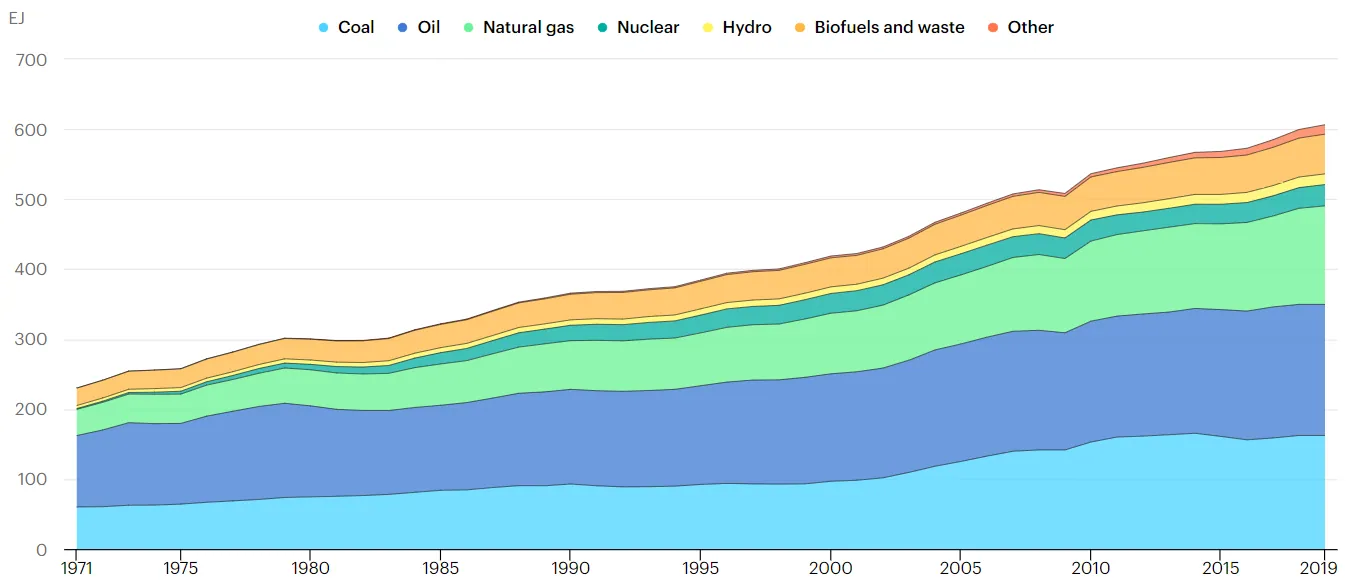
As shown in Figure 3, in 2019, oil provided 30.9% of the world's primary energy supply, coal 26.8%, and natural gas 23.2% of the world's primary energy supply. Following these are combustible renewable sources and waste (9.4%), nuclear (5.0%), hydropower (2.5%), and wind, geothermal, and solar (2.2%) [12]. China dominated the global markets for concentrating solar thermal power, hydropower, solar PV, and wind power, accounting for nearly half of all installations in 2020 [9]. In developing countries, biomass accounts for more than 20% of total energy supply. In these countries, the majority of biomass is used for cooking and heating [13].
Figure 3: Global share of total energy supply by source, 2019 [12]
Global energy demand increased by less than half the rate of growth seen in 2018, reaching 418 EJ (Exajoule) in 2019. As presented in Figure 4, oil (40.4%) remained the dominant fuel for the final consumption of energy followed by electricity (19.7%), natural gas (14.5%), biofuels (10.4%), coal (9.5%) and others (3.6%) including wind, solar, hydropower and geothermal [12].
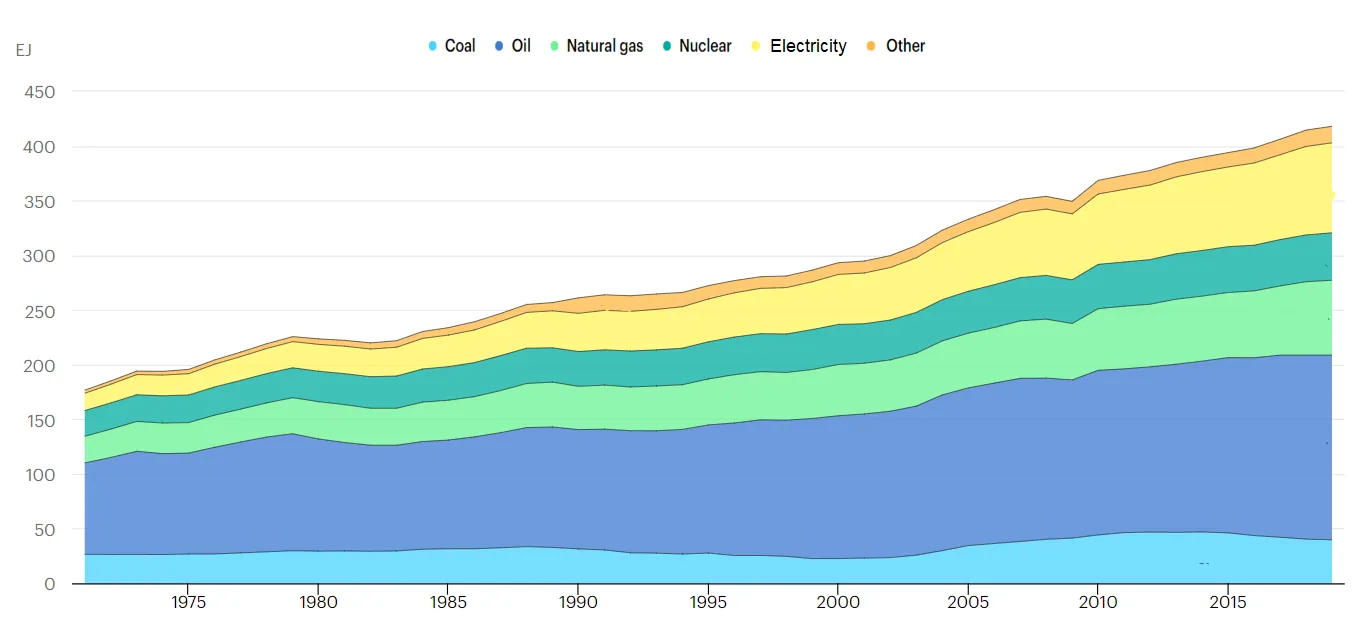
Regionally, with a 3.4% increase, China accounted for 90% of net global energy demand growth in 2019, while energy demand fell in almost all advanced economies. Energy demand in the European Union fell by 2%, while it fell by 0.8% in the United States. While demand in Southeast Asia increased at a rapid pace of 3.4%, growth in India fell from 4% in 2018 to 0.9% in 2019, the lowest level since 2007 [12].
Despite using the most renewable energy (26%), the power industry accounted for only 17% of total final energy consumption in 2019. Renewables continue to play a minor role in industrial energy demand, particularly in industries requiring high processing temperatures. Renewable energy accounts for approximately 14.8% of total industrial energy demand and is primarily used in businesses that require low-temperature process heat. Renewable electricity accounts for 10% of renewable industrial heat, but only 1% of total industrial heat consumption in 2019. The transportation sector continues to have the lowest renewables share, with oil and petroleum products (along with 0.8% non-renewable electricity) meeting nearly all global transportation energy needs (95.8%). Only 3.1% and 0.3% of those requirements were met by biofuels and renewable electricity, respectively. Renewable energy is meeting a growing portion of building final energy demand, but it still accounts for less than 15% of total energy demand [9].
Energy sector is a critical sector for any country's long-term development; however, its production and consumption have environmental, economic, and social consequences, such as climate change, pollution, and energy poverty. Sustainable energy is defined as energy that can be used repeatedly and meets our current energy needs without endangering its life or becoming depleted [3, 14]. When coal, oil, or gas are burned in fossil fuel power plants, heat is produced in the form of steam, which powers massive turbines that generate electricity. These machines produce electricity on a consistent basis for extended periods of time. In contrast, the combustion of fossil fuels emits large amounts of greenhouse gases and other harmful gases and solids into the atmosphere, causing climate change, acid rain, and soil and water contamination. Using renewable energy resources to generate electricity instead of fossil fuels reduces emissions from the power sector [3, 15]. It is essential to establish an energy system that meets economic needs while protecting the environment because energy production, conversion, and use have a substantial negative influence on the environment. The global CO2 emissions related to energy levels stagnated in 2019 at about 33 gigatonnes (Gt). Carbon emissions from energy use increased by 0.5% between 2018 and 2019, less than half the 10-year average annual growth rate of 1.1% [12, 16].
The advantages of renewable energy for the environment, such as lower carbon emissions and less air pollution, are well known. But only in recent decades, as the use of renewable energy technologies has spread, have its many socioeconomic advantages become clear. Each year, a sizable number of jobs are created worldwide thanks to renewable energy. A record 10.3 million people were employed globally in the renewable energy industry. More than a billion people live in areas without access to electricity, and another billion rely on erratic supplies. For the 80% of people without access to rural areas or small developing island states, micro renewable electricity solutions are now financially feasible thanks to increased reliability, rapidly declining technology costs, and supportive policies [15].
Energy Efficiency
Energy efficiency is the ratio of energy input to output in terms of performance, operation, products, or energy. It means doing the same amount of work with less energy. Energy efficiency is typically expressed as the amount of energy output for a specified energy input and is expressed as a percentage between 0% and 100%. From energy production to energy consumption, there are multiple places throughout the chain where energy efficiency can be increased [17].
Energy efficiency has several advantages, including lower greenhouse gas emissions, lower demand for energy imports, and lower household and economic expenditures. Every area of the economy has significant potential for efficiency improvements, whether it is buildings, transportation, industry, or energy generation. Energy efficiency initiatives can lead to the creation of new jobs in the energy sector and the industry [6, 17].
Global primary energy efficiency increased by 1.9% per year from 5.6 megajoules per US$ in 2010 to 4.7 in 2019. To reach the energy efficiency target, the yearly rate of increase must average 3.2% per year until 2030 [2].
Reference
1. WEC, World Energy Resources, World Energy Council. 2016.
2. UN. The Sustainable Development Goals Report 2022, United Nations. 2022 13/10/2022]; Available from: https://unstats.un.org/sdgs/.
3. IPCC, Renewable Energy Sources and Climate Change Mitigation, ed. R.P.-M. Ottmar Edenhofer, Youba Sokona, Kristin Seyboth, Patrick Matschoss, Susanne Kadner, Timm Zwickel, Patrick Eickemeier, Gerrit Hansen, Steffen Schloemer, Christoph von Stechow. 2011: Cambridge University Press, Cambridge, United Kingdom and New York, NY, USA.
4. Ackerman, C., et al., Primary Energy Infobook, The National Energy Education Development (NEED) Project in 2019.
5. Zohuri, B. and P. McDaniel, Chapter 9 - Energy insight: an energy essential guide, in Introduction to Energy Essentials, B. Zohuri and P. McDaniel, Editors. 2021, Academic Press. p. 321-370.
6. IEA, Energy Technology Perspectives 2020, International Energy Agency. 2020.
7. Iliev, I., et al., Energy Efficiency and Energy Management Handbook. Bulgaria Energy Efficiency for Competitive Industry Financing Facility (BEECIFF): Project Preparation, Capacity Building and Implementation Support, ed. I.K. Iliev. 2012.
8. Rahman, M., J.-H. Kim, and S. Hossain, Recent Advances of Energy Storage Technologies for Grid: A Comprehensive Review. Energy Storage, 2022.
9. REN21, Renewables 2021 Global Status Report, Paris: REN21 Secretariat. 2021.
10. Turkenburg, W., et al., Renewable Energy (Chapter 11), in Global Energy Assessment, J.ü.r. Schmid, Editor. 2012, Cambridge University Press.
11. Panwar, N.L., S.C. Kaushik, and S. Kothari, Role of renewable energy sources in environmental protection: A review. Renewable and Sustainable Energy Reviews, 2011. 15(3): p. 1513-1524.
12. IEA, Key World Energy Statistics, International Energy Agency, Editor. 2021, Energy Information Administration: Paris.
13. IRENA, Hydropower, in Renewable Energy Technologies: Cost Analysis Series. 2022, International Renewable Energy Agency: Germany.
14. Hollaway, L.C., 19 - Sustainable energy production: key material requirements, in Advanced Fibre-Reinforced Polymer (FRP) Composites for Structural Applications, J. Bai, Editor. 2013, Woodhead Publishing. p. 705-736.
15. IRENA. Renewable Energy Benefits, International Renewable Energy Agency. 2022 12/10/2022]; Available from: https://www.irena.org/benefits.
16. BP, BP Statistical Review of World Energy. 2020, British Petroleum: London. p. 1-44.
17. Erbach, G., Briefing 2015, Understanding Energy Efficiency, EPRS | European Parliamentary Research Service. 2015.