
Module 6 · Chapter 2
Sustainable agriculture
The only source of human food is agriculture. While ensuring global food security, sustainable agriculture should support sustainable management of land, water, and natural resources. In order for agriculture to be sustainable, it must provide the goods and services that will satisfy the needs of both the present and the future generations while maintaining profitability, environmental health, and social and economic equity [1, 2]. Food production systems, as well as the policies and institutions that support global food security, are increasingly incapable of reducing food insecurity or ensuring environmental sustainability [3].
Sustainable Development
Sustainability is based on the principle that “meet the needs of the present without compromising future generations' ability to meet their own needs”. A major objective of sustainability is for people to live peacefully and long-term on Earth. Decisions at the international, national, and individual levels can be guided by the idea of sustainability [4].
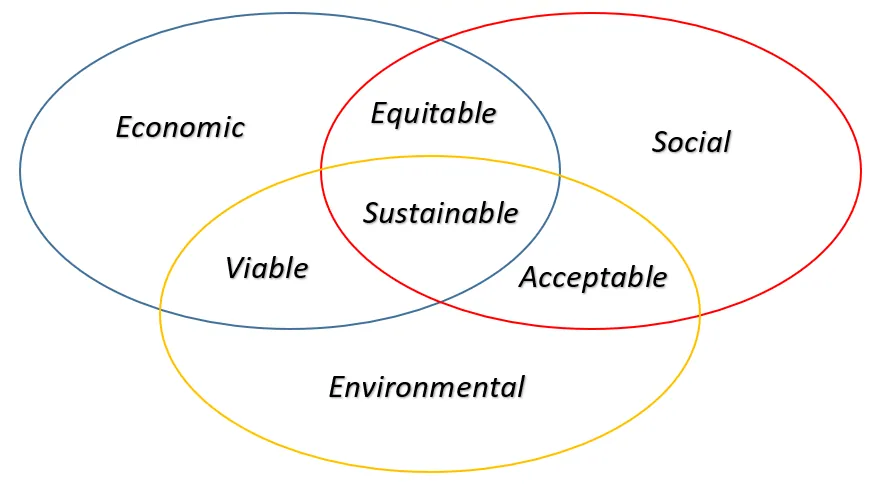
As presented in Figure 1, environmental, economic, and social pillars are used to describe sustainability. There are numerous issues associated with environmental sustainability, ranging from pollution to natural resource management. The main aim of environmental sustainability is to reduce the environmental impact of human activities while also encouraging the restoration and preservation of our natural habitat. Environmental protection is frequently the first thing that comes to mind when considering sustainability. However, the sustainability concept also embraces social and economic sustainability [5].
Economic sustainability refers to an economy's ability to sustain a specific level of economic production indefinitely. It involves achieving a balance between economic expansion and profit-making with the effects on the people and the environment. [6]. The social pillar of sustainability refers to values that promote equality and individual rights. In order to ensure social sustainability, impacts of both the positive and negative on people must be identified and managed [7].
The Global Goals, also referred to as the Sustainable Development Goals (SDGs), were established by the United Nations (UN) in 2015 as a component of the 2030 Agenda for Sustainable Development. Due to climate change, this agenda seeks to reduce poverty, health issues, illiteracy, and slow economic growth. SDGs are a "blueprint to achieve a better and more sustainable future for all" and include 169 targets in addition to 17 goals to address these problems (Figure 2). Over the next 15 years, the SDGs will guide national development plans [8].
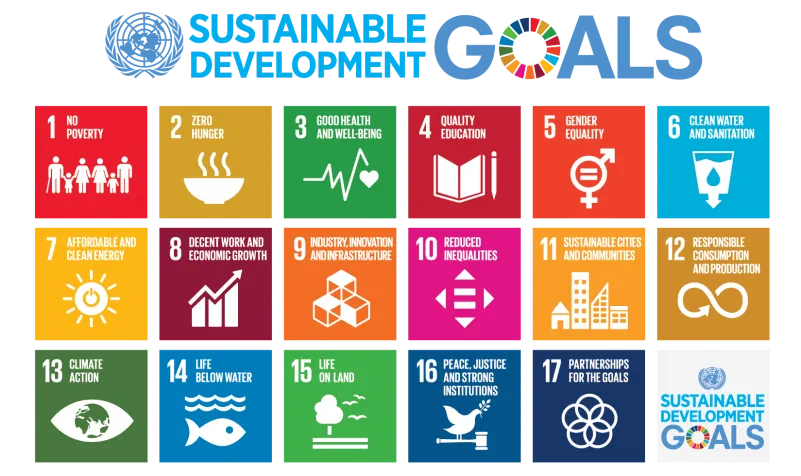
Since the SDGs are interconnected, many sectors and industries have an impact on a variety of SDG-related issues, including agriculture, which is essential to achieving the SDGs by 2030 as set forth by the UN. Agriculture is a focal point for many of the Sustainable Development Goals [9]. SDG #2, which relates to food production, calls for "ending hunger, achieving food security and improved nutrition, and promoting sustainable agriculture." However, without a successful and sustainable agricultural sector, other SDGs cannot be achieved. For example, food production is inextricably linked to other SDG challenges including ensuring access to clean water and sanitation (SDG #6), ensuring access to affordable and clean energy (SDG #7), promoting decent employment and economic growth (SDG #8), and promoting responsible consumption and production (SDG #12). Agriculture indirectly affects the SDGs for life on land (SDG #15), gender equality (SDG #5), climate action (SDG #13), and poverty (SDG #1). Food and agriculture are central to the 2030 Agenda, from eradicating poverty and hunger to combating climate change and conserving natural resources [8, 10].
Agriculture and Sustainability Issues
Agriculture is facing many challenges in the 21st century. The main sustainability concerns that the food and agriculture industry must address are hunger in developing countries, obesity in developed countries, rising food prices, persistent climate change, rising fuel and cost of transportation, flaws in the global market, global pesticide pollution, pest adaptation and resistance, loss of soil fertility and organic carbon, soil erosion, declining biodiversity, and desertification [11, 12].
Sustainable agriculture is a viable option for dealing with fundamental and applied food production issues in an environmentally, economically, and socially responsible manner. It entails creating and putting into practice management practices that support organic processes in order to preserve all resources, cut down on waste, and safeguard the environment while preserving or enhancing farm profitability. It is critical to work with natural soil processes [13, 14]. Furthermore, concerns about animal welfare must also be addressed in farm enterprises that include livestock [1].
The current rate of growth in agricultural production is unsustainable due to the detrimental effects on natural resources and the environment. Up to 75% of crop genetic diversity has been lost, one-third of farmland has been degraded, and 22% of animal breeds face extinction. Thirteen million hectares of forest are lost each year to other land uses, and more than half of fish stocks are fully utilized. The main issues are the growing scarcity and quick depletion of natural resources at a time when demand for agricultural products and services, such as food and feed, is rising quickly. The areas with the highest rates of food insecurity and agricultural dependence are predicted to experience the fastest population growth [15].
In sustainable agriculture systems, the already-existing soil energy flows, nutrient and water cycles, beneficial soil organisms, and natural pest controls are all fully utilized [13]. Agriculture is both a significant contributor to and one of the most vulnerable economic sectors to climate change. Greenhouse gas emissions from agriculture occur both within the farm gate and at the land use change boundary between natural ecosystems and agricultural land. They account for roughly 20% of all human-caused emissions [16].
As presented in Figure 3, as a result of a balance between rising farm gate emissions and falling emissions from land use change, worldwide agricultural emissions (including those from farm gate and land use change processes) were close to 11 billion tonnes of CO2 equivalent (CO2 eq.) in 2019 [16]. Only crop and livestock-related GHG emissions contribute roughly 5 billion tonnes of CO2 eq. to the atmosphere each year [17].
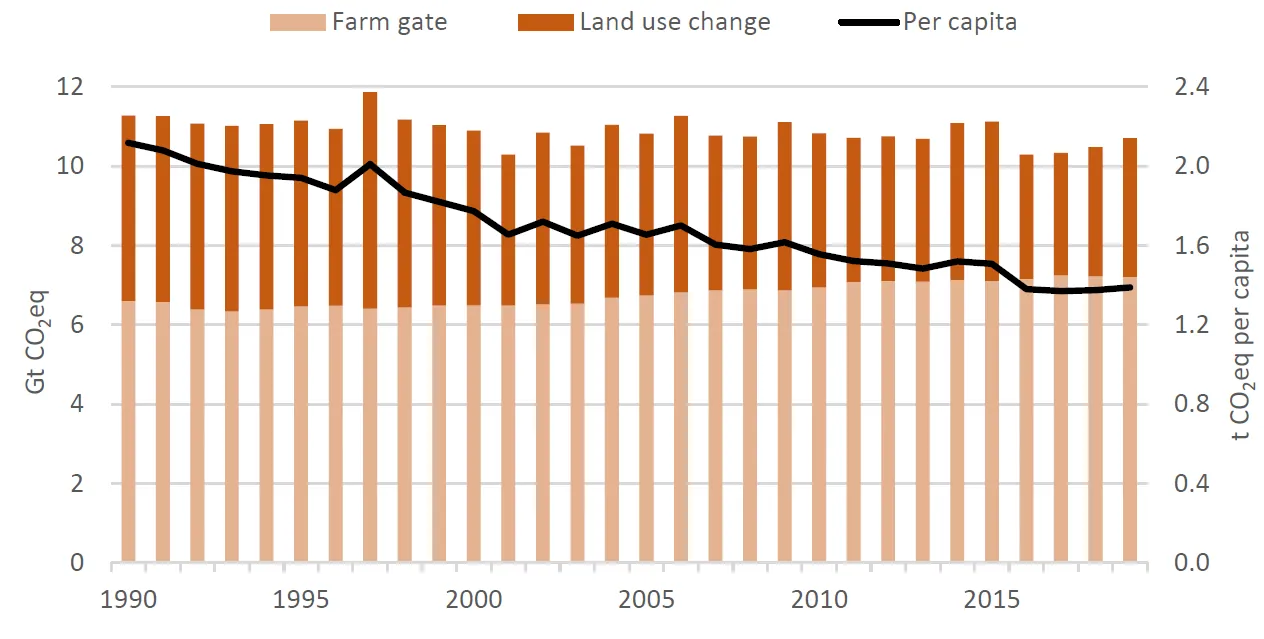
Asia had the largest absolute emissions (4 billion tonnes) in 2019, whereas Oceania and Latin America had the highest per capita emissions (4-6 tonnes per capita). Africa has had the biggest increase (30%) since 1990, while Latin America has seen the greatest reduction (20%). More over half of worldwide agricultural emissions were accounted for by Brazil, Indonesia, and China. In Brazil and Indonesia, deforestation and peat fire emissions dominated national agricultural emissions, respectively, but farm-gate emissions were the major contributor in China [16].
Within the farm gate, methane, nitrous oxide and CO2 emissions contributed more than 7 billion tonnes of CO2 equivalent (eq.) in 2019, a 9% increase since 1990. Livestock accounted for two-thirds of methane and nitrous oxide emissions. Land use change contributed 3.5 billion tonnes of CO2 eq., the majority of which came from carbon losses from deforestation and peatland fires. Since 1990, the former has decreased by about 30%, while the latter has increased by nearly 60% [16].
Sustainable Agriculture and Energy
In order to meet the world's increasing demand, make them more inclusive, secure, and sustainable, and comply with the Paris Climate Agreement and the 2030 Agenda for Sustainable Development, the energy and food systems must be transformed. The systems for supplying food and energy have a significant impact on the environment, economies, and society as a whole, which makes them essential for achieving many SDGs [18].
The food system's current energy use is unsustainable. Due to the lack of affordable, dependable, and sustainable energy for millions of people and small and medium-sized agri-food businesses, there are significant food losses in the post-harvest stages. Before it even reaches the market, about 14% of the food produced worldwide is lost [19]. Food losses are addressed throughout the supply chain, as reducing waste leads to lower demand for land, water, and energy, as well as lower emissions [20]. In 2019, more than 2.6 billion people paid a disproportionate amount of money to live without access to clean cooking fuels and technologies [18].
A third of the world's total final energy demand is accounted for by the agriculture and food systems, the majority of it in post-harvest processes and as fossil fuels [21]. At some point along the value chain, food losses result in the loss of about 30% of that energy [18].
All phases of food production, processing, and distribution up until final consumption are included in agri-food supply chains [12]. In the global agri-food system, agriculture is the primary source of greenhouse gas emissions. 10% to 15% of the world's greenhouse gas emissions are directly attributable to agriculture. Up to 30% more emissions result from adding land use changes and deforestation to the production of animal feed. Methane and nitrous oxide, which together account for about 22% of global emissions, is also primarily produced by agriculture [22].
Energy can help to achieve sustainable agriculture. This can be accomplished by incorporating efficient energy technologies and renewable energy into agricultural systems; utilizing waste from the agri-food industry to generate renewable energy, reducing waste-related GHG emissions, and trapping carbon in soils and energy crops using biofertilizers made from biomass. Having enough energy in food chains might help with climate change adaptation by increasing resilience to changing weather patterns and possibly increasing income through product and service diversification, value-added activities, and local job creation [18].
Reference
1. FAWC, Sustainable agriculture and farm animal welfare, Farm Animal Welfare Committee 2016: London, UK.
2. HLPE, Food losses and waste in the context of sustainable food systems. A report by the High Level Panel of Experts on Food Security and Nutrition of the Committee on World Food Security, Rome. 2014.
3. Pretty, J.N., J. Thompson, and F. Hinchcliffe, Sustainable agriculture: impacts on food production and food security. International Institute for Environment, Development. Gatekeeper Series, 1996(60).
4. Perdan, S., The Concept of Sustainable development and its Practical Implications. , in Sustainable Development in Practice: Case Studies for Engineers and Scientists. 2nd. ed. John Wiley & Sons Ltd, 2011. pp. 3-25, A. Azapagic, Editor. 2011.
5. Heinberg, R. and D. Lerch, What is sustainability? The post carbon reader, 2010. 11: p. 19.
6. Goniadis, G. and M. Lampridi, Introduction to Sustainable Development, ed. N. Moussiopoulos. 2015: International Hellenic University.
7. Purvis, B., Y. Mao, and D. Robinson, Three pillars of sustainability: in search of conceptual origins. Sustainability Science, 2019. 14(3): p. 681-695.
8. UN. Sustainable Development Goals, United Nations. 2022 13/10/2022]; Available from: https://unstats.un.org/sdgs/.
9. UN, Transforming our world: the 2030 Agenda for Sustainable Development, United Nations, A/RES/70/1, 2015. 2015.
10. Nhemachena, C., et al., Measuring Baseline Agriculture-Related Sustainable Development Goals Index for Southern Africa. 2018. 10(3): p. 849.
11. Lichtfouse, E., et al., Agronomy for sustainable agriculture. A review. Agronomy for Sustainable Development, 2009. 29(1): p. 1-6.
12. Gorjian, S., et al., Sustainable Food and Agriculture: Employment of Renewable Energy Technologies. Current Robotics Reports, 2022. 3(3): p. 153-163.
13. Chel, K., Renewable energy for sustainable agriculture. Agronomy for Sustainable Development, Springer Verlag/EDP Sciences/INRA, 10.1051/agro/2010029 . hal00930477, 2011. 31(1): p. 91-118.
14. UNDP, Sustainable Agriculture, in The International Guidebook of Environmental Finance Tools, United Nations Development Programme (UNDP). 2012, United Nations
15. FAO. Sustainable Agriculture. 2021 09/10/2022]; Available from: https://www.fao.org/sustainable-development-goals/overview/fao-and-the-2030-agenda-for-sustainable-development/sustainable-agriculture/en/.
16. FAO, Emissions from agriculture and forest land. Global, regional and country trends 1990–2019. FAOSTAT Analytical Brief Series No 25. Rome. 2021.
17. Tubiello, F., Greenhouse Gas Emissions Due to Agriculture. 2019.
18. FAO and IRENA, Renewable energy for agri-food systems – Towards the Sustainable Development Goals and the Paris Agreement. Abu Dhabi and Rome. https://doi.org/10.4060/cb7433en, 2021.
19. FAO, Food loss and waste must be reduced for greater food security and environmental sustainability, Food and Agriculture Organization, Rome, www.fao.org/news/story/en/item/1310271/icode/. 2020.
20. FAO, “Energy-Smart” Food for People and Climate Issue Paper, Food and Agriculture Organization, Rome. 2011.
21. FAO, Energy, agriculture and climate change towards energy-smart agriculture, Food and Agriculture Organization of the United Nations. 2016.
22. Andreas Gattinger, J.J., Adrian Muller, Friedhelm Göltenboth and Jørgen Olesen, Mitigating Greenhouse Gases in Agriculture A challenge and opportunity for agricultural policies. 2011: Stuttgart.