
Module 6 · Chapter 3
Energy usage in the agricultural sector
In many countries, agriculture is the most important economic sector. Energy has always been required for agricultural production and value addition. Agriculture makes extensive use of human, animal, and mechanical energy [1]. The modernization of many agricultural production activities increases mechanical energy consumption. The agricultural sector, like other sectors, has become dependent on energy sources such as oil and electricity as a result of the changes in the agricultural sector [2].
Energy efficiency is required to sustain agricultural production due to economic savings, conservation of fossil resources, and reduction in air pollution. Furthermore, because agricultural land is limited, the only way for producers to increase total output is to use more inputs. Given the agricultural sector's reliance on energy to feed a growing population, as well as the impact of energy use on the environment and human health, as well as limited natural resources, it is critical to investigate energy use and energy efficiency in the agricultural sector [2, 3].
Agricultural Energy Use
Through the process of photosynthesis, agriculture transforms solar energy into food energy for humans and feed for animals. Simple farming practices like scattering seeds on the ground and accepting the meagre yields that followed constituted primitive agriculture. Today, modern (intensive) agricultural practices, in which various methods are used to obtain high yields from the soil, have largely replaced primitive agriculture [4]. As a result of the implementation of modern agricultural production processes, a shift from human or animal power, which is widely used in agricultural production processes, to mechanical energy using fuels has occurred [5].
Energy has always been crucial for agricultural production and rural development. From small organic farms to large industrial farms, agriculture uses a lot of energy [6]. Today, energy use in crop and animal production processes in the agricultural sector is categorised into two groups: direct and indirect [7].
Direct Energy Usage in Agriculture: The phrase "direct energy used in agriculture" refers to energy used directly in agricultural operations like harvesting, irrigation, drying, storing, heating greenhouses, and marketing, as well as in infrastructure, farm machinery, tractors, and lorries [7]. In animal production, electricity, biomass, coal, and natural gas are used for activities such as feed preparation-distribution, manure cleaning, milking, lighting, heating, ventilation, and cooling in agricultural buildings such as animal shelters [8].
Indirect Energy Usage in Agriculture: The phrase "indirect energy used in agriculture" refers to the energy used in the production of mineral fertilizers and chemical pesticides, insecticides, herbicides, and other agricultural chemicals, as well as the chemical substances used in their processing [7]. Indirect energy, as the name implies, is not used directly on the farm. These energy inputs are usually found in the industrial sector [8].
Today's agriculture frequently uses an intensive farming system because of the growing population and the high demand for food. Given the quick crop rotation in the field and high input use, intensive farming requires a farmer to invest significant financial resources and knowledge in managing the land and crop [5]. As shown in Figure 1, modern agriculture necessitates the use of energy at all stages of production, including energy use in farm machinery, water management, irrigation, sowing, and harvesting. Energy is used in agricultural production stages such as farming, fertilizer production, transportation, and processing. Agriculture includes crop cultivation and harvesting, as well as livestock care and slaughter. Transportation is the process of transporting agricultural products to the next stage of production using any mode of transportation. Foods that cannot be consumed immediately after leaving the farm must be processed. Post-harvest energy use includes energy used for food processing, storage, and transportation to markets. Furthermore, many energy inputs, such as mineral fertilizers and chemical pesticides, are used in agriculture [9-11].
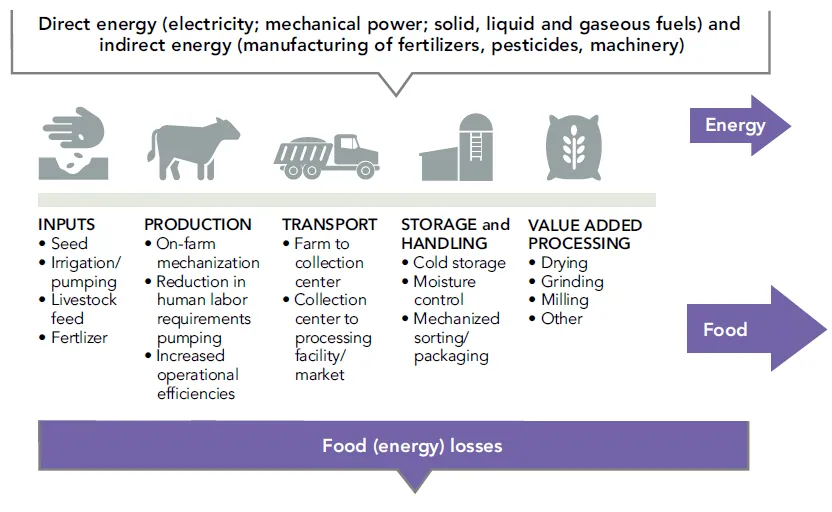
Agriculture, which includes crop cultivation and animal husbandry, is one of the most energy-intensive stages of the food chain, accounting for roughly one-third of total energy consumed in the food production chain [3]. Tillage operations, the first stage of crop production, are typically carried out using the most energy-intensive operations [13].
Crop drying and storage is also a major step in fuel utilization. For each hectare of crop harvested/dried, a high temperature dryer consumes 55 litres of fuel oil. To reduce moisture from 20% to 15%, approximately six litres of fuel (diesel) are required for each tonne of crop to be dried [14].
Nowadays, most irrigation systems consume high amounts of energy. Irrigation system energy consumption is primarily seen as a technical challenge with the aim of improving performance [15]. Most farms use wells and groundwater sources to pump water, though some have access to public water sources. The majority of pumps use electricity, but remote locations may also have diesel or propane pumps [16, 17].
The energy consumed in livestock operations is almost entirely direct energy consumption, and it is relatively low in comparison to crop operations, both as a percentage of total operating expenditure and in terms of total energy consumption. Energy is directly consumed by livestock enterprises for ventilation systems, refrigeration, lighting, heating, irrigation, motors, and waste handling, whereas crop enterprises use energy for sowing, harvesting, irrigation, and drying [16].
Energy accounts for a significant portion of most crops' operating expenses, particularly when indirect energy expenditures on fertilizer are considered, because fertilizer production is extremely energy-intensive, necessitating large amounts of natural gas. Energy and fertilizer expenditures account for more than half of the total operating expenses for some crops, such as oats, corn, wheat, and barley. The ratio of direct to indirect energy consumption varies by crop [16, 18]. Detailed information on energy use in agriculture is presented in Table 1.
Table 1: Energy uses in agricultural production [19]
| Direct Use of Energy | Fuel |
|---|---|
Operating farm machinery and large trucks: Field work (tractors, combines, mowers, balers, etc.) Input purchase and deliveries (large trucks) |
Diesel fuel |
Operating small vehicles (cars and pickup trucks): - Farm management activities |
Gasoline |
Operating small equipment: - Irrigation equipment Drying of grain or fruit Ginning cotton Curing tobacco Heating for frost protection in groves and orchards Crop flamers Heating/cooling of cattle barn, pig or poultry brooder, greenhouse, stock tanks, etc. Animal waste treatment Standby generators |
Diesel fuel Natural Gas LP Gas Electricity |
General farm overhead Lighting for houses, sheds, and barns Power for farm household appliances |
Electricity |
Custom operations Field work (e.g., combining) Drying Other |
Diesel Gasoline Natural Gas LP Gas Electricity |
Marketing Transportation: elevator to terminal, processor, or port Elevating |
Diesel Gasoline |
| Indirect Use of Energy | Fuel |
| Fertilizer | Natural Gas |
| Pesticides (insecticides, herbicides, fungicides) | Petroleum Natural Gas |
European Union Agricultural Energy Use
In 2020, the European Union's direct energy consumption was 886 million tonnes of oil equivalent (toe), including direct usage of oil and petroleum, electricity, natural gas, renewables, and solid fossil fuels. Agriculture and forestry consumed 3.2% of total direct energy consumption in the EU in 2020 [20]. As presented in Table 2, the Netherlands had the highest proportion of its total direct energy consumption in the agricultural and forestry sector; the share of 9.0% shows the significance of the glasshouse production of horticultural plants, fruits, and vegetables. Also having substantial percentages were Latvia (5.4%) and Poland (5.5%) [20].
Table 2: Direct energy consumption in the European Union [20]
| Direct consumption of energy by agriculture and forestry |
Total direct consumption of energy | Share of total direct consumption of energy by agriculture and forestry | |||||||
|---|---|---|---|---|---|---|---|---|---|
| (1000 toe) | (1000 toe) | (%) | |||||||
| 2018 | 2019 | 2020 | 2018 | 2019 | 2020 | 2018 | 2019 | 2020 | |
| EU | 27,515 | 27,842 | 28,008 | 926,013 | 937,857 | 885,764 | 3.0 | 3.0 | 3.2 |
| Belgium | 800 | 902 | 806 | 33,636 | 32,580 | 31,039 | 2.4 | 2.8 | 2.6 |
| Bulgaria | 185 | 187 | 188 | 8,595 | 9,707 | 9,513 | 2.2 | 1.9 | 2.0 |
| Czechia | 620 | 635 | 638 | 23,991 | 24,222 | 23,753 | 2.6 | 2.6 | 2.7 |
| Denmark | 596 | 581 | 568 | 14,017 | 13,547 | 13,131 | 4.2 | 4.3 | 4.3 |
| Germany | 3,302 | 3,573 | 3,626 | 207,170 | 200,804 | 193,617 | 1.6 | 1.8 | 1.9 |
| Estonia | 124 | 113 | 109 | 2,408 | 2,823 | 2,727 | 5.2 | 4.0 | 4.0 |
| Ireland | 223 | 222 | 222 | 10,188 | 11,317 | 10,840 | 2.2 | 2.0 | 2.0 |
| Greece | 264 | 277 | 277 | 17,914 | 15,401 | 14,483 | 1.5 | 1.8 | 1.9 |
| Spain | 2,457 | 2,604 | 2,715 | 76,338 | 81,514 | 72,323 | 3.2 | 3.2 | 3.8 |
| France | 4,085 | 4,037 | 4,170 | 145,126 | 139,131 | 128,169 | 2.8 | 2.9 | 3.3 |
| Croatia | 218 | 221 | 234 | 5,937 | 6,726 | 6,432 | 3.7 | 3.3 | 3.6 |
| Italy | 2,798 | 2,719 | 2,759 | 119,742 | 113,119 | 103,057 | 2.3 | 2.4 | 2.7 |
| Cyprus | 42 | 43 | 45 | 1,367 | 1,627 | 1,529 | 3.1 | 2.6 | 2.9 |
| Latvia | 181 | 202 | 205 | 3,228 | 3,925 | 3,798 | 5.6 | 5.1 | 5.4 |
| Lithuania | 108 | 111 | 114 | 3,742 | 5,460 | 5,284 | 2.9 | 2.0 | 2.2 |
| Luxembourg | 27 | 24 | 24 | 3,185 | 3,790 | 3,265 | 0.8 | 0.6 | 0.7 |
| Hungary | 647 | 673 | 703 | 15,642 | 17,970 | 17,602 | 4.1 | 3.7 | 4.0 |
| Malta | 5 | 6 | 7 | 319 | 544 | 500 | 1.6 | 1.2 | 1.4 |
| Netherlands | 3,934 | 3,927 | 3,818 | 47,520 | 44,317 | 42,262 | 8.3 | 8.9 | 9.0 |
| Austria | 530 | 521 | 511 | 21,810 | 26,228 | 24,817 | 2.4 | 2.0 | 2.1 |
| Poland | 3,919 | 3,813 | 3,868 | 53,561 | 71,891 | 70,251 | 7.3 | 5.3 | 5.5 |
| Portugal | 384 | 380 | 411 | 17,214 | 16,356 | 15,215 | 2.2 | 2.3 | 2.7 |
| Romania | 566 | 557 | 531 | 21,947 | 23,713 | 23,472 | 2.6 | 2.3 | 2.3 |
| Slovenia | 75 | 73 | 72 | 4,542 | 4,863 | 4,429 | 1.6 | 1.5 | 1.6 |
| Slovakia | 133 | 129 | 132 | 9,925 | 10,248 | 9,611 | 1.3 | 1.3 | 1.4 |
| Finland | 689 | 684 | 666 | 23,282 | 24,729 | 23,191 | 3.0 | 2.8 | 2.9 |
| Sweden | 604 | 624 | 589 | 33,667 | 31,305 | 31,454 | 1.8 | 2.0 | 1.9 |
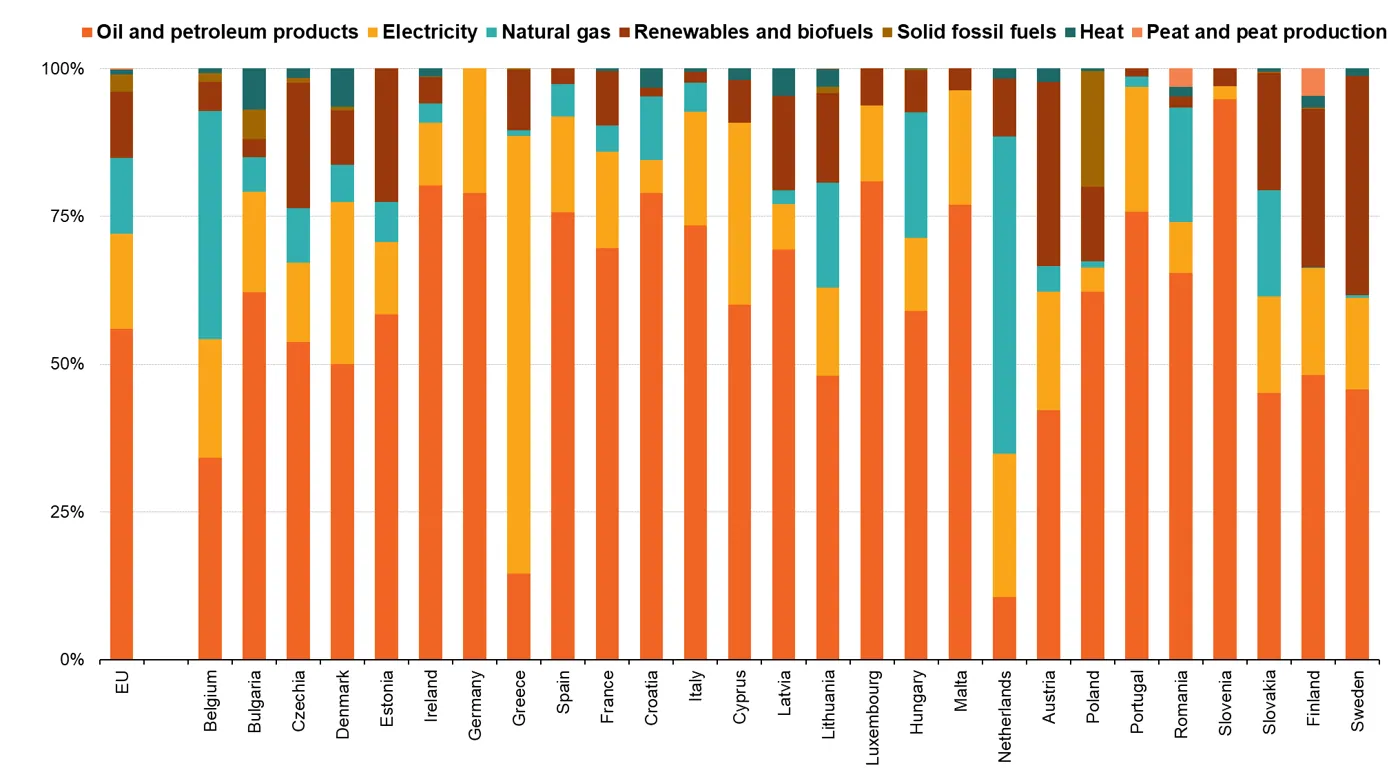
In the EU, oil and petroleum products accounted for the majority (56.0%) of total direct energy use in the agricultural and forestry sector excluding biofuels in 2020. This was a substantially bigger share than the whole economy (35.0%) [20]. As presented in Figure 2, oil and petroleum products were the most often utilized fuel types in the agricultural and forestry sectors in the EU. There were, however, some significant outliers. In the Netherlands, direct consumption of energy from oil and petroleum products accounted for just 10.6% of total direct consumption by the agriculture and forestry industry in 2020, with natural gas accounting for the majority (53.5%) and electricity accounting for one-quarter (24.3%). In Greece, electricity accounted for nearly three-quarters (74.0%) of total direct energy use by the agriculture and forestry sectors. Renewables and biofuels contributed to about one-third (37.1% and 31.1%, respectively) of total direct energy consumption in Sweden and Austria [20, 21].
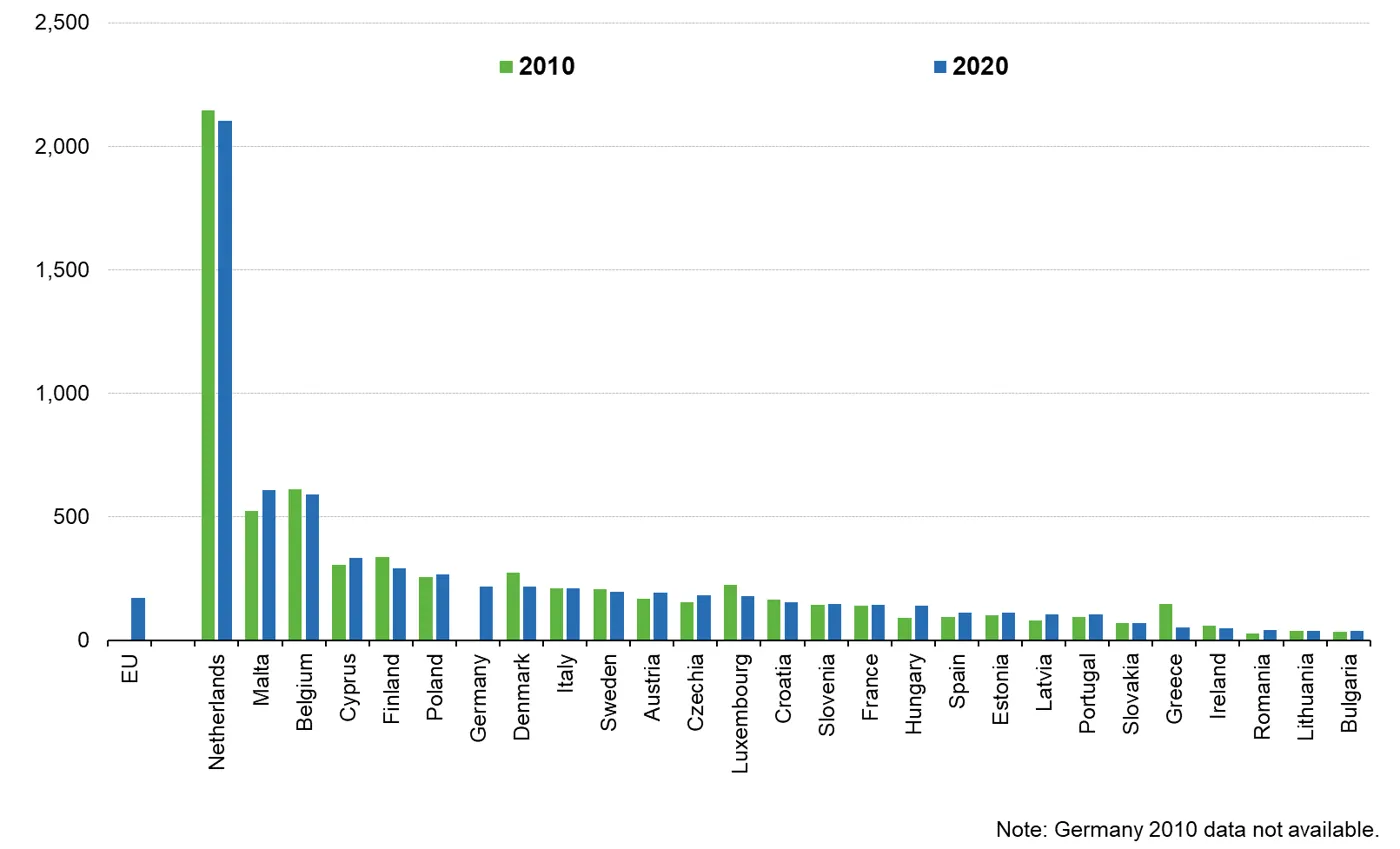
Since countries vary in size, it is impossible to compare total energy consumption directly between them. It is necessary to designate a common denominator in order to compare trends across nations. The indicator and the denominator should ideally be strongly correlated. The usable agricultural area is a common denominator to evaluate agri-environmental parameters across nations (UAA). As shown in Figure 3, the average direct energy consumption of the EU agriculture and forestry sector was 173 kilos of oil equivalent per hectare (kgoe/ha) in 2020 [20].
The large-scale production of fruits, vegetables, and plants in greenhouses in the Netherlands helps to explain the substantially higher average direct energy consumption per hectare of UAA in 2020 (2 104 kgoe/ha) than in other European countries. Between 2000 and 2020, apparent energy consumption per hectare of UAA fell most dramatically in Greece (-64.2%) but climbed most sharply in Hungary (+ 54.2%) [20].
Reference
1. Ozkan, B., H. Akcaoz, and C. Fert, Energy input–output analysis in Turkish agriculture. Renewable Energy, 2004. 29(1): p. 39-51.
2. Bekhet, H.A. and A.J.I.B.R. Abdullah, Energy use in agriculture sector: input-output analysis. 2010. 3(3): p. 111.
3. Fabio Monforti-Ferrario, J.-F.D., Irene Pinedo Pascua, Vincenzo Motola, Manjola Banja, Nicoale Scarlat, Hrvoje Medarac, Luca Castellazzi, Nicola Labanca, Paolo Bertoldi, David Pennington, Malgorzata Goralczyk, Erwin M. Schau, Erwan Saouter, Serenella Sala and G.T. Bruno Notarnicola, Pietro Renzulli, Energy use in the EU food sector: State of play and opportunities for improvement, European Commission EUR 27247 EN – Joint Research Centre – Institute for Energy and Transport and Institute for Environment and Sustainability, a.M.-F.a.I.P. Pascua, Editor. 2015: Luxembourg: Publications Office of the European Union.
4. Finan, T., 8. Intensive Agriculture. Portuguese agriculture in transition, 2019: p. 141.
5. Sial, A., et al., Intensive Farming: It's Effect on the Environment. 2021. 12: p. 37480-37487.
6. Raser, G. and M. Silecchia, Energy Use in U.S. Agriculture: An Overview 2020, Institute for Energy and the Environment, : Vermont Law School.
7. Schnepf, R. Energy Use in Agriculture: Background and Issues. 2004.
8. Beyaz, A., et al., Tarımsal Üretimde Enerji Verimliliğinin Planlanması ve Sağlanması. 2017.
9. FAO, Chapter 2: Energy for Agriculture, The Food and Agriculture Organization (FAO) in The ninth session of the United Nations Commission on Sustainable Development (CSD-9), G. Best, Editor. 2011.
10. Rokicki, T., et al., Changes in Energy Consumption in Agriculture in the EU Countries. 2021. 14(6): p. 1570.
11. Silecchia, G.R.a.M. Energy Use In U.S. Agriculture: An Overview. 2020 [28.07.2023]; Available from: https://farmandenergyinitiative.org/wp-content/uploads/2020/08/Energy-Use-in-Agriculture.pdf.
12. Olivier Dubois, A.F., Ana Kojakovic, and M.P. Irini Maltsoglou, and Luis Rincon, , Energy Access Food and Agriculture, in International Bank for Reconstruction and Development / THE WORLD BANK, Food and Agriculture Organization of the United Nations. 2017: Washington.
13. Forgó, Z., et al., Energy Consumption Evaluation of Active Tillage Machines Using Dynamic Modelling. 2021. 11(14): p. 6240.
14. Caslin, B. and D. Forristal, Energy Use On Tillage Farms, Energy Fact Sheet No: 1 – August 2016. 2016.
15. Daudin, K., et al., Energy consumption of irrigation systems: a functional perspective. 2020.
16. Hicks, S., Energy for growing and harvesting crops is a large component of farm operating costs, The U.S. Energy Information Administration (EIA) in Today in Energy. 2014.
17. Kalinichenko, A. and O. Kostenko, Alternative Ways of Energy Supply in Rural Areas. Zeszyty Naukowe Politechniki Częstochowskiej Zarządzanie, 2019. 35: p. 52-68.
18. IFA and UNEP, Industry as a partner for sustainable development, Fertilizer Industry. The International Fertilizer Industry Association and United Nations Environment Programme, 2002.
19. Schnepf, R., Energy Use in Agriculture: Background and Issues. CRS Report for Congress, 2004.
20. EUROSTAT, Agri-environmental indicator - energy use. 2022.
21. Zhu, N., et al., Energy-sustainable agriculture in the European Union member states: Overall productivity growth and structural efficiency. Socio-Economic Planning Sciences, 2023: p. 101520.