
Module 6 · Chapter 7
Renewable energy applications in agriculture – 2
Human food is only produced through agriculture. The focus of sustainable agriculture is on the need to employ tools and techniques that increase food production without compromising environmental resources or ecosystem services [1].
The energy requirements for heating, cooling, traction, and other farm energy functions can be met with a variety of technologies. Rural areas can produce renewable energy using geothermal, bioenergy, solar, wind, and solar energy sources. Farmers can use a variety of technologies simultaneously. In other circumstances, the farm's renewable energy production can be injected into the gas or electricity grids. Both at the farm level and across the entire agricultural sector, there are a wide range of options and potential for the production and distribution of renewable energy [2].
Most agricultural equipment is run by fossil fuels, which produce greenhouse gases and hasten climate change by releasing them into the atmosphere. By promoting the use of renewable energy sources like solar, wind, bioenergy, hydropower, and geothermal energy, such environmental sustainability issues can be reduced [3, 4]. New opportunities for cooperation in the production, sale, and distribution of renewable energy are presented by numerous small- and medium-sized installations. They replace fossil fuels, promote economic growth in rural areas, and contribute to energy security [2].
Use of Wind Energy in Agriculture
Wind is a type of solar energy that is received indirectly. This type of energy is constantly replenished by the sun and is produced by the sun's heating of the earth's surface. The different heating of the earth's surface causes variations in the temperature, humidity, and pressure of the air, and this variation in pressure causes the air to move. Wind characteristics vary in time and space due to geographical differences and inhomogeneous heating of the earth's surface [5, 6].
Wind energy is now one of the most important renewable energy sources, with the fastest development in technology and utilization, and an economy that is competitive with conventional energy sources. Wind energy is the process of obtaining mechanical or electrical energy through turbines by utilizing the kinetic energy of the air already present. Wind energy is environmentally friendly, can provide energy security, and is a viable alternative to traditional fossil-fuel-based energy [7, 8].
Wind energy applications in agriculture can be divided into two categories. These are:
Mechanical application areas (such as water extraction and grinding), and
Electrical application areas (off-grid and grid-connected applications) [9].
Wind energy is used to create mechanical energy from wind turbines, electricity from wind turbines, or water from wells using wind pumps [10]. The use of wind energy in rural areas is known to have begun with windmills. Windmills have been used to draw water from wells and grind grain since the Middle Ages. Wind energy is converted into mechanical energy by a turbine, which causes two plates to rotate rhythmically and the products between these two plates to be ground. Windmills have long supported agricultural activities [11, 12].
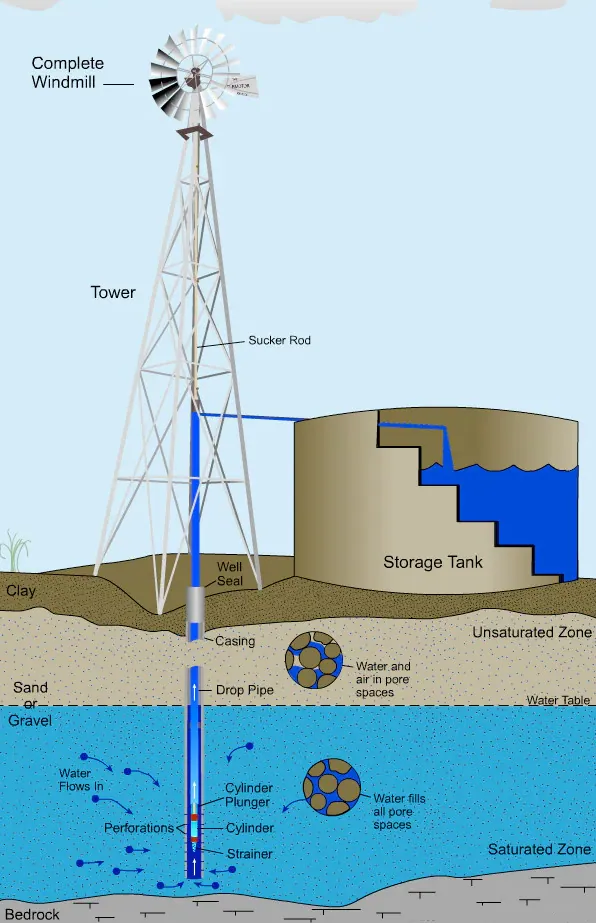
Pumps are machines that convert liquid potential energy into kinetic energy. Wind-powered pumps only use wind energy to draw water. The kinetic energy of the wind flow is converted into mechanical energy by the shaft on the wind turbine and used for pumping water in agricultural areas and drawing water from wells, as shown in Figure 1. With the help of the device to which it is connected, the piston of the pump installed on the source moves up and down and discharges the water to the desired area on the surface. The water taken from the source is transferred out via hoses using pressure difference. Because wind energy is an intermittent source, it is used in conjunction with storage systems to meet water demand continuously [13-15]. A small amount of wind is required for the system to function. In light winds, a wind pump can draw an average of 10-15 tonnes of water. Users can supply pumps of various sizes based on their requirements. The capacity varies according to the size of the rotor to which the pump is connected [16].
Wind energy is important in the generation of electricity, and the proportion of electricity generated using this energy source is steadily increasing [17]. R Wind turbines are the primary components of wind power plants. Although wind energy generation is a relatively new technology, the processing logic is identical to that of older windmills. A wind turbine is made up of several components, including a generator, a tower, electrical equipment, gearboxes, a propeller blade and body (rotor), and a foundation. With the rotational movement of the rotor shaft, the kinetic energy of the wind is converted into mechanical energy in the rotor and transferred to the generator in the body. The energy generated by the generator is stored in batteries or directly transmitted to electricity receivers [6, 10].
Wind turbines can be used both with and without a connection to the power grid. Grid-connected wind turbines are typically used for high-power applications. Off-grid tribunes are mostly used for minor requirements [18, 19].
Wind energy is a non-polluting, fuel-free energy source. Windmills installed in every farm or settlement unit in agricultural areas significantly reduce energy production costs, and such systems installed in areas far from transmission lines are economical in every way. If these systems are connected to the electricity distribution network, additional income can be obtained by selling the portion of the electricity produced in excess of consumption by establishing the necessary legal ground. The most significant advantage of wind turbines is that they do not take up much space due to their small projection, allowing them to be installed in agricultural areas [19, 20].
Use of Hydropower Energy in Agriculture
Since water has been essential to our survival since the beginning of time, humanity has always established living spaces near bodies of water. It has used water not only for daily needs, but also for transportation, hunting, and even energy generation. Rivers provided the first simple mode of transportation. One of the first examples of water transport is the flow of cut/collected trees and branches over water. This method, which is still widely used in forestry activities, also resulted in the development of rafts or boats, the first mode of transportation. This also aided the growth of commercial activities [21].
In agriculture, the energy of running water is used mechanically or electrically. For centuries, the power of water has been used to generate mechanical power. Mechanical power enables daily activities such as agricultural processing. The grain grinding process, which is the cornerstone of agricultural production with water mills still used today, is one of the important applications of the mechanical power of water in agriculture [22]. A water mill is a mechanical structure that employs a water wheel or turbine. This system works by directing water from a river or pond to a water wheel via a channel or pipe. Depending on the flow of water, water wheels can be horizontal or vertical. Horizontal water wheels are simpler, but they require a high water velocity to function properly [23].
The most widely used renewable energy source is hydropower because it has several advantages over other sources, including high energy density, low cost, and dependability [24]. The two main types of hydroelectric power plants are those that are located in reservoirs and those that are located along rivers. River-type hydroelectric power plants use the river's current to turn turbines, which then generate electricity. A dam is used to gather and store large amounts of water in hydroelectric power plants with reservoirs [25].
Hydroelectric power plants range in size from very small to very large. River-type micro or small hydroelectric power plants, typically in the kW range, are used to generate electricity in rural areas in many countries. As illustrated in Figure 2, these systems operate on a simple principle: water from streams or rivers flows through a turbine, which rotates and turns a generator, which generates electricity. To achieve reliable energy production, it is critical to understand local water resources and design the system accordingly [26, 27].
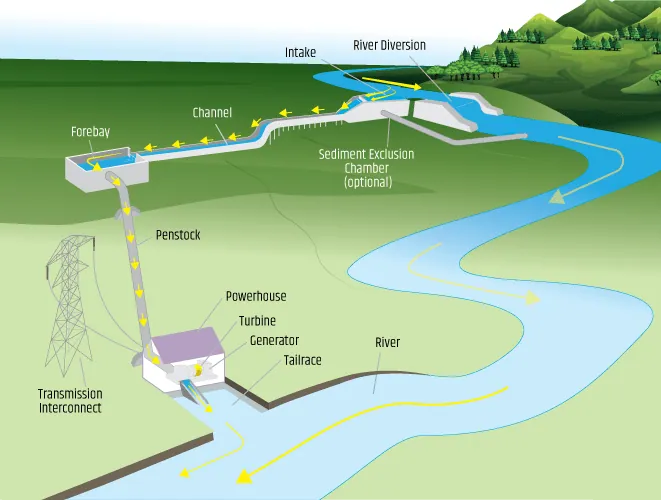
The use of small hydropower plants is growing because of how well they can be incorporated into the agricultural supply chain. The energy produced by the current flows in irrigation canals represents a significant untapped opportunity with the development of these systems. The irrigation canal is used in this way to operate together for effective irrigation service and energy production [28].
Hydroelectric power plants generate electricity that is used for lighting, heating greenhouses, processing and storing agricultural products, and water pumping in agricultural areas. Dams are also utilized for fish farming and direct irrigation [29].
Use of Bioenergy Energy in Agriculture
There are two types of biomass energy available today: traditional and contemporary. Modern biomass energy sources, also known as biofuels, include biodiesel, ethanol, and biogas produced from energy crops, energy forests, and waste materials. Traditional biomass energy is described as the simple combustion of wood and animal wastes [20]. Biomass is used on farms either directly for electricity and heat or indirectly as fuels in liquid, solid, or gaseous form. More than 30% of the energy used in households worldwide for heating, cooking, and lighting is derived from biomass [30].
With rapid technological innovation and growing automation, the use of petroleum-based fuels in agricultural production activities such as tillage, fertilisation, spraying, harvesting, and transport to market is increasing. This raises agricultural enterprise production costs due to fuel consumption and causes environmental problems in rural areas. It is critical to use biofuels instead of petroleum fuels in agricultural activities [31].
Bioenergy from agricultural and forestry activities is critical for farms to generate their own energy. It is also critical for combating climate change and ensuring energy supply security [25, 32].
The previous sections provide detailed information on bioenergy and its agricultural applications.
Use of Hybrid Energy Systems in Agriculture
Hybrid energy systems are energy systems that use multiple energy sources. A hybrid energy system generates energy by combining renewable and fossil sources [33]. Figure 3 demonstrates an example of a hybrid power generation system. A hybrid energy system is planned with a market focus rather than a technology focus: the priority is to select the most efficient and reliable energy systems to meet the needs of the users [34].
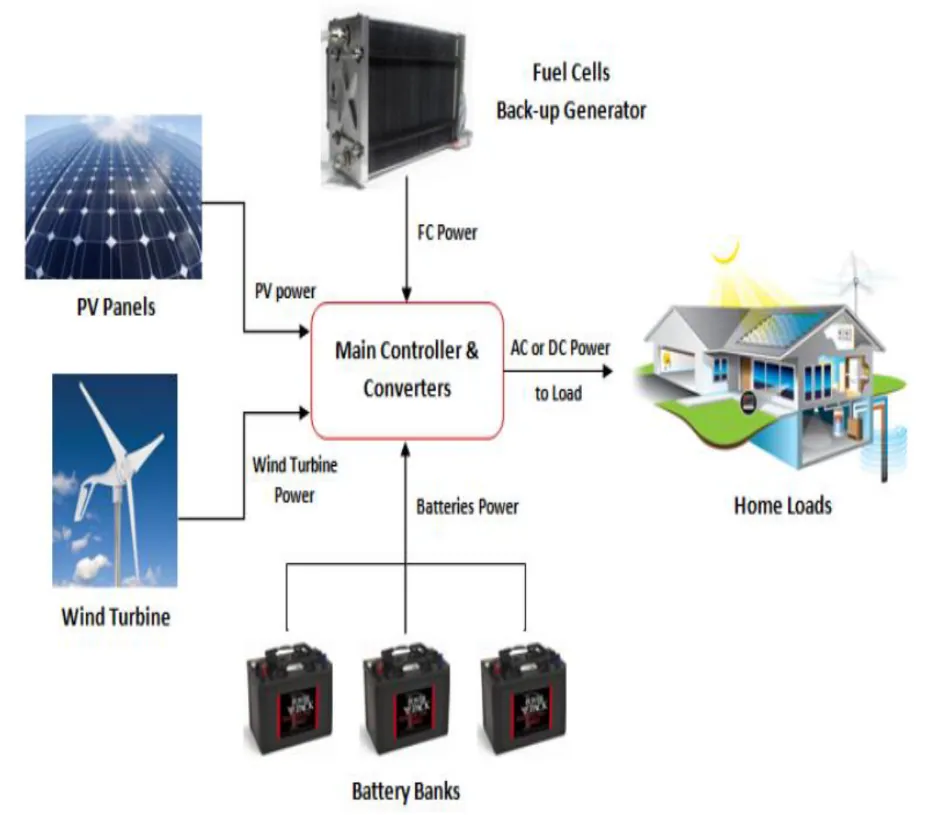
A small hybrid system combines several advantages from a single system. Hybrid systems are those that use more than one energy source to achieve the best performance. It is an ideal system for places with a summer and winter energy requirement that should not be interrupted, or where the existing renewable energy system should be supported. Hybrid energy systems can take advantage of existing energy infrastructure while also adding components to help reduce costs, environmental impacts, and system failures [36]. A small hybrid system combines several advantages from a single system. Hybrid systems are those that use more than one energy source to achieve the best performance. It is an ideal system for places with a summer and winter energy requirement that should not be interrupted, or where the existing renewable energy system should be supported. Hybrid energy systems can take advantage of existing energy infrastructure while also adding components to help reduce costs, environmental impacts, and system failures [37].
Hybrid energy systems provide an alternate energy source for agriculture. These systems combine one or more renewable energy sources with storage and may include a non-renewable energy source at times. Micro versions of these systems, such as a micro wind turbine with a few solar panels, can be used to power rural areas in low and middle-income countries. They can also help to overcome some of the challenges associated with traditional renewable energy systems by diversifying the energy source [38].
Reference
1. UNDP, Sustainable Agriculture, in The International Guidebook of Environmental Finance Tools, United Nations Development Programme (UNDP). 2012, United Nations
2. EIP-AGRI, Agricultural European Innovation Partnership (EIP-AGRI) Focus Group Enhancing production and use of renewable energy on the farm. 2019: Belgium.
3. Chel, K., Renewable energy for sustainable agriculture. Agronomy for Sustainable Development, Springer Verlag/EDP Sciences/INRA, 10.1051/agro/2010029.hal00930477, 2011. 31(1): p. 91-118.
4. Atılgan Türkmen, B., Renewable Energy Applications for Sustainable Agricultural Systems. International Journal of Innovative Approaches in Agricultural Research, 2020. 4(4): p. 497-504.
5. YEGM. Renewable Energy Sources. 2013 [12.05.2023]; Available from: http://www.eie.gov.tr/english/index-e.html.
6. Breeze, P., Chapter 11 - Wind Power, in Power Generation Technologies (Third Edition), P. Breeze, Editor. 2019, Newnes. p. 251-273.
7. Nurbay, N. and A. Çınar, Rüzgar türbinlerinin çeşitleri ve birbirleriyle karşılaştırılması. Yenilenebilir Enerji Kaynakları Sempozyumu, 2005: p. 19-21.
8. Türkmen, B.A., Orta ve Küçük Ölçekli Rüzgar Türbinlerinin Yaşam Döngüsü Boyutunda Sürdürülebilirliği: Literatür Taraması. Dicle Üniversitesi Mühendislik Fakültesi Mühendislik Dergisi, 2022. 13(3): p. 393-404.
9. Mahmoud, M., et al., Chapter 3.3 - Applications of wind energy, in Renewable Energy - Volume 1 : Solar, Wind, and Hydropower, A.G. Olabi, Editor. 2023, Academic Press. p. 331-345.
10. Bhatia, S.C., 8 - Wind energy, in Advanced Renewable Energy Systems, S.C. Bhatia, Editor. 2014, Woodhead Publishing India. p. 184-222.
11. Olabi, A.G., et al., Wind Energy Contribution to the Sustainable Development Goals: Case Study on London Array. 2023. 15(5): p. 4641.
12. Acosta-Silva, Y.d.J., et al., Applications of solar and wind renewable energy in agriculture: A review. 2019. 102(2): p. 127-140.
13. Taşkın, O. and A. Vardar, Tarımsal Üretimde Bazı Yenilenebilir Enerji Kaynakları Kullanımı. Uludağ Üniversitesi Ziraat Fakültesi Dergisi, 2016. 30(1): p. 179-184.
14. Karishma, C., Farming the wind and wind power agriculture. Just Agriculture, 2021. 1(7).
15. Aermotorwindmill. How a Windmill Pumps Water?, Genuine Aermotor Windmills. 2004 [08.08.2023]; Available from: https://aermotorwindmill.com/pages/how-a-windmill-works.
16. Soyut Windmill. Rüzgar Su Pompası Nedir? 2023 [08.07.2023]; Available from: http://www.soyutwindmill.com/ruzgar-su-pompasi/nasil-calisir/.
17. TÜBA, Rüzgâr Enerjisi Teknolojileri Raporu, Türkiye Bilimler Akademisi,, İ. Dinçer, Editor. 2019: Ankara.
18. Gürbüz, İ.B., G. Özkan, and Ş. Korkmaz, Rüzgar Enerji Santrallerinin Kırsala Olan Sosyo-Ekonomik Etkileri ve Sosyal Kabulü. Avrupa Bilim ve Teknoloji Dergisi, Ejosat 2021, 2021. 1: p. 223-231.
19. Bıçakçı, E., C. Balabanlı, and E. Acar, Tarım ve Mera Alanlarında Rüzgâr ve Güneş Enerji Sistemleri Kurulması Hakkında Değerlendirmeler. Iğdır Üniversitesi Fen Bilimleri Enstitüsü Dergisi, 2023. 13(1): p. 700-712.
20. Karaca, C., Türkiye’de Sürdürülebilir Tarım Politikaları: Tarım Sektöründe Atıl ve Yenilenebilir Enerji Kaynakların Değerlendirilmesi. Tarım Ekonomisi Dergisi, 2013. 19(1): p. 1-19.
21. Shiji, C., S. Dhakal, and C. Ou, Greening small hydropower: A brief review. Energy Strategy Reviews, 2021. 36: p. 100676.
22. Angelakis, A.N., et al., Sustainable and Regenerative Development of Water Mills as an Example of Agricultural Technologies for Small Farms. 2022. 14(10): p. 1621.
23. Liz Bates, S.H., Smail Khennas, Nararya Sastrawinata, Expanding Energy Access in Developing Countries, The Role of Mechanical Power, ed. T.U.N.D.P. (UNDP). 2009, UK: Practical Action Publishing Ltd.
24. IRENA, Hydropower, in Renewable Energy Technologies: Cost Analysis Series. 2022, International Renewable Energy Agency: Germany.
25. Atılgan Türkmen, B., Renewable Energy Applications for Sustainable Agricultural Systems. International Journal of Innovative Approaches in Agricultural Research, 2020. 4(4): p. 497 - 504.
26. EERE. Types of Hydropower Plants, US Department of Energy, Energy Efficiency & Renewable Energy, Water Power Technologies Office. 2023 [28.06.2023]; Available from: https://www.energy.gov/eere/water/types-hydropower-plants.
27. Singal, S.K., et al., Chapter 1 - Introduction to small hydropower, in Small Hydropower, S.K. Singal, et al., Editors. 2023, Elsevier. p. 1-14.
28. Cengiz, K., Sulama kanalları üzerine inşa edilen hidroelektrik santrallerin işletilmesi üzerine bir çalışma. Avrupa Bilim ve Teknoloji Dergisi, Ejosat 2021, 2020(19): p. 138-144.
29. Clement, O., et al., Renewable Energy Usage for Agricultural Practices: A review. 2018 International Conference of The Nigerian Institution of Agricultural Engineers, Lagos, Nigeria. 2018.
30. Saleem, M., Possibility of utilizing agriculture biomass as a renewable and sustainable future energy source. Heliyon, 2022. 8(2): p. e08905.
31. ALMA, H., TÜBA Biyokütle Enerjisi Raporu, in TÜBA Enerji Çalışma Grubu. 2022.
32. TOB, İKLİM DEĞİŞİKLİĞİ VE TARIM DEĞERLENDİRME RAPORU, T.R.G.M. T.C. Tarım ve Orman Bakanlığı, Tarımsal Çevre ve Doğal Kaynakları Koruma Daire Başkanlığı, Editor. 2021.
33. Ding, J.J. and J.S. Buckeridge, Design considerations for a sustainable hybrid energy system. IPENZ Transactions, 2000. 27(1).
34. Manwell, J., Hybrid energy systems. Encyclopedia of energy, 2004. 3(1): p. 215-229.
35. Agarwal, S., S. Chourasiya, and D. Palwalia. Hybrid Energy Management System design with Renewable Energy Sources (Fuel Cells, PV Cells and Wind Energy): A Review. in APGRES 2017. 2018. Malaysia.
36. Zohuri, B., Hybrid Renewable Energy Systems, in Hybrid Energy Systems, Driving Reliable Renewable Sources of Energy Storage, B. Zohuri, Editor. 2018, Springer. p. 1-38.
37. İncitaş. Yenilenebilir Enerjide Hibrit Dönemi. 2023 [15.06.2023]; Available from: https://www.incitas.com.tr/bilgi-merkezi/blog/yenilenebilir-enerjide-hibrit-donemi.
38. Buddila, W. The Future of Rural Energy Is Hybrid Renewable Systems. 2021 [12.08.2023]; Available from: https://www.engineeringforchange.org/news/future-rural-energy-hybrid-renewable-systems/.