
Module 6 · Chapter 4
Energy production in the agricultural sector: bioenergy
Agriculture and energy have a special relationship because agriculture is both energy production and energy consumption. Photosynthesis is the process by which plants absorb solar energy and convert it into their own biomass. The biomass can be burned directly or converted into fuel-grade liquid biofuels or biogas products. Agriculture, on the other hand, necessitates energy inputs at all stages of production, including direct energy use in agricultural machinery, water management, irrigation, planting, and harvesting. Energy used for food processing, storage, and transportation to markets is included in post-harvest energy use. Furthermore, many indirect energy inputs are used in agriculture in the form of fertilizers and pesticides [1].
In line with the growing awareness of agricultural production, biomass energy is one of the renewable energy sources that is gaining popularity and funding each year. This energy is a crucial source of renewable energy that can sustainably meet the rising energy demand brought on by the industrialization and rapidly growing population [2]. This energy can reduce reliance on an overloaded power grid and replace costly fuels used in local industry. Biomass can generate all forms of energy, including electricity, gas, liquid fuels, and heat, and its use can provide rural employment, prevent migration to cities, increase agricultural profitability, and help restore degraded land. This energy is also beneficial to the fight against global warming [3, 4].
Biomass
Biomass is an important energy source that can meet the rapidly increasing energy demand caused by population growth and industrialization [5]. Biomass is defined as "the biodegradable fraction of products, waste and residues from biological origin from agriculture (including vegetal and animal substances), forestry and related industries including fisheries and aquaculture, as well as the biodegradable fraction of industrial and municipal waste" by Directive 2009/28/CE [6].
Biomass is a source of chemical energy from the sun. Sunlight is used by organisms that use photosynthetic processes to produce glucose from carbon dioxide and water, such as plants and algae. This process, known as photosynthesis, converts solar energy into chemical bond energy and results in the production of biomass. A sustainable energy source is biomass. Biomass is produced by plants through photosynthesis [7].
Biomass is defined as living or recently deceased organisms, as well as their plant or animal byproducts. The term is widely understood to exclude coal, oil, and other fossilized remains of organisms, as well as soil. In this strict sense, biomass includes all living things. However, in the context of biomass energy, the term refers to crops, residues, and other biological materials that can be used to replace fossil fuels in the production of energy and other products. Living biomass absorbs carbon as it grows and releases it when used for energy, resulting in a carbon-neutral cycle that does not increase the concentration of greenhouse gases in the atmosphere [8, 9].
The transition to renewable energy sources has gained importance due to the annual increase in global population and the depletion of energy resources. With 55% of all renewable energy and over 6% of the world's energy supply coming from modern bioenergy, it is the most significant source of renewable energy worldwide. Between 2010 and 2021, the use of modern bioenergy increased by an average of 7% annually and is on the rise [10].
Bioenergy Resources
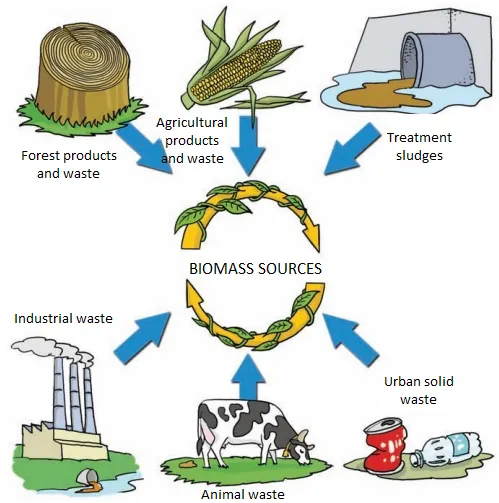
Biomass resources are resources that we come across in a variety of settings and can be found almost anywhere. As shown in Figure 1, biomass energy sources include [11]:
Wood and waste products from wood processing, such as firewood, wood pellets, wood chips, sawdust, and waste products from furniture and lumber mills, as well as alcohol from pulp and paper mills.
Waste products and crops, including corn, soybeans, sugar cane, switchgrass, woody plants, and algae, as well as crop and food processing leftovers, principally for the creation of biofuel.
The presence of biological materials in municipal solid waste, such as waste food, yard trimmings, and wool, cotton, and paper goods.
Production of biogas and renewable natural gas from animal manure and human sewage
Biomass Utilization
The two types of biomass utilization are categorized as traditional (classical) and modern. The traditional use of biomass is the production of locally gathered wood, charcoal, agricultural wastes, and animal wastes using simple conversion techniques. In other words, energy is traditionally provided by direct combustion of biomass material such as wood, plant and animal wastes, and is widely used, particularly in developing countries [13].
The traditional method's output, which is typically less efficient, is primarily used for cooking and heating. Given the rising population trends in many countries, reducing the use of traditional biomass continues to be a difficult task. For a more sustainable and effective use of biomass resources, incentives for modern biomass use are critical. The production of plants for feedstock is prioritized in modern biomass utilization. The direct combustion of biomass produced today as well as the indirect utilization of pre-processed, solid biomass with high energy density for the production of electricity and/or heat are two examples of modern biomass utilization. Incentives and support for bioenergy technologies need to rise in each nation for modern bioenergy utilization to rise globally [8, 10].
In modern biomass use, conversion methods from biomass materials such as animal and agricultural wastes, domestic, urban, and industrial wastes/wastewater with organic content, energy crops, energy forestry products, forest wastes, algae and moss growing in aquatic ecosystems can be used to generate process heat, electricity, and liquid or gaseous fuel [13]. Modern applications include direct combustion of the biomass produced and indirect use of high energy density, pre-processed solid biomass for electricity and/or heat generation. To increase the global use of modern bioenergy, each country's support and incentives for bioenergy technologies must be increased [8, 10].
While the primary applications of biomass are electricity, heat, and transportation, other applications of biomass include the reuse or marketing of byproducts generated during biomass processes. The following industries use biomass [8]:
Energy Sector: Biomass is used to generate electricity in the form of solids, liquids, and gases.
Industry Sector: In this industry, energy from biomass is used for a variety of tasks, including the production of steam, cogeneration, process heating, cooling, lighting, and heating.
Transportation Sector: Biofuels provide alternative fuels, particularly for road and air transportation.
Building Sector: It is primarily used in heating and cooking in this industry.
Converting Biomass To Energy
Organic materials such as forest, agricultural, domestic, and animal wastes are examples of biomass, which is defined as biological material produced directly or indirectly through photosynthesis. Various conversion methods are used to convert biomass into bioenergy [14].
Biomass energy is a type of solar energy that is released and stored as chemical energy as a result of various biological and thermo-chemical processes involving chemical bonds between oxygen, carbon, and hydrogen molecules. Biomass can be converted into solid, liquid, or gaseous fuels, making it a versatile renewable energy source. It can be used to generate heat and/or electricity, as well as as a transportation fuel [14, 15].
Several process steps are required to convert biomass into useful energy. The applied technologies are tailored to the physical structure, chemical composition, and energy services required by the feedstocks. Outputs such as biogas, biodiesel, bioethanol, and synthetic gas are produced using various conversion methods applied to biomass raw materials. These outputs are used in areas such as heating, electricity, and transportation [8, 16].
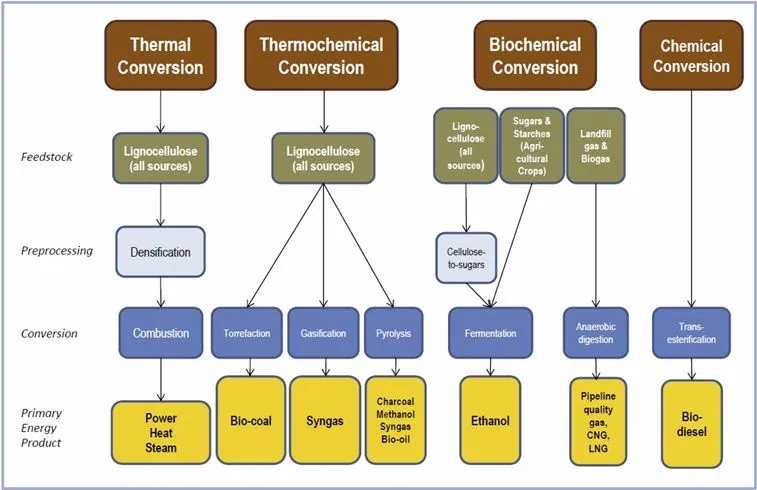
As presented in Figure 2, various processes are used to convert biomass to energy, including [11]:
Thermal conversion - direct combustion
Thermochemical conversion
Chemical conversion
Biological conversion
Thermal conversion - direct combustion
Direct combustion is the most common and mature method of converting biomass into useful energy. Combustion is the rapid chemical reaction of combustible components in biomass with oxygen. As a byproduct of this chemical reaction, heat, carbon dioxide, water vapour, and some metal oxides are produced [18].
They have a capacity range of a few MW to 100 MW or more. The steam boiler, which generates high-temperature and high-pressure steam, and the turbines, which use this steam to generate electricity, are the two main components of the direct combustion process. Furnaces and boilers are typically used to generate steam for use in district heating/cooling systems or to drive turbines to generate electricity. All biomass can be burned directly to heat buildings and water, heat industrial systems as well as generate electricity in steam turbines. Although new combustion systems have been developed to increase efficiency, the heat obtained is typically close to the heat that would be produced from medium-quality coal depending on the type of biomass. Fluidised bed combustion systems are also available in the industry as highly efficient combustion systems [11, 12, 19].
Incineration is the most commonly used technology for utilizing biomass to generate electricity and heat. In Europe alone, there are over 1000 active biomass power plants. Biomass combustion is widely used for energy production in Finland and Sweden, which have large forested areas. Outside of Europe, the majority of the plants are in Brazil, China, and India. Plants in China or India are typically designed to generate electricity. In Europe, biomass power plants generate both electricity and process heat for district/central heating systems [15].
Thermochemical conversion
The process of using heat to create various types of solid, liquid, or gaseous fuels is known as thermochemical conversion. This conversion produces combustible gas as a result of the high-temperature decomposition of carbon-containing biomass. Pyrolysis, torrefaction, gasification, and liquefaction are all examples of thermochemical conversion processes. Using a variety of process conditions and reactor configurations, the energy stored in the structure of biomass can be converted into solid fuels by carbonisation (charcoal), liquid fuels by pyrolysis or liquefaction (bio-oils), or gaseous fuels by gasification (syngas) [15].
Pyrolysis is the oldest and most basic method for producing gas from biomass. It is defined as a sequence of chemical and physical events that occur when wood is heated to 900 oC in an oxygen-free environment. Gases, tar, organic compounds, water, and charcoal are produced as a result of pyrolysis [20]. Pyrolysis is a preferred method because all of the inputs can be recycled into products, it can be used to process any type of organic waste or waste, it uses less energy because it heats with the gas produced in the system, and it allows for parameter adjustment to produce the desired product. There are three ways to perform pyrolysis: slowly, quickly, and instantly. If the intended product is solid, the waste should go through a slow pyrolysis process; if it is liquid, a fast pyrolysis process should be used [5].
Torrefaction, like pyrolysis, is the conversion of biomass using heat in the absence of oxygen, but at lower temperatures than pyrolysis typically uses. Temperatures in torrefaction typically range between 200 and 320 oC [17]. Pulverized biomass is hydrophobic and has a high energy density. As a result, it can be stored outside and transported over long distances without significantly absorbing water and losing calorific value. Pelletizing layered biomass can further cut processing and transportation costs [5].
Gasification is the high-temperature decomposition of solids such as carbon-containing biomass to produce combustible gas. During the gasification process, biomass is burned with controlled air supplied to the fuel cell. Combustible gases such as hydrogen and methane, as well as carbon monoxide, carbon dioxide, and nitrogen, are among the byproducts. Approximately 85% of the energy in biomass can be converted into gas during the gasification process. These are thermal decomposition processes that involve heating biomass raw materials to high temperatures in closed, pressurized vessels known as gasifiers. They are distinguished primarily by process temperatures and the amount of oxygen available during the conversion process [21, 22]. The ash left over from waste combustion is also converted into biochar, which varies depending on the chemical properties of the waste. The gas produced after this point is used to generate heat and power in combustion engines, microturbines, heat engines, and gas turbines [14].
Chemical conversion
Chemical conversion involves the use of chemical agents to convert biomass into liquid fuels. Chemical conversion of biomass is the process of converting biomass into other forms of usable energy through chemical interactions [17]. The most common type of chemical-based conversion is transesterification. Transesterification is the chemical reaction that bonds fatty acids from oils, fats, and greases to alcohol. This process reduces fatty acid viscosity and makes them combustible. Biodiesel, glycerin, and soaps are all common byproducts of transesterification. Glycerin separates from biodiesel as a result of the reaction because it has a higher density than biodiesel and settles to the bottom. Then, distillation is used to recover the alcohol that was combined with the biodiesel. Alcohol and oil react together to produce glycerin, biodiesel, and alcohol. Biodiesel can be made from almost any bio-oil (such as soybean oil), animal fat or tallow, or tree oil [17, 23].
Biochemical conversion
Biochemical conversion describes the process of utilizing bacteria or other microorganisms' enzymes to break down biomass. The term "biochemical conversion methods" describes the biological processes used to transform biomass. These procedures seek to separate various microorganisms or enzymes from biomass to produce products and intermediate products. Biogas, hydrogen, ethanol, butanol, acetone, various organic acids, and chemicals are produced as a result of the process. [5].
Key biochemical conversion processes include anaerobic digestion and fermentation [19]. The use of microorganisms in the absence of oxygen to break down organic matter is known as anaerobic digestion or airless digestion. This process is also referred to as the conversion of biomass to methane and carbon dioxide. Anaerobic digestion, a bio-chemical translation system, is a method applied to produce methane and carbon-rich biogas from crop residues, food residues and manure (human and animal). Anaerobic digestion is widely used in wastewater treatment and to reduce landfill emissions. Anaerobic digestion is a multi-stage procedure. First, bacteria are used in hydrolysis to break down carbohydrates into digestible forms for other bacteria. The resulting sugars and amino acids are converted by the second group of bacteria into carbon dioxide, hydrogen, ammonia and organic acids. The byproducts are then transformed by additional bacteria into methane and carbon dioxide [5, 17]. Anaerobic digestion can biodegrade almost all biomass, with the exception of woody materials, and is suitable for moist feedstocks like animal wastes, sewage sludge, moist agricultural wastes, and organic fractions of municipal waste. In landfills, anaerobic digestion is also used to produce energy from landfill gas [5].
The use of yeasts to convert carbohydrates into alcohol, specifically ethanol, also known as bioethanol, is known as fermentation. Heat is used in this process to convert starch in organic matter into sugar. The sugar that results is fermented to produce ethanol. There are several stages to the overall process. The crop materials are pulverized or ground before being mixed with water to form a slurry. Heat and enzymes are used to process the ground materials into a finer slurry. To convert the starches into glucose sugar, additional enzymes are added. The sugary slurry is then pumped into a fermentation chamber and yeasts are added. After 48-50 hours, the fermented liquid is distilled to separate the alcohol from the remaining solids [5, 24].
The conversion of biomass through fermentation is crucial because it makes it possible to produce a variety of products under straightforward circumstances. The structure and composition of the biomass feedstock have an impact on how much organic matter ferments. The choice of raw materials for this process should take into account the demand competition that exists between them and food products. However, it is acknowledged that forestry and agricultural wastes are the best sources of biomass [5].
Advances In Biomass Technologies
Because of advances in energy technologies, biomass, which has historically and primarily been used for home heating for centuries, is now being used in transportation and for the production of electricity. By being transformed into energy forms like hydrogen, ethanol, methanol, methane, and pyrolysis oil, it also aids in technological advancement and the nation's economy [14].
The production of various biomasses has become an important issue with the modern utilization of biomass. Energy forests and energy agriculture stand out in this regard. In addition to energy crops containing energy-rich components, plants grown in various climatic regions include reed canary grass, reed grass, and kenger grass. Other biomass feedstock options include aquatic biomass such as algae and mosses, as well as non-food oil seed species such as Jatropha [5, 25].
Ash, fertilizer, and biochar are the most valuable byproducts of biomass processing. Waste ash produced by biomass plants can be used as an additive material for cement in the production of road briquettes or as fertilizer in land reclamation. Another byproduct of pyrolysis is biochar, which can be reincorporated into electricity generation processes, used for heating, or applied as fertilizer. One of the most promising approaches to generating renewable energy is biogas production from anaerobic digestion of resources such as animal waste and sewage sludge. This process produces digested organic biomass with properties useful for soil fertilization [14, 26].
Advantages and Disadvantages of Biomass Energy
The use of biomass, like any other form of energy generation, has both advantages and disadvantages. Bioenergy has enormous potential among alternative energy sources and can provide continuous energy. Another advantage is that bioenergy is easily stored. The following are some of the advantages of biomass energy [8, 27, 28]:
As a natural component of the cycle, the use of biomass lowers the amount of carbon released into the atmosphere when compared to other fossil fuels.
Biomass can transform waste into a renewable energy source because society produces waste continuously.
Numerous energy outputs from biomass can be produced for a variety of uses.
Nearly everywhere has a plentiful supply of biomass resources.
In terms of resource potential, biomass is among the most significant sources of renewable energy.
In contrast to other energy sources, biomass power plants have high availability and can run continuously because they can run at baseload.
When sustainable methods are employed, biomass improves the quality of the soil, the air, and the water. For instance, by restoring degraded lands, the use of biomass feedstocks can improve the soil. In addition to the numerous environmental advantages that biomass can offer, it also slows down the rate of climate change.
Local production and processing of biomass fuel reduces reliance on imports in energy consumption and boosts the local economy by generating jobs. reducing the buildup of waste
Utilizing solid wastes helps reduce the formation of waste. As a result, landfill land requirements and disposal costs are both decreased.
The most serious issue confronting the biomass sector is a lack of long-term and consistent policies, as well as the uncertainty created by the unpredictability of future regulations and incentives. The disadvantages of biomass are listed below [8, 27]:
Some biofuels need to be boosted with fossil fuels to increase efficiency even though bioenergy is not sufficiently efficient.
Although biomass is carbon-neutral, methane gas is produced when some of its wastes are used, which is bad for the environment.
Deforestation for energy production destroys forest areas and threatens biodiversity.
Production losses could result from management and staff who operate bioenergy plants not having the necessary industry expertise.
Not every type of waste can be used directly as biomass. In order to utilize waste more effectively, waste segregation should be encouraged.
Reference
1. FAO, Chapter 2: Energy for Agriculture, in The Energy and Agriculture Nexus, Environment and Natural Resources Working Paper No. 4, Food and Agriculture Organization of the United Nations. 2000: Rome.
2. FAO, Chapter 4: The Energy Function of Agriculture, in The Energy and Agriculture Nexus, Environment and Natural Resources Working Paper No. 4, Food and Agriculture Organization of the United Nations. 2000: Rome.
3. FAO, Chapter 3: Rural Energy Supply, in The Energy and Agriculture Nexus, Environment and Natural Resources Working Paper No. 4, Food and Agriculture Organization of the United Nations. 2000: Rome.
4. Lacirignola C. and Graziano da Silva J., Energy and Agri-Food Systems: Production and Consumption, in Mediterra : Zero waste in the Mediterranean. Natural resources, food and knowledge. FAO (Rome, Italie), CIHEAM (Paris, France). Presses de Sciences Po. 409 p. 2016.
5. Çolakoğlu, M., S. Aslan, and E. Kumdereli, Biyokütle ve Biyoenerji Sektörlerine Genel Bakış, P. Türkiye, Editor. 2022: Ankara.
6. Di Fraia, S., et al., Energy potential of residual biomass from agro-industry in a Mediterranean region of southern Italy (Campania). Journal of Cleaner Production, 2020. 277: p. 124085.
7. Hanif, M.A., et al., Chapter 9 - Renewable energy from biomass, in Renewable and Alternative Energy Resources, M.A. Hanif, et al., Editors. 2022, Academic Press. p. 555-603.
8. PWC. Biyokütle ve Biyoenerji Sektörlerine Genel Bakış. 2021; Available from: https://www.pwc.com.tr/tr/sektorler/enerji/biyokutle-ve-biyoenerji-sektorlerine-genel-bakis-web.pdf.
9. EESI. Bioenergy (Biofuels and Biomass). 2022 12.05.2023]; Available from: https://www.eesi.org/topics/bioenergy-biofuels-biomass/description.
10. IEA, Bioenergy, IEA, Paris https://www.iea.org/reports/bioenergy, License: CC BY 4.0. 2022.
11. EIA. Biomass - Basics, The U.S. Energy Information Administration (EIA). 2022 11.02.2023]; Available from: https://www.eia.gov/energyexplained/biomass/#:~:text=Biomass%20sources%20for%20energy%20include,from%20pulp%20and%20paper%20mills.
12. Çağlayan, E., Ö. Ataç, and V. Çoban, Biyoenerji Her Yerde. Bilim ve Teknoloji, 2009. Mayıs
13. Sözen, E., et al., Biyokütle kullanımının enerji, çevre, sağlık ve ekonomi açısından değerlendirilmesi. Bartın Orman Fakültesi Dergisi, 2017. 19(1): p. 148-160.
14. Deloitte, Biyokütlenin altın çağı. 2014.
15. ALMA, H., TÜBA Biyokütle Enerjisi Raporu, in TÜBA Enerji Çalışma Grubu. 2022.
16. Adams, P., et al., Biomass conversion technologies, in Greenhouse gas balances of bioenergy systems. 2018, Elsevier. p. 107-139.
17. Williams, C. Biomass Conversation. 2010 13.03.2023]; Available from: https://web.archive.org/web/20190120125347/http://www.wgbn.wisc.edu/conversion/.
18. Glushkov, D.O., et al., Composition of gas produced from the direct combustion and pyrolysis of biomass. Process Safety and Environmental Protection, 2021. 156: p. 43-56.
19. Tursi, A. and F. Olivito, 1 - Biomass conversion: general information, chemistry, and processes, in Advances in Bioenergy and Microfluidic Applications, M.R. Rahimpour, et al., Editors. 2021, Elsevier. p. 3-39.
20. Hornung, A., Biomass Pyrolysis, in Encyclopedia of Sustainability Science and Technology, R.A. Meyers, Editor. 2012, Springer New York: New York, NY. p. 1517-1531.
21. Wieser, A., Biomass Combustionbion for Electricity Generation, in Encyclopedia of Sustainability Science and Technology, R.A. Meyers, Editor. 2012, Springer New York: New York, NY. p. 1231-1268.
22. Abdurrahman, G., Biomass Conversion Technologies for Bioenergy Generation: An Introduction, in Biotechnological Applications of Biomass, B. Thalita Peixoto, B. Thiago Olitta, and B. Luiz Carlos, Editors. 2020, IntechOpen: Rijeka. p. Ch. 1.
23. Sinem, I. and S.J.A.B.v.T.D. Yavuz, Biyokütleden Elde Edilen Biyoyakıtlara Genel Bir Bakış. 2022(34): p. 193-201.
24. Brethauer, S. and M.H. Studer, Biochemical Conversion Processes of Lignocellulosic Biomass to Fuels and Chemicals - A Review. Chimia (Aarau), 2015. 69(10): p. 572-81.
25. Karaosmanoğlu, F. Biyokütle teknolojilerinde yenilikler ve trendler. 2021 03.06.2023]; Available from: https://biyoenerjidergisi.com/biyokutle-teknolojilerinde-yenilikler-ve-trendler/.
26. Alessandra, T., et al., Biomass Digestion to Produce Organic Fertilizers: A Case-Study on Digested Livestock Manure, in Biomass Now, M. Miodrag Darko, Editor. 2013, IntechOpen: Rijeka. p. Ch. 8.
27. Rahman, S.R., et al., Overview of biomass energy. International Journal of Engineering Research Technology, 2013. 2(11).
28. Rosillo-Calle, F., Overview of biomass energy, in The biomass assessment handbook. 2012, Routledge. p. 23-48.